
How to Form a UK Limited Company as a Non-Resident
By JoshWP Team | Updated: | ~28 min read | UK Ltd Company Non-Resident Friendly ECCTA 2025/26 Update Companies House
Yes — you can form a UK private limited company (Ltd) entirely online without living in the UK, holding British citizenship, or visiting the country. Under the Companies Act 2006 there is no residency requirement for directors or shareholders. You need at least one director (aged 16+), at least one shareholder, a unique company name, a UK registered office address, share capital details, Persons with Significant Control (PSC) information, and memorandum and articles of association. Incorporation is filed with Companies House and is commonly completed the same day or next working day once documents and identity checks are correct.
Most non-residents use an Authorised Corporate Service Provider (ACSP) — a formation agent authorised under the Economic Crime and Corporate Transparency Act (ECCTA) 2023 — such as Your Company Formations. An ACSP packages the UK registered office, director service address, mail forwarding, Companies House filing, and identity verification into a fixed-fee non-resident package. From late 2025 into 2026, identity verification of directors and PSCs is a legal requirement, not optional paperwork.
Non-negotiable: A UK Ltd is a legitimate corporate vehicle for trading, holding assets, invoicing clients, and onboarding payment processors. It is not a mechanism for hiding beneficial ownership, avoiding tax in your home country, or creating anonymous banking. Director names, PSC details, and the registered office appear on the public Companies House register (residential addresses are usually protected). UK-incorporated companies are generally UK tax resident and must register for Corporation Tax with HMRC.

Table of Contents
- What a UK limited company actually is
- Who a UK Ltd suits — and who it doesn’t
- Core requirements to register
- The 2025/26 identity verification rules (ECCTA)
- Ltd vs LLP vs US LLC
- Choosing a formation agent
- Complete formation roadmap
- Your Company Formations walkthrough (with screenshots)
- What documents you receive
- Corporation Tax, HMRC, VAT, and substance
- Business banking: Payoneer vs Wise
- Cost breakdown and charts
- Ongoing compliance obligations
- Common mistakes and honest risks
- Final checklist
- FAQs
- Sources
What Is a UK Limited Company?
A private company limited by shares (almost always abbreviated Ltd) is the standard UK corporate vehicle registered at Companies House. It is a separate legal person: it can own property, enter contracts, open bank accounts, sue and be sued, and continue indefinitely even if directors or shareholders change. Shareholders’ liability is generally limited to the amount unpaid on their shares — typically a nominal £1 per share for a simple one-person company.
Unlike a UK Limited Liability Partnership (LLP), a Ltd company is not tax transparent. The company itself pays Corporation Tax on its taxable profits. After tax, profits can be retained, reinvested, or distributed as dividends to shareholders. Directors may also take a salary (subject to PAYE/NIC if employed). This structure is widely recognised by payment processors, marketplaces, advertisers, freelancers, e-commerce sellers, and B2B clients worldwide.
Plain English: A UK Ltd is a company box with its own legal identity. You (and any co-founders) own shares in the box, control it as director(s), and the box — not you personally — usually carries the trading contracts and liabilities. The government registers it at Companies House, taxes its profits through HMRC, and expects annual accounts and a confirmation statement every year.
For creators and channel owners comparing entity choices, see also how to create an LLC for a YouTube channel and Google AdSense — many of the same banking and payment questions arise whether you choose a UK Ltd or a US LLC.
Who a UK Ltd Suits — and Who It Doesn’t
Often a strong fit
- Solo founders who want limited liability without needing a second partner (unlike an LLP)
- Non-resident freelancers, agencies, SaaS founders, and consultants who want a recognised UK entity for contracts and invoicing
- Businesses planning to raise equity investment, issue multiple share classes, or build a formal cap table
- Founders who need credibility with UK/EU clients, marketplaces, or payment processors that prefer a limited company
- Holding or operating companies that will retain profits inside the company rather than pass them straight through to owners
- People comparing UK formation against a US LLC and who prefer UK company law, GBP banking options, or UK market positioning
Often the wrong tool
- Anyone expecting total anonymity — director and PSC names are publicly searchable at Companies House
- Founders who want pure pass-through taxation at the entity level (consider an LLP or a US LLC structure instead)
- People who will never maintain a UK registered office or respond to official mail
- Businesses that assume a UK Ltd removes home-country tax, CRS/FATCA reporting, or local licensing duties — it does not
- High-risk or prohibited activities that banks and ACSPs will refuse to onboard
If a US structure fits better for your market or payment stack, compare the best LLC formation services for non-US residents and our full guide on how to form an LLC for non-US residents.
What You Need to Register a UK Limited Company
Legal minimums
- Company name — unique, not offensive, not misleading, and free of restricted words (e.g. Royal, Bank, University) without permission
- At least one director — individual aged 16+, any nationality/residence; corporate directors are heavily restricted
- At least one shareholder — individual or company; can be the same person as the director
- UK registered office address — physical address in England & Wales, Scotland, or Northern Ireland that can accept and acknowledge official documents
- Share capital statement — class, nominal value, number of shares, and who holds them
- PSC register — anyone with more than 25% of shares/voting rights or significant influence/control
- Memorandum & articles — model articles are fine for most simple companies
- SIC code(s) — nature of business classification
- Company email address — now required on incorporation filings
Practical non-resident extras
- Registered office service — virtually all non-residents buy this rather than using a personal UK address
- Director service address — keeps your residential address off the public record (residential address is still filed but protected)
- Mail forwarding / scanning — so Companies House, HMRC, and bank letters reach you overseas
- Identity verification — via Companies House directly or through an ACSP (formation agent)
- Passport/ID + proof of residential address — for AML/KYC with the agent and later for banking
- Forwarding address — your real overseas address for packages and private mail (not published on Companies House)
Name tips that save headaches later: Run a Companies House name check, a Google/social search for brand conflicts, and a domain-name search before you incorporate. Restricted or sensitive words need prior approval. Names that are too similar to existing companies can be challenged. A catchy, pronounceable name that matches an available .co.uk or .com domain is worth an extra hour of checking.
Identity Verification Under ECCTA — What Non-Residents Must Know
The Economic Crime and Corporate Transparency Act 2023 is the biggest Companies House reform in decades. Its core goal is to stop anonymous shell companies while still allowing legitimate non-resident ownership and directorship. For anyone forming a UK limited company as a non-resident in 2025–2026, identity verification is the practical centrepiece of that reform.
Who must verify
- Individual directors of new and existing companies
- Individual Persons with Significant Control (PSCs)
- Certain other roles as Companies House guidance expands enforcement
How verification works
- Directly with Companies House — via GOV.UK One Login / digital identity where available for your nationality and documents
- Via an ACSP — an Authorised Corporate Service Provider (typically a formation agent, accountant, or solicitor) performs the check to Companies House standards and links the verified identity to the filing
Non-residents whose passports or document types are harder to complete via the pure digital route commonly use an ACSP. Reputable formation agents such as Your Company Formations build this into the non-resident package and will request photo ID, address proof, and sometimes a video or biometric-style check.
Skip this at your peril: Unverified directors and PSCs can be blocked from appointment, face restrictions on confirmation statements, and risk offences under ECCTA. Transition windows apply for existing officers, but new incorporations are expected to meet verification requirements at or before filing. Plan ID documents into day one of your formation process.
What else ECCTA tightened
- Appropriate address rules — registered offices must be real places that can receive and acknowledge documents; pure PO boxes and non-functional addresses face more scrutiny
- Company email contact — required so Companies House can reach the company
- Stronger data quality checks — filings with inconsistent or incomplete officer/PSC data are more likely to be rejected
- ACSP regime — professional agents who handle non-resident filings must be authorised and supervised
UK Ltd vs UK LLP vs US LLC
Choosing the wrong vehicle is one of the most expensive early mistakes. Use the comparison below as a planning lens — not as tax or legal advice — then confirm with a qualified adviser for your residence and activity.
| Factor | UK Private Ltd | UK LLP | US LLC (typical) |
|---|---|---|---|
| Minimum people | 1 director + 1 shareholder (can be same person) | 2 members at all times | 1 member possible |
| Tax at entity level (UK/US default) | Corporation Tax on company profits | Tax transparent — members taxed on their share | Often pass-through (check elections & residence) |
| Equity / investment readiness | Strong — shares, classes, cap table | Weak for classic equity rounds | Possible, but C-Corp often preferred for VC |
| Public disclosure | Directors + PSCs on Companies House | Members on Companies House | Varies by state; often less public than UK |
| Registered address needed | UK registered office required | UK registered office required | US registered agent required |
| Best simple use case | Solo or multi-founder operating company | Two+ partners wanting pass-through UK vehicle | US market/payment stack, freelancers, holding |
If you specifically need a partnership-style UK vehicle with two members, read How to Form a UK LLP as a Non-Resident. If your clients and payment rails are US-centric, start with How to Form an LLC for Non-US Residents.
Choosing a Formation Agent as a Non-Resident
You can file directly with Companies House if you already control a compliant UK registered office and can complete identity verification yourself. In practice, most non-residents use a formation agent because they need:
- A UK registered office + director service address that meets “appropriate address” rules
- Mail scanning/forwarding to an overseas address
- ACSP-supported identity verification
- A guided online flow that reduces rejected filings
- Optional extras (confirmation statement filing, VAT registration help, accountancy intro)
What to look for
Non-resident package
Explicit international/non-resident options with registered office and service address included or clearly priced.
ACSP / ID verification
Authorised to verify directors and PSCs under the post-ECCTA regime — ask if unclear.
Transparent pricing
Companies House fee shown separately from agent fee; renewals for address services disclosed up front.
Mail handling
Scanning, email alerts, and a private forwarding address so HMRC and bank letters don’t go missing.
Support quality
Human support that understands non-resident KYC, not only UK-resident walk-ins.
Upsell discipline
Useful add-ons available, but you can skip bank intros, premium domains, and “lifetime” extras you don’t need.
This guide walks through Your Company Formations in full screenshot detail because it is a long-established UK agent with dedicated non-resident packages, registered office options (including London service addresses), free model memorandum/articles, and a clear multi-step online flow. Other agents exist; compare live packages and always read renewal terms for address services.
Ready to form your UK Ltd?
Use a non-resident package that includes registered office, director service address options, and filing support — then complete identity verification before you apply for banking.
Complete Formation Roadmap for Non-Residents
Decide structure and purpose
Confirm a private Ltd by shares is right (vs LLP or US LLC). Note intended SIC codes, whether you will trade or hold assets, and who will be director/shareholder/PSC.
Choose and check the company name
Companies House name check + brand/domain search. Add Ltd or Limited ending. Avoid restricted words without prior approval.
Select a non-resident formation package
Pick an international package with registered office (and ideally director service address). Budget for year-two address renewals.
Pay and create your agent account
Checkout, then complete company particulars, jurisdiction (England & Wales is most common), addresses, officers, shares, and PSC nature of control.
Complete identity verification
Provide passport/ID and any ACSP checks so directors and PSCs are verified under ECCTA before or at filing.
Submit to Companies House
Final review, KYC tick-boxes, terms acceptance. Digital incorporation is often same-day when clean.
Receive statutory documents
Certificate of Incorporation, company number (CRN), memorandum & articles, share certificates, and register extracts.
Register for Corporation Tax with HMRC
UK companies must tell HMRC they are liable for Corporation Tax within three months of starting business activity. Many agents assist; do not ignore the deadline.
Open business banking
Apply for Payoneer and/or Wise Business with incorporation docs ready. Traditional high-street UK banks are often difficult for pure non-residents.
Set up books and compliance calendar
Accounts year-end, confirmation statement anniversary, VAT threshold monitoring, and director duty reminders.
Watch: Video Guide
Recommended watch: This video provides a helpful walkthrough of How to Form a UK Limited Company as a Non-Resident and complements the information covered in this guide.
Form the Privacy LLC First, Then Wire Banking
Get the entity and registered agent correct before you open Payoneer, Wise, Stripe, PayPal, or marketplace accounts. Document consistency is everything.
How to Form a UK Ltd with Your Company Formations (Step-by-Step)
The following walkthrough mirrors the real non-resident package flow. Screenshots are annotated so you can follow along on desktop or mobile. Always choose the Non-Resident (international) package path — do not accidentally select a UK-resident-only bundle if you live abroad.

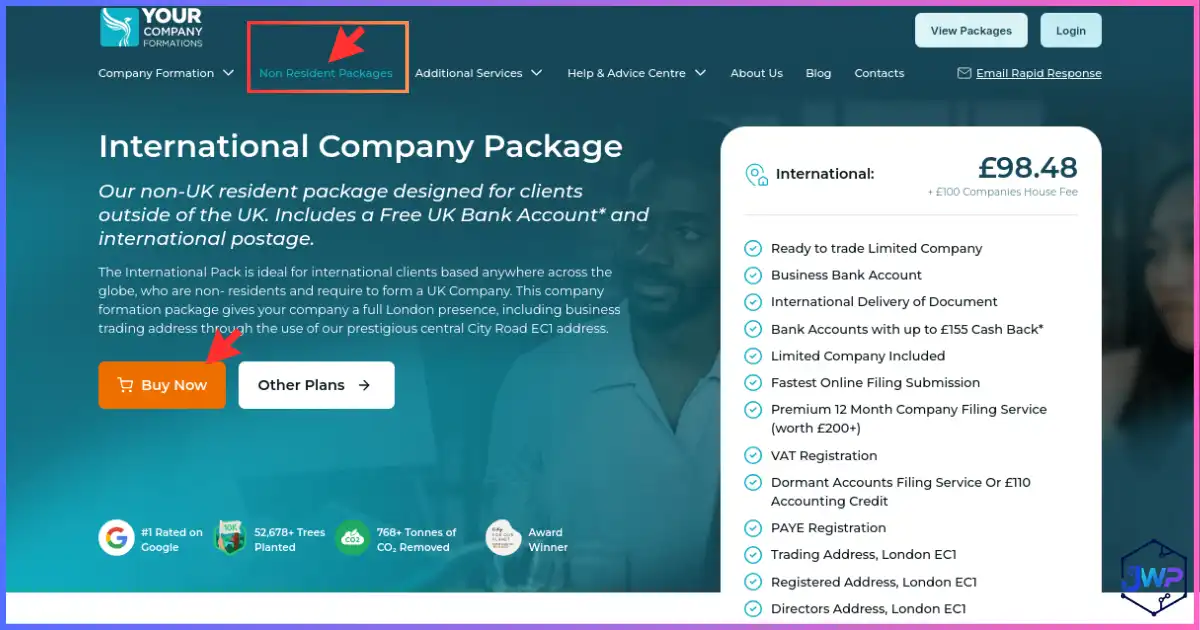
Step 1 — Choose a Non-Resident package
Start by selecting packages designed for founders outside the UK. Non-resident packages typically bundle (or clearly offer) a UK registered office, director service address options, and formation filing so you never need a personal UK address on the public record.
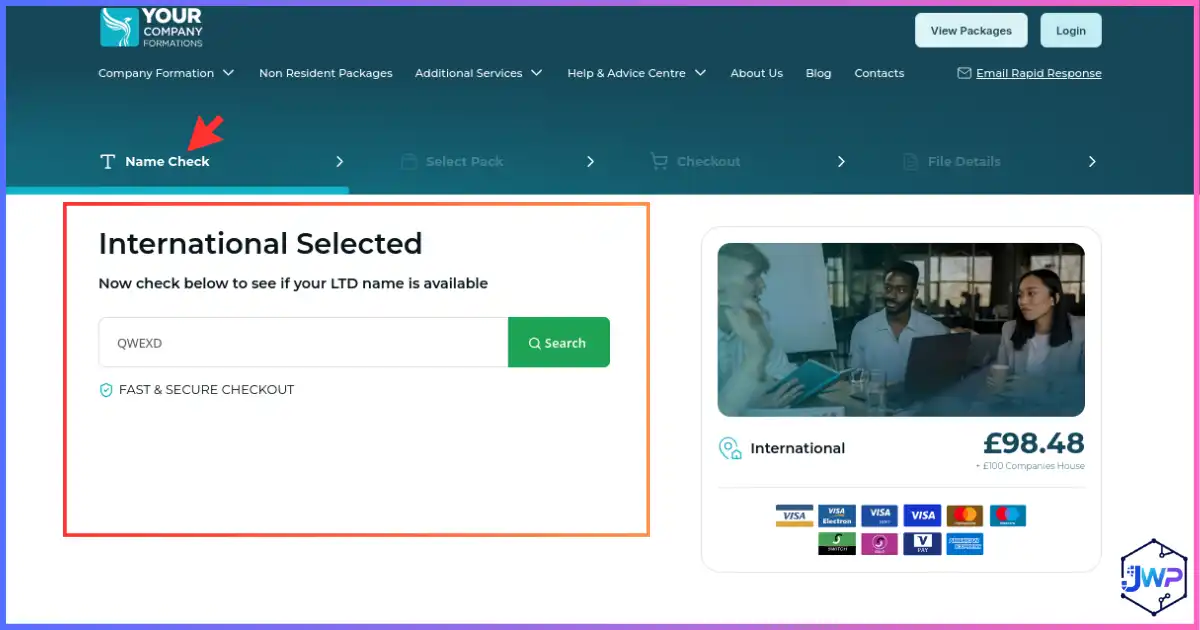
Step 2 — Run a company name check
Enter your proposed name. The checker tells you whether it is available at Companies House. Also mentally check restricted words, similarity to existing brands, and domain availability before you lock anything in.
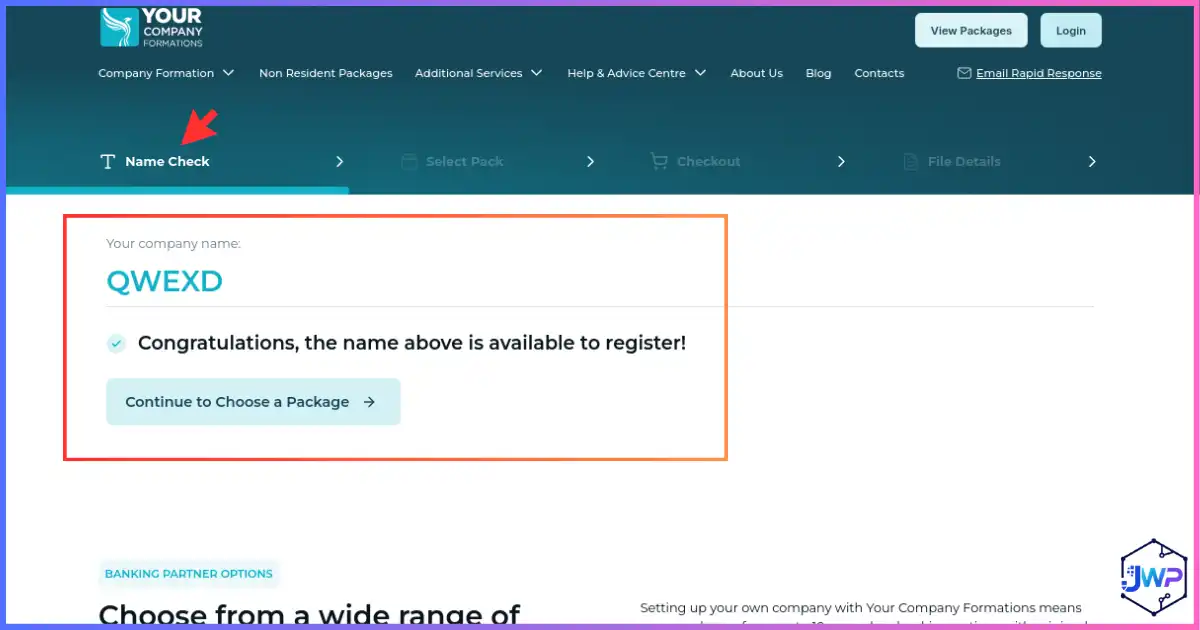
Step 3 — Confirm availability and proceed with a package
When the name is free, continue into package selection. Compare what is included for year one: incorporation, registered office, director service address, confirmation statement help, domain vouchers, accountancy consults, and any cashback partner offers. Buy what you need; you can add services later from the portal.
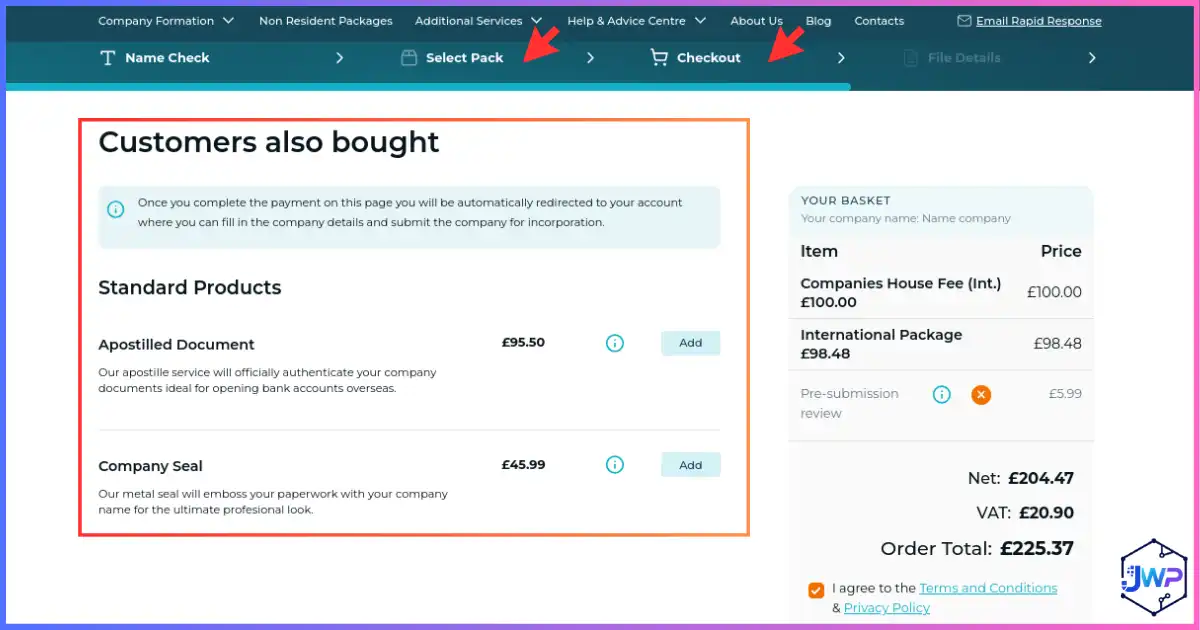
Step 4 — Checkout
Review the cart carefully. Confirm you are buying a limited company formation (not LLP or guarantee company) and that address services you need are included. Note VAT where applicable on agent services.
Step 5 — Create an account to complete checkout
Create a portal account with a real email you monitor. You will return here for documents, mail notifications, optional extras, and future compliance filings.
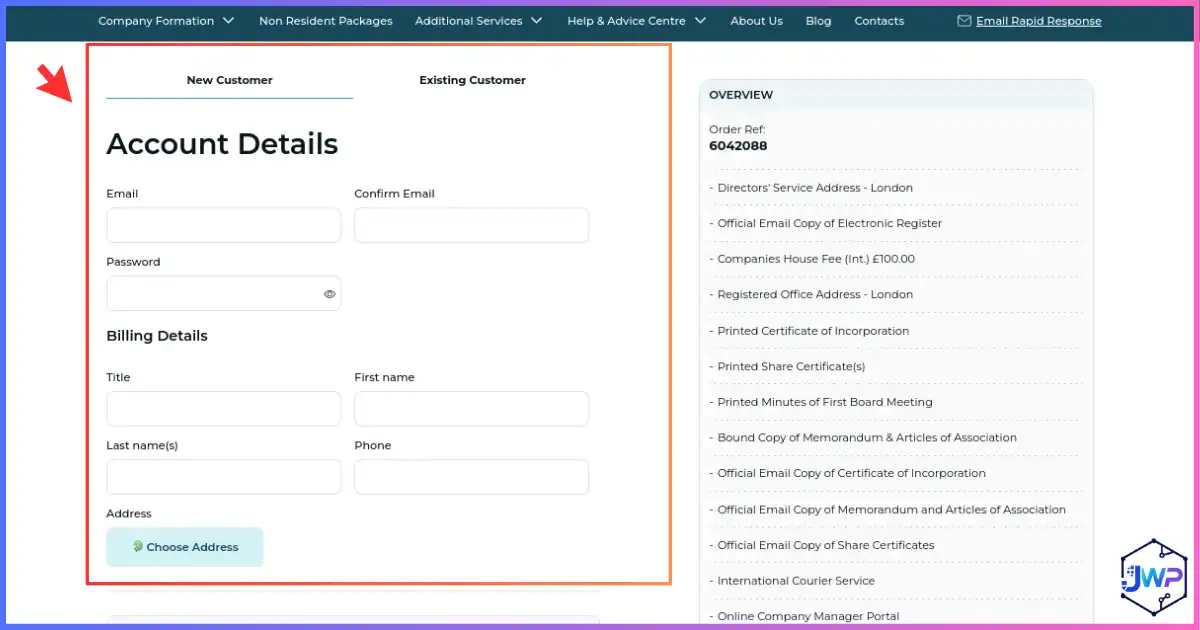
Form while you follow along
Open the non-resident package flow in a second tab and complete each screen as you read. Identity documents ready = fewer stalls later.
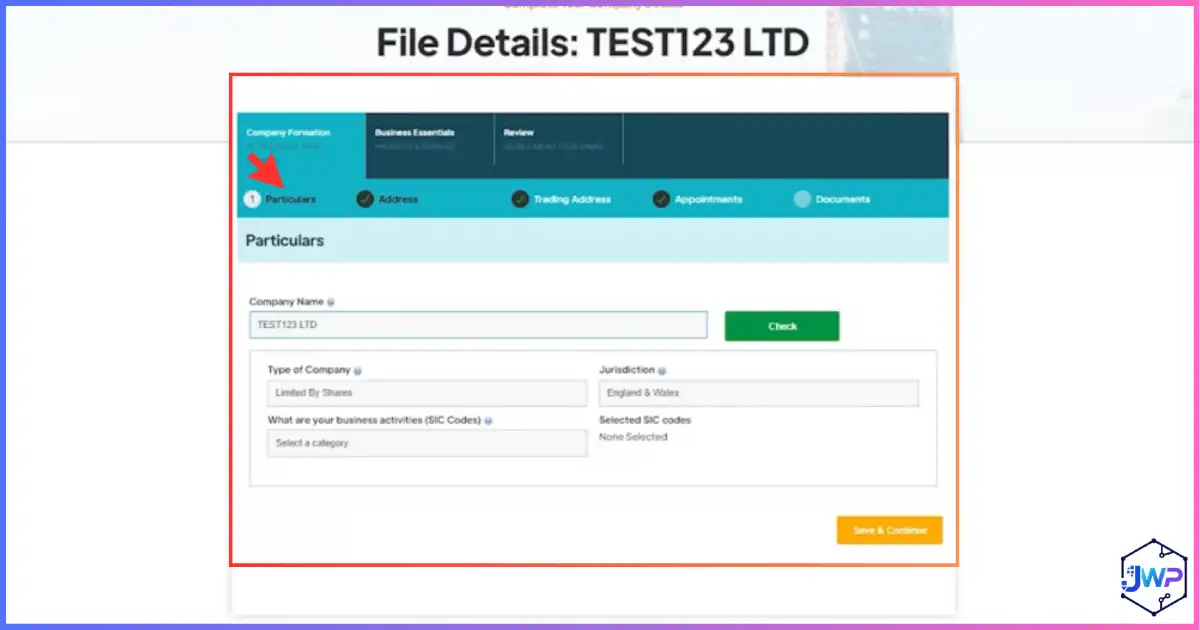
Step 6 — Company particulars (file details)
Fill company particulars: full name with ending (Ltd / Limited), jurisdiction (England and Wales is the default for most non-residents), SIC codes, and other file details the system requests. Dropdowns reduce common errors — use them.
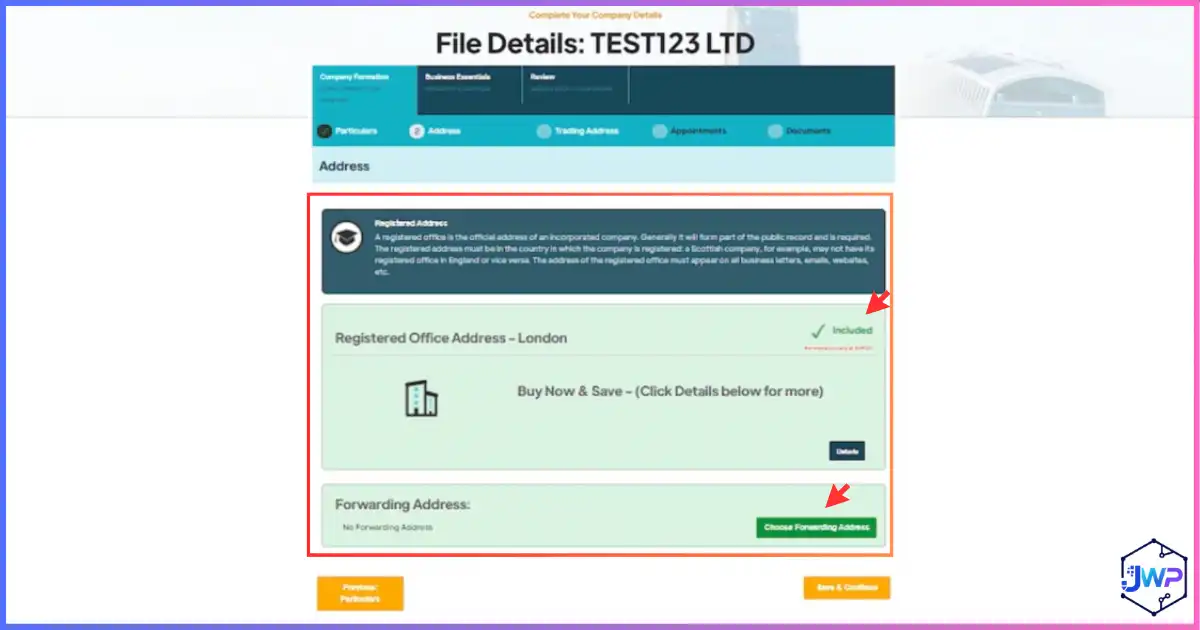
Step 7 — Trading / registered office and forwarding address
If your package includes a registered office (for example a London EC1 address), select it rather than inventing an address. Then add your forwarding address — your real overseas address for mail and packages. The forwarding address is for the agent’s mail handling; it is not published as the registered office on Companies House.
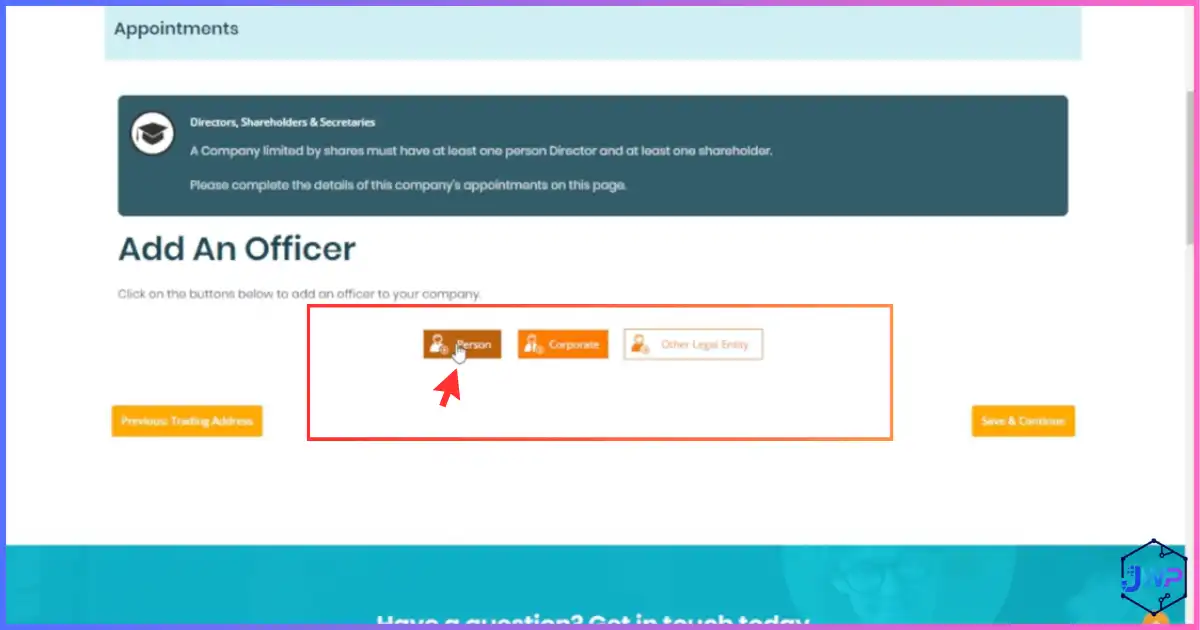
Step 8 — Add an officer
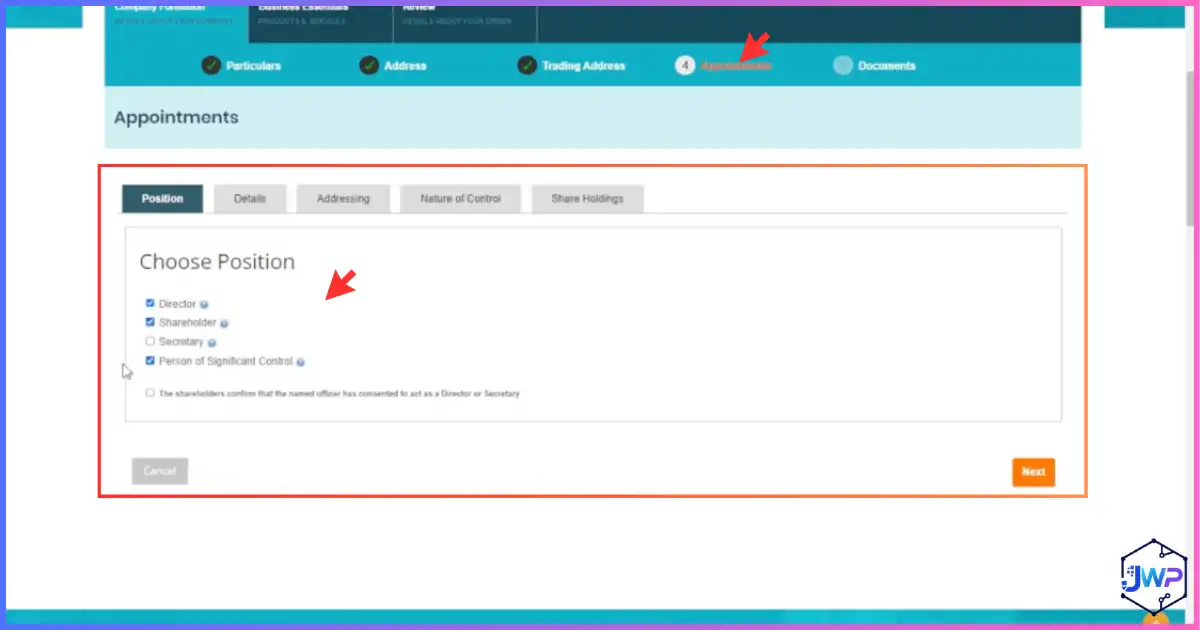
A company needs at least one director, one shareholder, and one PSC. As a solo founder you typically tick all three roles for yourself. Multi-founder companies split roles as needed.
Step 9 — Officer details and positions
Select positions with checkboxes. Ticking Director + Shareholder + PSC opens the relevant tabs for personal details, service address, nature of control, and shareholding.
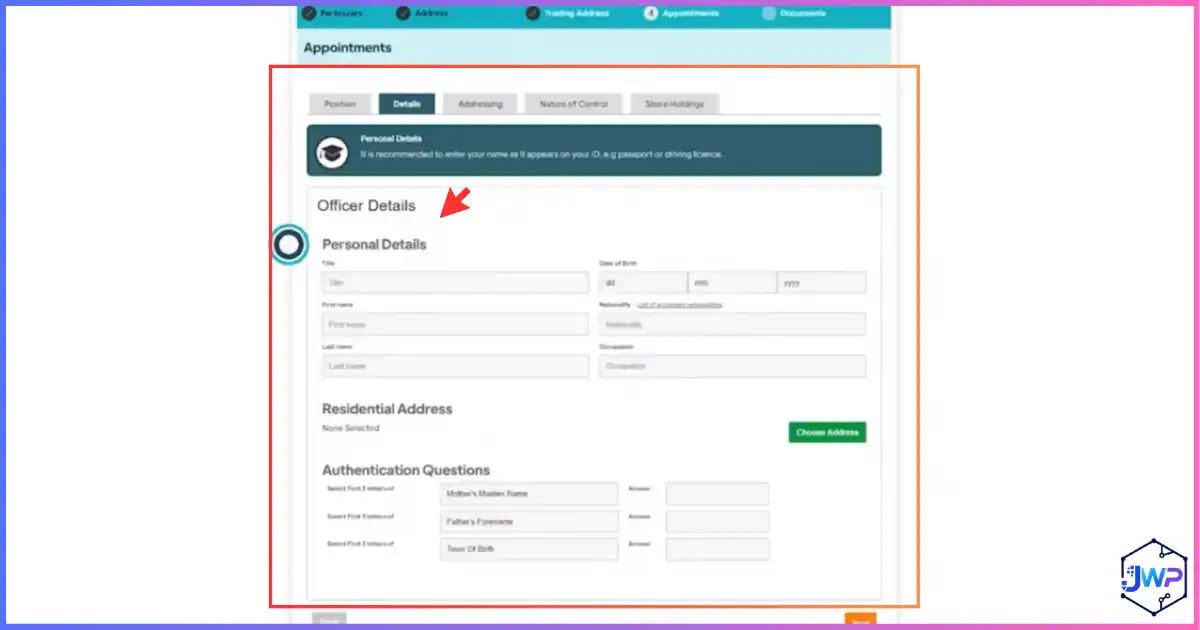
Step 10 — Director personal details and authentication questions
Enter full legal name, date of birth, nationality, occupation, residential address, and authentication questions used for future Companies House filings. Accuracy matters: mismatches with passport data can delay identity verification and banking KYC.
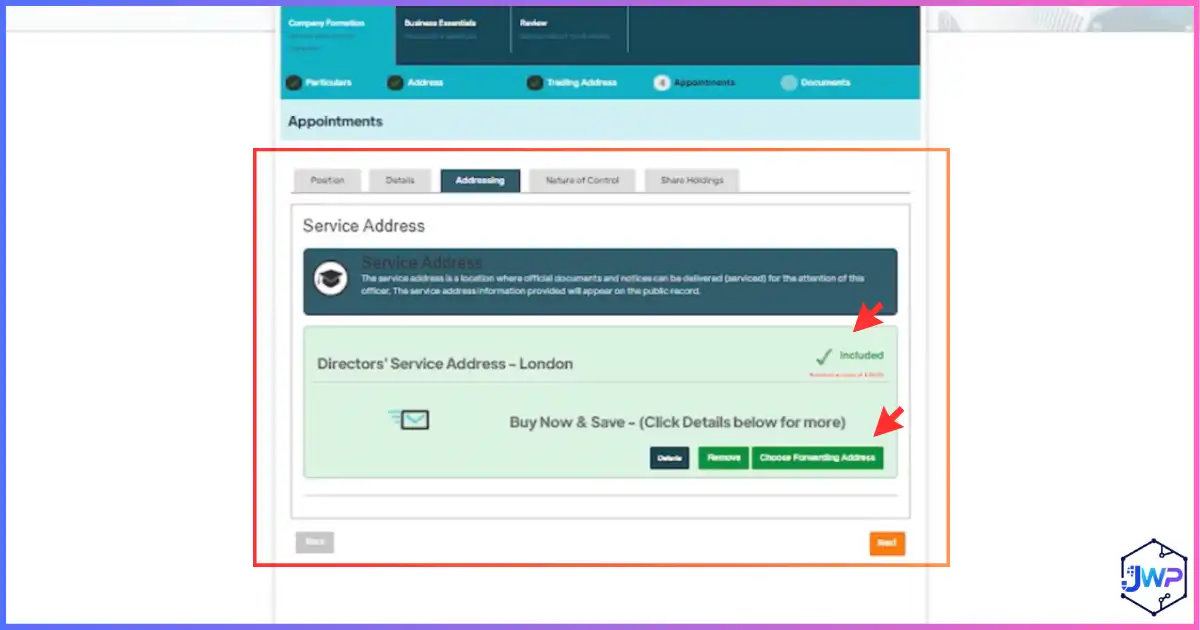
Step 11 — Director service address and forwarding address
If the package includes a director service address, use it so your home address does not appear on the public record. Still provide a private forwarding address for the director so the agent can route non-public correspondence.
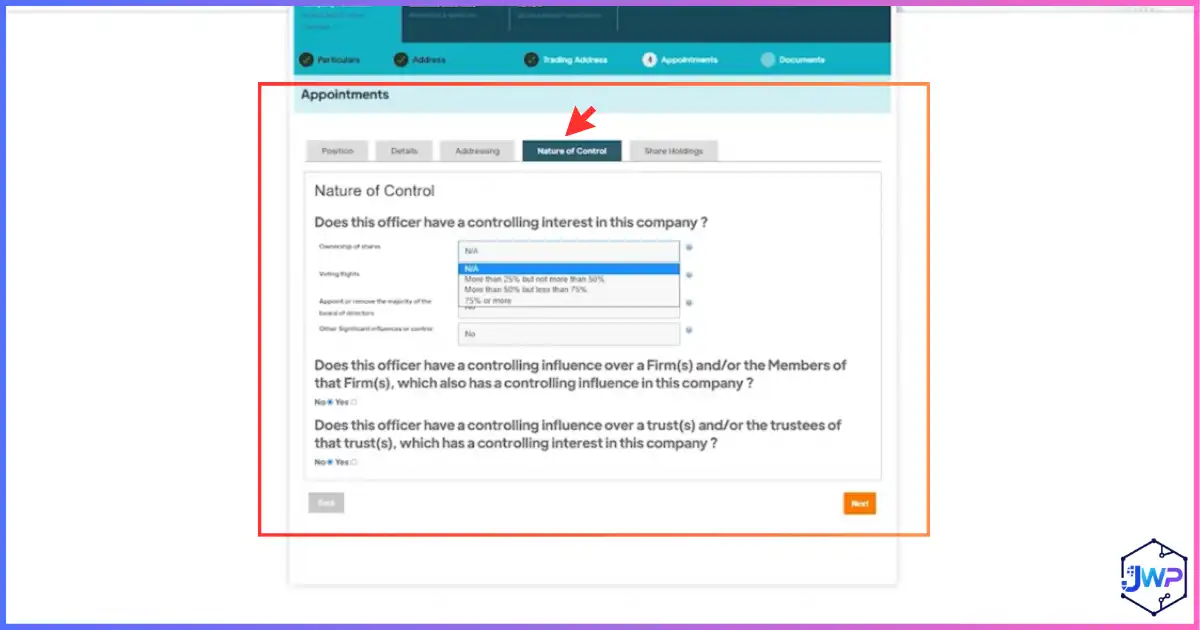
Step 12 — Nature of control (PSC)
Select how control is held by share ownership. Typical bands:
- More than 25% but not more than 50% — common in equal two-person partnerships of shares
- More than 50% but less than 75% — majority but not super-majority
- 75% or more — full/near-full ownership (most solo founders)
Answer any additional influence/control questions honestly. Opacity here is both illegal and a banking red flag.
Step 13 — Shareholding value and quantity
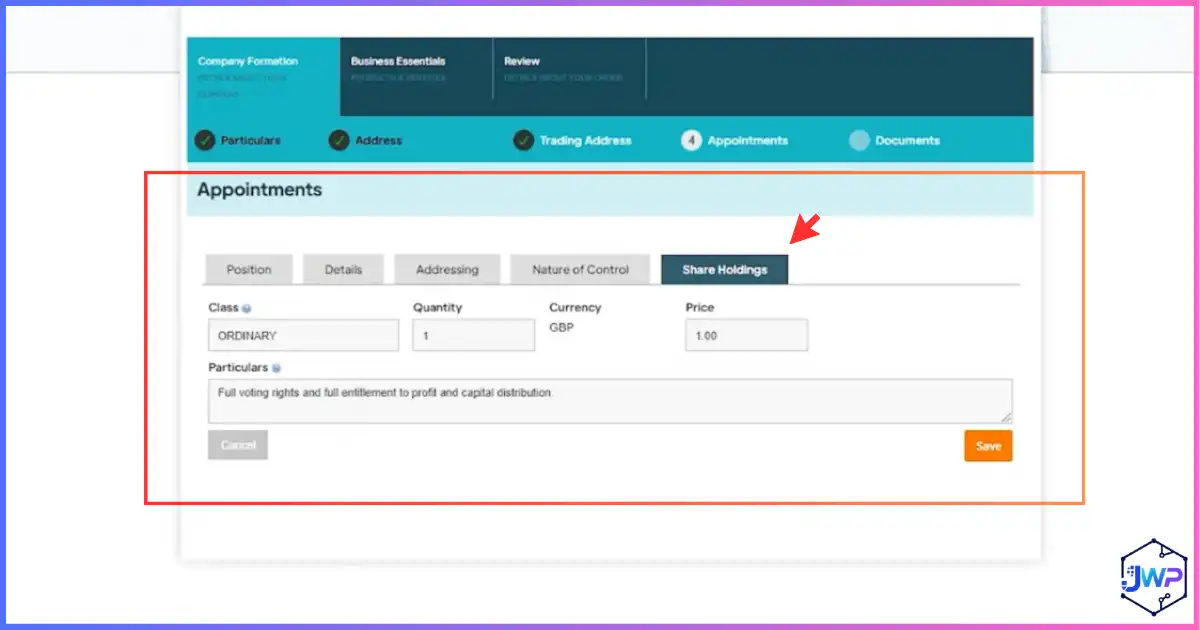
Most simple companies use ordinary shares at £1 nominal value each (for example 100 shares of £1 = £100 share capital). Shares are usually shown as allotted. You can customise after legal advice, but the default works for the majority of small non-resident companies.
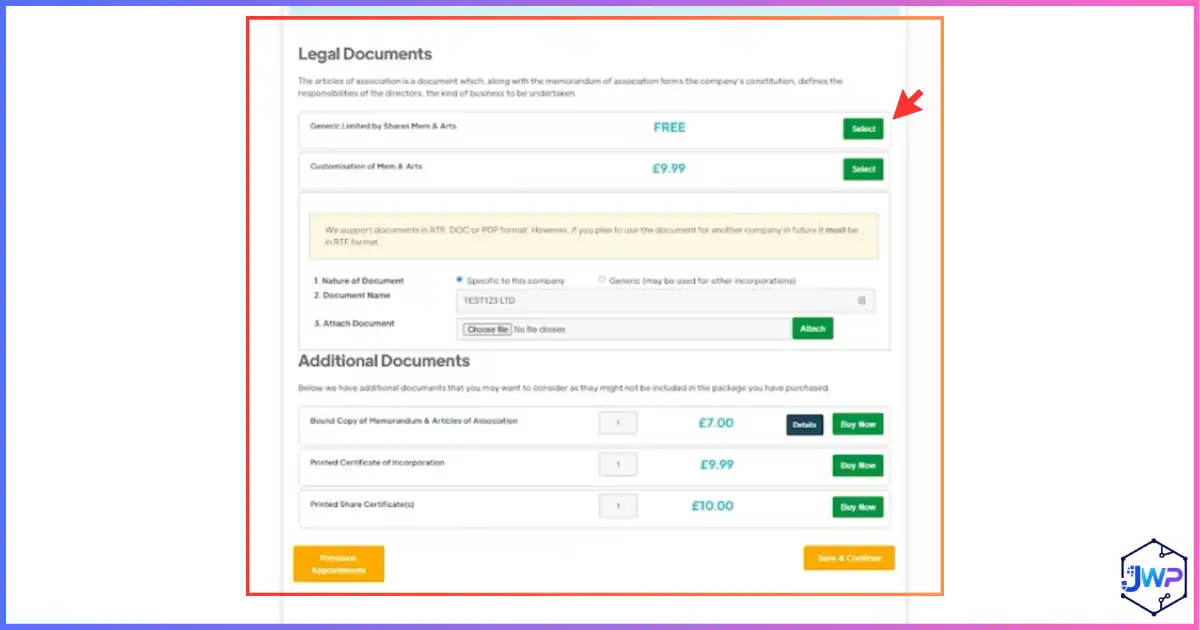
Step 14 — Legal documents: free memorandum option
For the legal document section, most companies choose the free model memorandum and articles. Only pay for customised mem & arts if you have specific rights, multiple share classes, or restrictions that model articles cannot handle — and ideally after solicitor input. Custom templates should still follow Companies House structure.
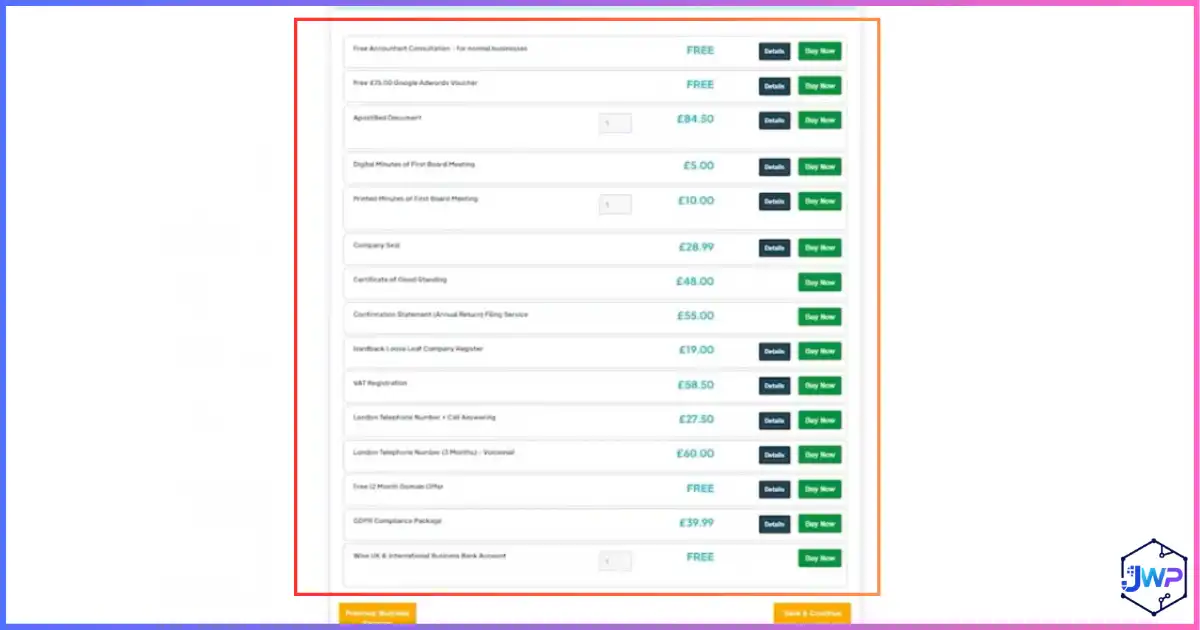
Step 15 — Optional extras: skip unnecessary upsells
Partner bank intros, premium seals, extra certificates, marketing vouchers, and cashback offers can be useful — or pure noise. Add only what you will use in the next 90 days. You can usually purchase extras later from the portal after the company exists. Avoid stacking costs you do not understand.
After step 15: You will usually see a final review screen (double-check every name, address, share figure, and SIC code), then an invoice/payment confirmation, KYC declarations, and terms acceptance. The agent will contact you to verify photo ID and address. Once Companies House accepts the filing, the company legally exists from the incorporation date on the Certificate of Incorporation.
What Documents You Receive
- Certificate of Incorporation — proof the company exists, with company number (CRN) and incorporation date
- Memorandum of Association — the subscribers’ statement on forming the company
- Articles of Association — internal rules (model or custom)
- Share certificate(s) — evidence of share ownership for each shareholder
- Statutory registers / company register extracts — directors, members, PSCs, and related records
- Authentication code / WebFiling credentials — for future Companies House filings (store securely)
Keep digital and printed copies. Banks, Payoneer, Wise, payment processors, and platforms (including routes discussed in our UK PayPal for non-UK residents guide) will ask for the Certificate of Incorporation, proof of directors/UBOs, and sometimes articles or a register extract.
Corporation Tax, HMRC, VAT, and Management Substance
Corporation Tax basics
A company incorporated in the UK is generally UK tax resident and chargeable to Corporation Tax on its taxable profits. Current headline rates (confirm on GOV.UK for your accounting period):
- 19% small profits rate — taxable profits of £50,000 or less
- 25% main rate — taxable profits above £250,000
- Marginal relief — between £50,000 and £250,000, producing an effective rate between 19% and 25%
Thresholds can be affected by associated companies. This is planning information, not a tax computation.
HMRC registration
New companies must usually notify HMRC that they are within the charge to Corporation Tax within three months of starting business activity. Companies House notifies HMRC of incorporation, but you still have active duties: CT registration, record-keeping, and filing a Company Tax Return (CT600) when required. Dormant companies have lighter practical burdens but still face Companies House filing duties.
VAT
Register for VAT if taxable turnover exceeds the current UK threshold (historically around £90,000 — always verify the live figure), or voluntarily if reclaiming input VAT makes commercial sense. VAT registration creates ongoing return and record obligations.
Central management and control
Where board decisions are actually made can matter for tax residence analysis, double-tax treaties, and foreign controlled-company rules in your home country. Holding all board meetings exclusively abroad, having no UK substance, and booking profits through a UK shell while living and managing everything elsewhere can create unexpected outcomes in both the UK and your residence country. Get cross-border tax advice early if profits will be material.
Home-country tax still exists. Forming a UK Ltd does not erase personal tax residence, CFC rules, exit taxes, or reporting regimes (CRS/FATCA) where they apply. Dividends and director fees may be taxable where you live. Treat the Ltd as a real company with real books — not a sticker.
Business Banking for Non-Resident UK Ltds: Payoneer vs Wise
Traditional UK high-street banks frequently require UK presence, face-to-face onboarding, or residency profiles that pure non-resident directors cannot meet. That is why most remote founders start with regulated fintech / e-money providers that support multi-currency business accounts.
Payoneer
Strong for: receiving payments from marketplaces, platforms, advertisers, agencies, and international clients — with local receiving account details in multiple currencies including GBP, USD, and EUR in many cases.
Consider: fee structures vary by payment type, currency conversion, and withdrawal method. Map fees against your real payment mix before standardising on one rail.
Wise Business
Strong for: multi-currency balances, transparent FX, paying suppliers, and holding a UK account number + sort code style receiving details where Wise supports your company profile.
Consider: Wise is not a full traditional bank (limited lending/cheque products). Confirm eligibility for UK Ltds with non-resident directors and restricted activity lists before applying.
Practical onboarding tips
- Incorporate first — both providers want Certificate of Incorporation, CRN, and UBO/director IDs
- Use the company name exactly as registered; mismatches cause KYC failures
- Prepare proof of business activity (website, invoices, contracts, store URLs)
- Keep company funds completely separate from personal accounts
- Many founders use both: Payoneer for inbound platform payouts, Wise for FX and supplier payments
If you also need PayPal specifically, see How to Create a UK PayPal Account as a Non-UK Resident — requirements and friction differ from Payoneer/Wise.
Form the company first, then open banking
Have your Certificate of Incorporation and director ID pack ready before you start Payoneer or Wise applications. Parallel applications without docs usually stall.
Cost Breakdown and Charts
Figures below are planning estimates combining the current Companies House digital incorporation fee (commonly £50 — confirm live schedule) with typical non-resident agent packaging (formation + registered office + service address). Agent list prices change; always check the live cart.
Year-One Cost: DIY Direct Filing vs Non-Resident Agent Package
Illustrative. DIY assumes you already control a compliant UK registered office (rare for pure non-residents). Agent package assumes first-year registered office + director service address commonly needed offshore. Excludes optional VAT registration help, premium mail scanning, and professional tax advice.
Typical Formation Timeline by Stage (Non-Resident)
Planning days, not guarantees. Companies House digital filing is often the fastest stage; identity verification, HMRC onboarding, and bank KYC set the real path to “fully operational.”
Illustrative Year-One Budget Allocation
Representative mix for a solo-director online services Ltd using an agent package. Your mix shifts with VAT, accountant retainers, or multi-director verification.
Ltd vs LLP vs US LLC: Suitability Across Common Priorities
Generalised illustration only. Real suitability depends on founder count, funding plans, market, and personal tax residence.
| Item | Typical range | Notes for non-residents |
|---|---|---|
| Companies House digital incorporation | £50 (confirm live) | Paid via agent or direct filing; paper is higher/slower |
| Formation agent service | £50–£200+ | Non-resident packages cost more when addresses are bundled |
| Registered office + service address (year 1) | £50–£300 | Almost always required if you have no UK address |
| Confirmation statement (annual) | £34 digital (confirm live) | Plus agent filing fee if outsourced |
| Accounts preparation | £300–£2,000+ | Depends on dormant vs trading complexity |
| ID verification / ACSP assist | Often included / £20–£100+ | Budget extra if not in package |
Ongoing Compliance Obligations
- File a confirmation statement with Companies House at least every 12 months
- Prepare and file annual accounts (even small/dormant companies have filing duties)
- Keep statutory registers accurate (directors, members, PSCs) and report changes promptly
- Maintain identity verification currency for directors/PSCs as ECCTA enforcement continues
- Register and file for Corporation Tax as required; keep accounting records for the statutory period
- Monitor the VAT threshold and register if you cross it (or choose voluntary registration deliberately)
- Renew registered office / service address subscriptions so official mail never bounces
- Operate the company through proper board decisions and separate bank accounts — limited liability is weakened by sham or commingled finances
Many formation agents offer ongoing secretarial packages (confirmation statement, address renewal, mail scanning). For trading companies, a UK accountant familiar with non-resident directors is usually worth more than any one-off formation discount.
Common Mistakes and Honest Risks
Mistakes that cause delays or problems
- Selecting an LLP package or UK-resident-only bundle instead of a non-resident Ltd package
- Using a personal home address as registered office and exposing it publicly
- Skipping identity verification or providing ID that does not match filing data
- Inventing PSC structures that hide the real owner — transparency rules make this both illegal and self-defeating
- Paying for every upsell at checkout without understanding renewals
- Commingling personal and company banking from day one
- Ignoring the three-month Corporation Tax notification window after starting business
Honest limitations to weigh
- Director and PSC names are public — a UK Ltd is not an anonymity product
- UK tax residence of a UK-incorporated company is the default starting point; substance and treaties are technical
- High-street UK banking remains difficult for many pure non-residents
- Annual compliance is real work (or real accountant fees) even for small companies
- Payment processors can still reject applications based on industry, country risk, or incomplete UBOs
Final Pre-Formation Checklist
- Confirmed a private Ltd by shares is the right vehicle (vs LLP or US LLC)
- Checked company name availability + brand/domain conflicts
- Selected a non-resident package with registered office (and ideally director service address)
- Prepared passport/ID and proof of residential address for ACSP verification
- Decided share capital (e.g. 100 × £1 ordinary shares) and PSC control band
- Chosen free model articles unless you have a documented reason to customise
- Understood Corporation Tax registration and annual filing duties
- Planned banking route: Payoneer, Wise, or both
- Budgeted year-two address renewals and basic accounting support
Start formation when the checklist is green
Frequently Asked Questions
Can a non-resident form a UK limited company without visiting the UK?
Yes. Name check, officer details, identity verification (via ACSP if needed), and Companies House filing can all be completed online. You must still have a UK registered office address, which a formation agent can provide.
Do I need UK citizenship or a visa to be a director?
No. There is no residency or citizenship requirement to act as a director of a UK private limited company. You must be at least 16, not disqualified, and identity-verified under current Companies House rules.
How many directors and shareholders are required?
At least one director and one shareholder. The same individual can hold both roles. Corporate directors are heavily restricted under recent reforms.
What is a PSC and do non-residents need one on the register?
A Person with Significant Control is anyone who owns more than 25% of shares or voting rights, or otherwise exercises significant influence or control. Non-resident owners must still be disclosed accurately on the PSC register and identity-verified.
Does a UK Ltd pay Corporation Tax if directors live abroad?
A UK-incorporated company is generally UK tax resident and within the Corporation Tax regime on its profits, regardless of where directors live. Residence, permanent establishment, and treaty analysis can be complex — take professional advice for material profits.
What are the current Corporation Tax rates?
As of the latest confirmed structure: 19% small profits rate (profits £50,000 or less), 25% main rate (profits above £250,000), with marginal relief between those bands. Always confirm live HMRC rates for your accounting period.
How long does incorporation take?
Digital incorporations are commonly processed the same day or within about 24 hours once filings and identity checks are correct. Full operational readiness (banking KYC, tax setup) often takes longer.
Should I use Payoneer or Wise for my UK Ltd?
Payoneer is often stronger for receiving marketplace and client platform payouts. Wise is often stronger for multi-currency holding and transparent FX transfers. Many non-resident Ltds use both. See our full Payoneer and Wise guides.
Is a UK Ltd more private than a US LLC?
Usually not. UK directors and PSCs are publicly searchable at Companies House. Many US states disclose less on public free searches, though beneficial ownership reporting regimes still apply. Choose based on market and compliance fit, not myths about secrecy.
Can I form a UK Ltd for freelancing, YouTube, or online services?
Yes, many non-residents do — provided the activity is lawful, you complete proper disclosure, and you meet tax and platform rules. For creator-specific entity planning, also see forming an entity for YouTube and AdSense.
What happens if I never file accounts or confirmation statements?
Late filing penalties, prosecution risk, and ultimately strike-off. Directors can face consequences. Non-residence is not a defence for ignoring Companies House duties.
Do I need custom articles of association?
Most simple single-director companies use free model articles. Customise only for multi-class shares, special veto rights, or other structural needs — ideally with a solicitor.
Sources and Further Reading
References are grouped so the article stays readable while remaining research-backed. Always verify current fees, thresholds, and identity rules on official sites before filing.
Related guides on JoshWP
Official government & regulatory sources
Legal Disclaimer
This article is for educational purposes only and is not legal, tax, accounting, or financial advice. UK limited company formation, identity verification, registered office rules, Corporation Tax, VAT, banking eligibility, and formation-agent pricing depend on your specific facts and can change. Consult a qualified UK solicitor and accountant, and check current guidance directly with Companies House and HMRC, before incorporating or relying on any figure in this article. Some links are affiliate links; if you buy through them, we may earn a commission at no extra cost to you.