
How to Form an LLC for Non-US Residents : The Complete Guide
By JoshWP Team | Updated: | ~21 min read | Business Formation · International Founders
Quick Answer
Yes — non-US residents can legally form and own a US LLC, with no requirement to be a US citizen, hold a green card, or even ever set foot in the country. You don’t need an SSN or ITIN to form the LLC itself, and you can get an EIN (Employer Identification Number) without an SSN through the IRS’s international applicant process. What you will need: a registered agent with a physical address in your formation state (Northwest Registered Agent is the option covered in this guide), a chosen formation state (Wyoming, Delaware, and New Mexico are the most common for non-residents), and — once formed — a way to actually receive and manage payments, since traditional US banks are notoriously difficult for non-residents to open with remotely.
Most foreign founders solve this with Mercury or Relay as a primary US business bank account, complemented by Payoneer or Wise for multi-currency receiving — this guide covers all five options honestly, including which ones don’t work for non-residents at all. This guide covers every requirement, the full formation walkthrough, EIN specifics, ongoing compliance (including a major 2025 rule change on beneficial ownership reporting most guides haven’t updated), the full banking landscape, and real total costs.
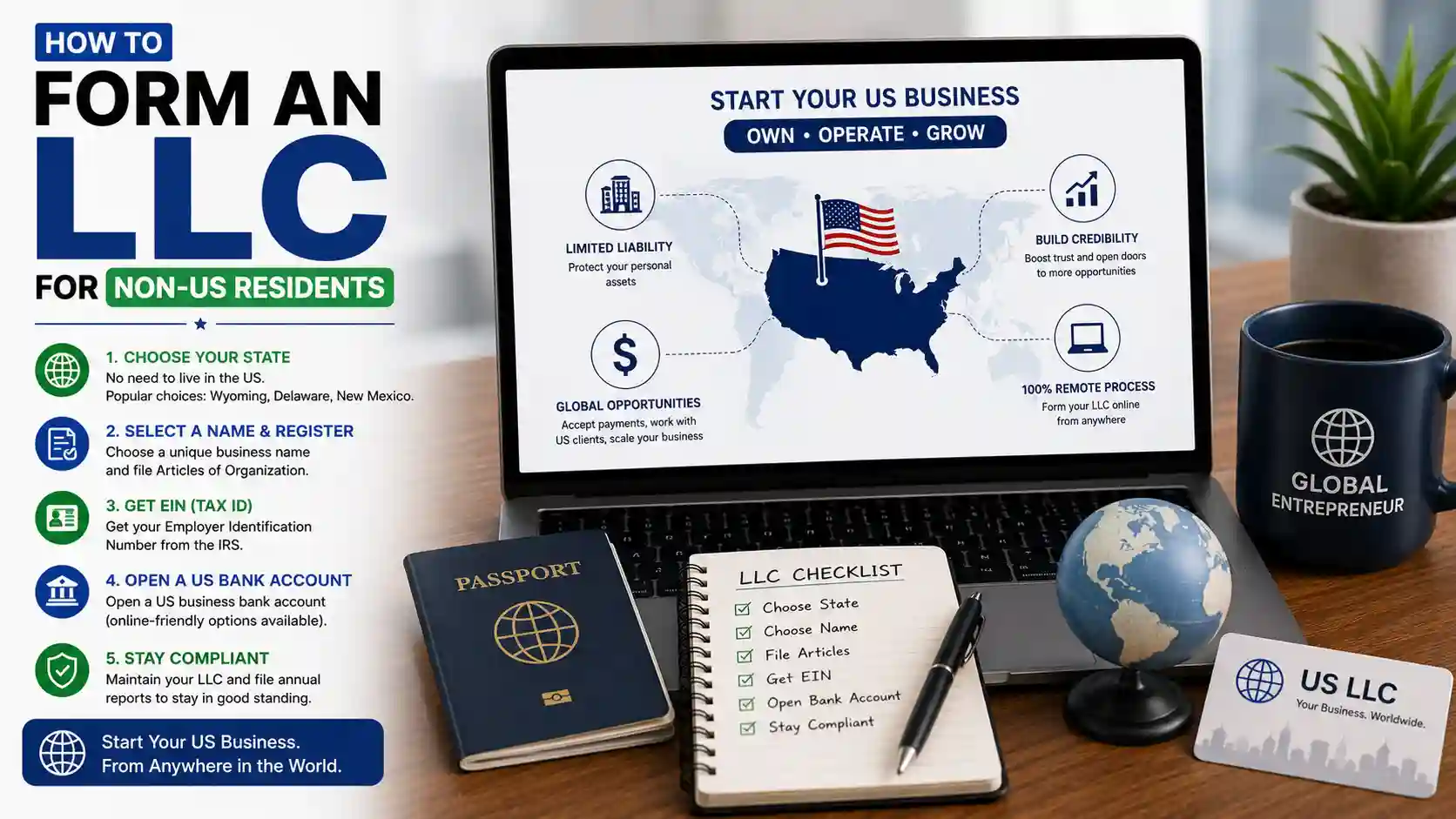
Every year, hundreds of thousands of non-US residents — freelancers, e-commerce sellers, SaaS founders, YouTube creators, dropshippers — form a US LLC without ever living in the United States. It’s completely legal, more accessible than most people assume, and often the single unlock that lets an international founder access US payment processors, marketplaces, and clients that simply won’t work with a foreign business entity.
The problem is that most guides on this topic are either written for US residents and gloss over the parts that are actually different for foreign founders, or they’re outdated on compliance requirements that changed significantly in 2025. This guide is neither. We’ll walk through every real requirement, the actual formation screens step by step, how to get an EIN without a Social Security Number, what compliance genuinely applies to you post-formation, and how to handle banking — the part that trips up more non-resident founders than anything else.
For a broader comparison of formation services before you commit, our guide to the best LLC formation services for non-US residents is worth a look first if you haven’t already chosen a provider.
Table of Contents
- 1. Why Non-US Residents Form US LLCs
- 2. Full Requirements Checklist
- 3. Choosing the Right State
- 4. Step-By-Step: Forming Your LLC
- 5. Getting an EIN Without an SSN
- 6. Compliance Requirements After Formation
- 7. Bank Setup: Mercury, Relay, Wise & More
- 8. Taxes for Non-US LLC Owners
- 9. Real Costs, Charted
- 10. Common Mistakes to Avoid
- 11. Frequently Asked Questions
Why Non-US Residents Form US LLCs
🏦 Access to US payment processors. Stripe, PayPal Business, and many US marketplaces are far easier to qualify for with a US LLC and EIN than as a foreign individual or foreign entity.
🛍️ Marketplace and platform requirements. Amazon, certain ad networks, and B2B vendors frequently prefer or require a US business entity, particularly for higher payout thresholds.
📺 Content monetization. Creators running YouTube channels through an LLC for AdSense, or managing multiple AdSense accounts across projects, often find a proper US entity simplifies both eligibility and tax documentation.
🛡️ Liability protection. An LLC legally separates your personal assets from business liabilities — the same core benefit US residents get, available to foreign founders too.
🤝 Client and investor credibility. A US LLC with a US address and EIN often reads as more established to US-based clients and partners than an overseas sole proprietorship.
💵 Currency and banking flexibility. A US entity opens the door to USD-denominated accounts through providers like Payoneer and Wise, reducing exposure to unfavorable local banking terms.
Full Requirements Checklist
Here is genuinely everything required — and, just as importantly, everything not required — to form a US LLC as a non-resident.
✓ What You Actually Need
- A valid passport or government ID from your home country
- A registered agent with a physical address in your formation state
- A chosen business name that’s available in your formation state
- A formation fee plus your state’s filing fee
- An EIN application (no SSN needed — covered in full below)
- A plan for receiving payments (Payoneer, Wise, or a US bank account)
✗ What You Do NOT Need
- US citizenship or a green card
- A Social Security Number (SSN)
- An ITIN to form the LLC (though useful for some tax filings later)
- A US residential or business address of your own
- To ever physically visit the United States
- A US-based business partner or co-founder
The One Genuine Gatekeeper: The Registered Agent
Every US LLC, regardless of the owner’s residency, legally must have a registered agent — a person or company with a physical (not P.O. Box) address in the formation state, available during business hours to receive legal and state correspondence on the LLC’s behalf. This is the one requirement non-residents cannot work around on their own, since you don’t have a US address to use, which is exactly why a service like Northwest Registered Agent exists.
Choosing the Right State
You can legally form an LLC in any of the 50 states regardless of where you live, and you don’t have to form in the state where you’ll do business unless you plan to have a genuine physical presence there. For non-residents with no US physical operations, three states dominate for good reason.
| State | Filing Fee | Annual Fee | Why Non-Residents Choose It |
|---|---|---|---|
| Wyoming | ~$100 | ~$60/year | No state income tax, strong privacy protections, low ongoing cost — the most common default pick |
| Delaware | ~$110 | ~$300/year franchise tax | Business-friendly court system, preferred by some investors and larger operations, higher ongoing cost |
| New Mexico | ~$50 | $0 (no annual report required) | Lowest cost, strongest privacy (member names aren’t published), no recurring annual report filing |
Popular Formation States for Non-Resident LLCs
Illustrative distribution based on commonly reported patterns among non-resident formations, not official state-level data.
There’s no universally “correct” answer here — Wyoming is the reasonable default for most non-residents running an online business with no physical US presence, New Mexico wins on raw cost and privacy, and Delaware makes sense mainly if you’re planning to raise investment or eventually convert to a C-Corp.
Step-By-Step: Forming Your LLC With Northwest Registered Agent
Here’s the real formation flow, screen by screen. We’re using Northwest Registered Agent for this walkthrough — see our full Northwest Registered Agent review for more on why it’s a strong fit specifically for non-resident founders (privacy-first filings, in-house registered agent in every state, and a straightforward flat fee with no confusing upsell tiers).
Visit the Northwest Homepage
Start at Northwest’s homepage and begin the LLC formation flow.
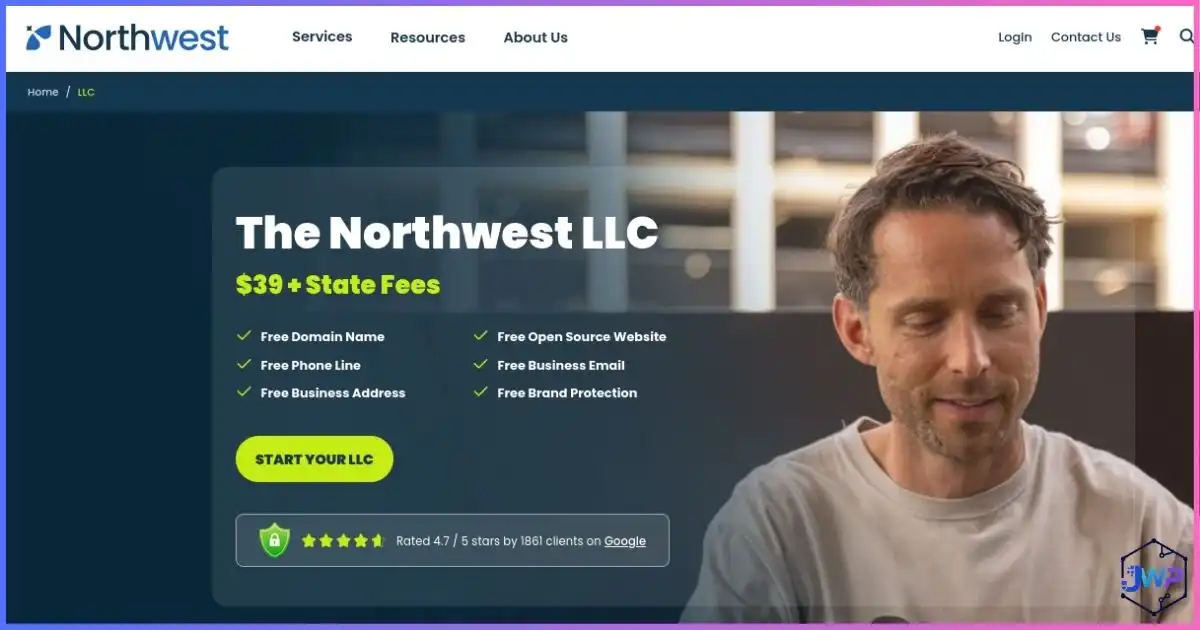
Northwest’s homepage — the starting point for the entire formation process covered below.
Enter Your Formation Details
Select your entity type (LLC) and your formation state — Wyoming, Delaware, and New Mexico are the most common picks for non-resident founders, as covered above.
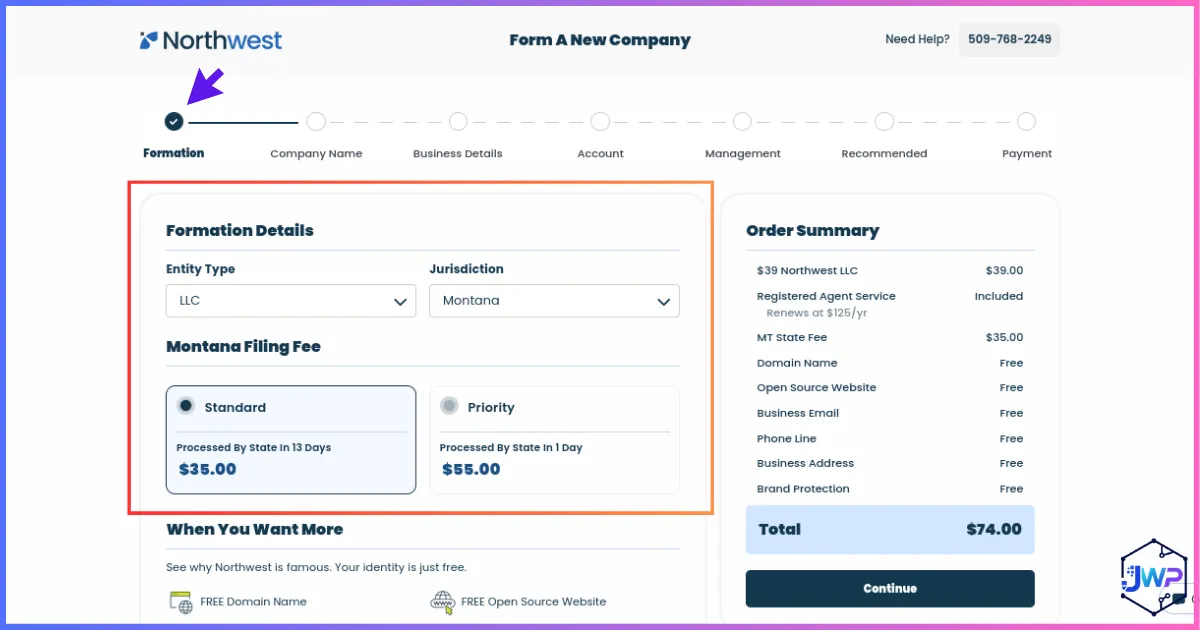
This is where you lock in your entity type and formation state before anything else.
Add Your Company Name (EIN Service Recommended, Not Required)
Enter your desired LLC name. You’ll also see Northwest’s EIN service offered here as an add-on — genuinely optional, but worth strongly considering as a non-resident, since getting an EIN without an SSN yourself involves an international phone call to the IRS (detailed in full below).
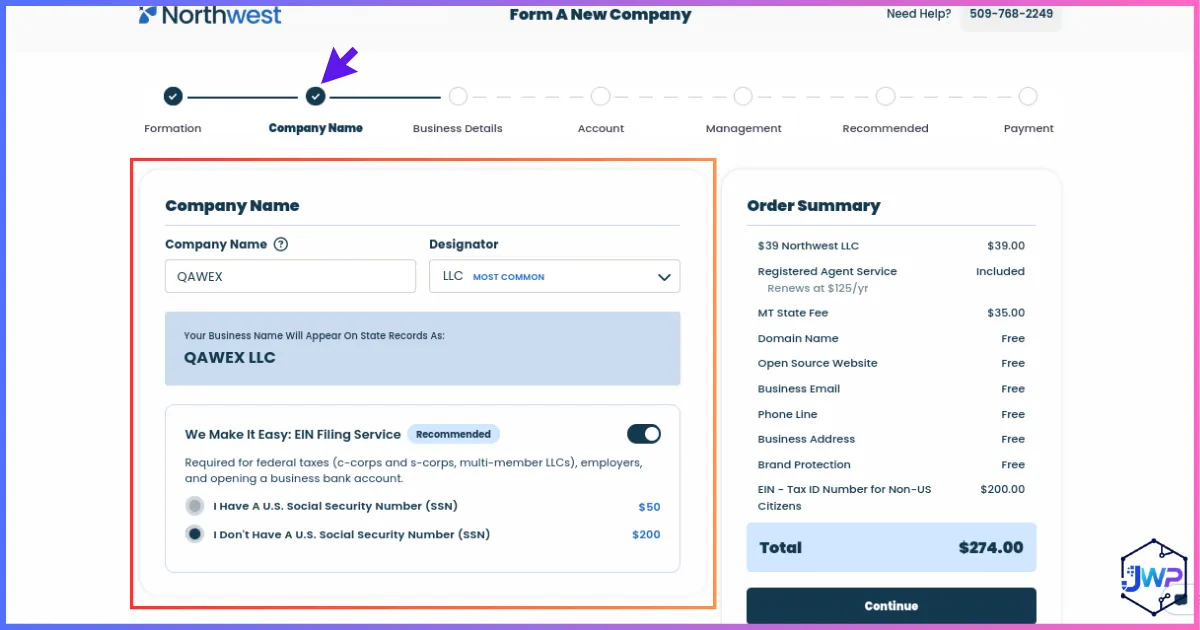
The EIN add-on shown here can save non-resident founders a genuinely time-consuming international IRS call.
Add Your Business Details
Provide basic details about what your business does — this feeds into your formation documents and doesn’t require a US address at this stage.
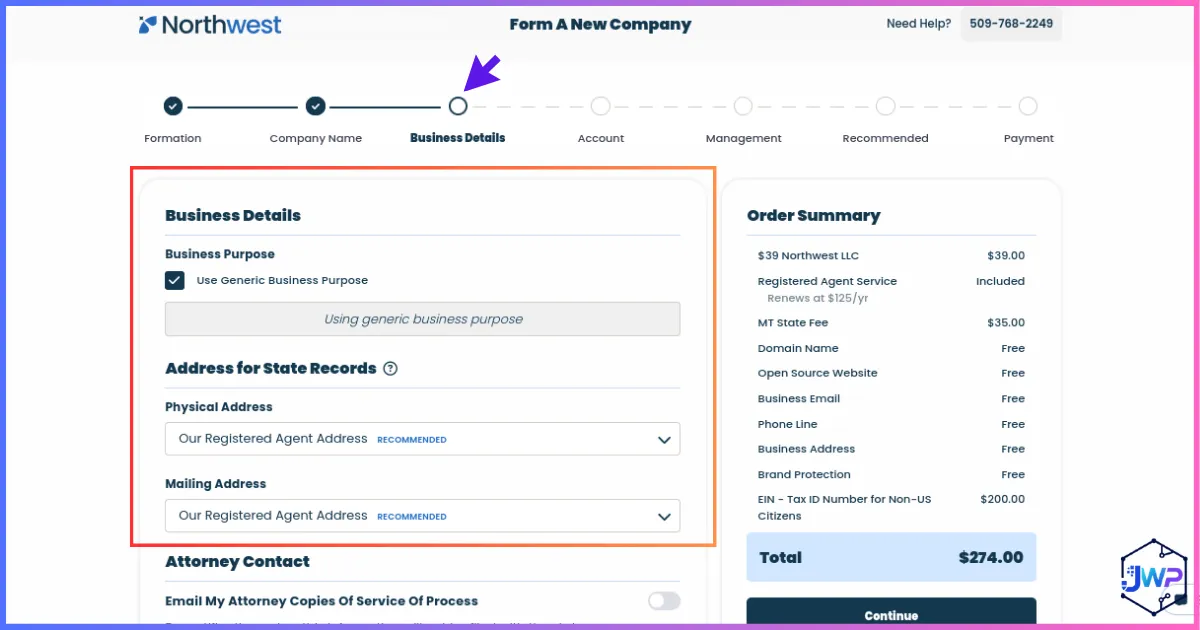
Basic business details — your foreign address is accepted here without issue.
Create Your Account
Set up your Northwest login credentials — this becomes your dashboard for tracking formation status, documents, and your registered agent service going forward.
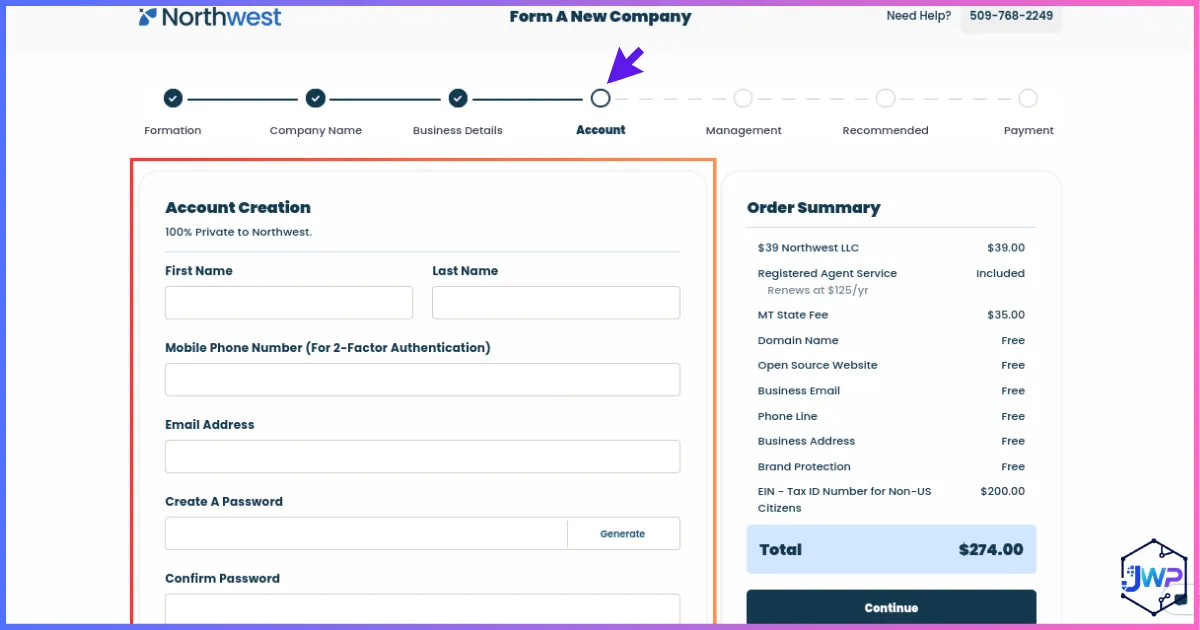
Your login here doubles as the dashboard where formation documents and registered agent mail scans appear later.
Enter Company Management Details
List the LLC’s members or managers — as the non-resident owner, this is simply your name and foreign address; no US co-owner or manager is required.
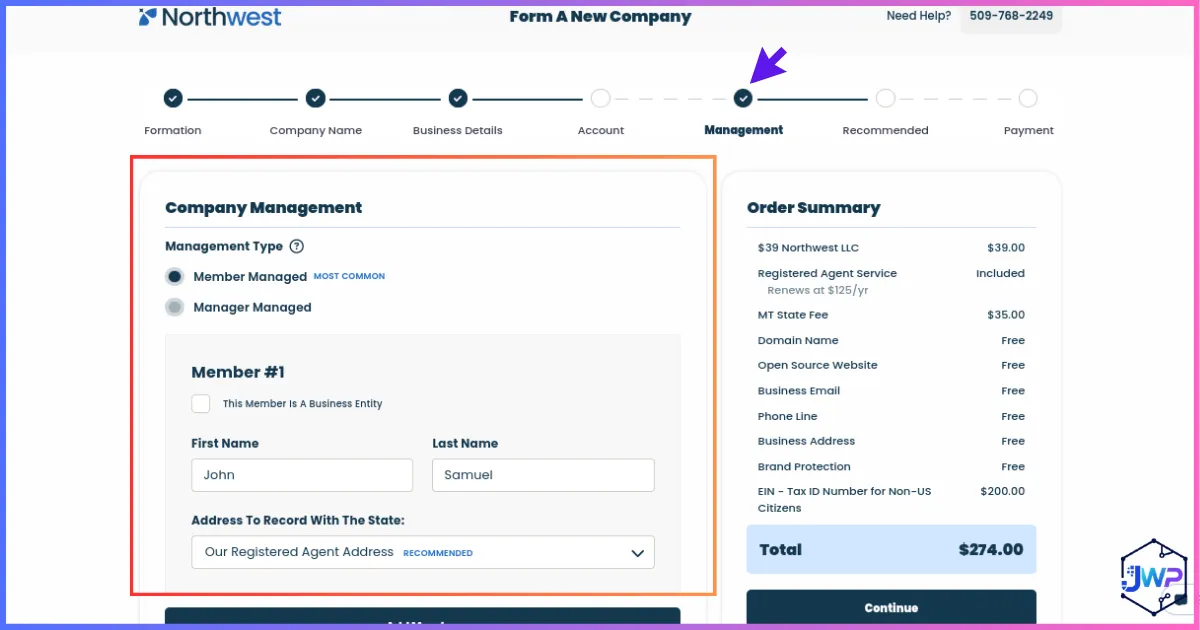
Foreign founders list themselves here directly — no US-based manager or member is required by law.
Review Optional Recommended Services
Northwest presents optional add-ons here (like expedited filing) — review each on its own merits rather than accepting defaults, since none are mandatory to legally form your LLC.
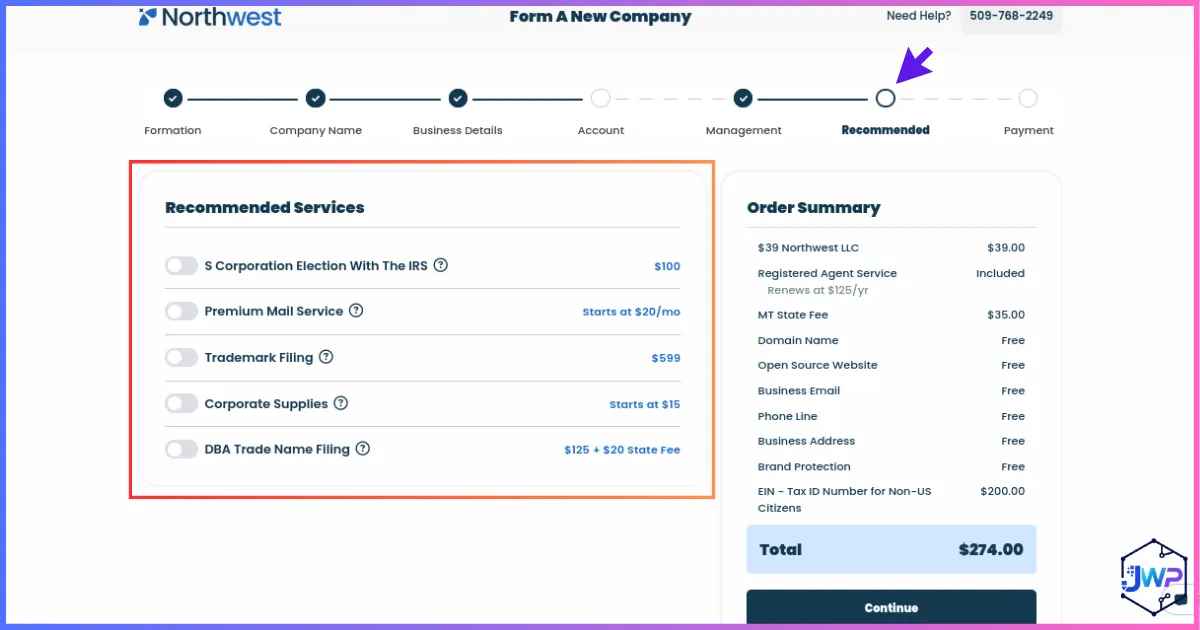
Every add-on on this screen is genuinely optional — decide based on your own timeline and needs, not default selections.
Enter Payment Information
Complete your order with a debit or credit card. International cards are generally accepted without issue. Once submitted, Northwest files your Articles of Organization with the state on your behalf.
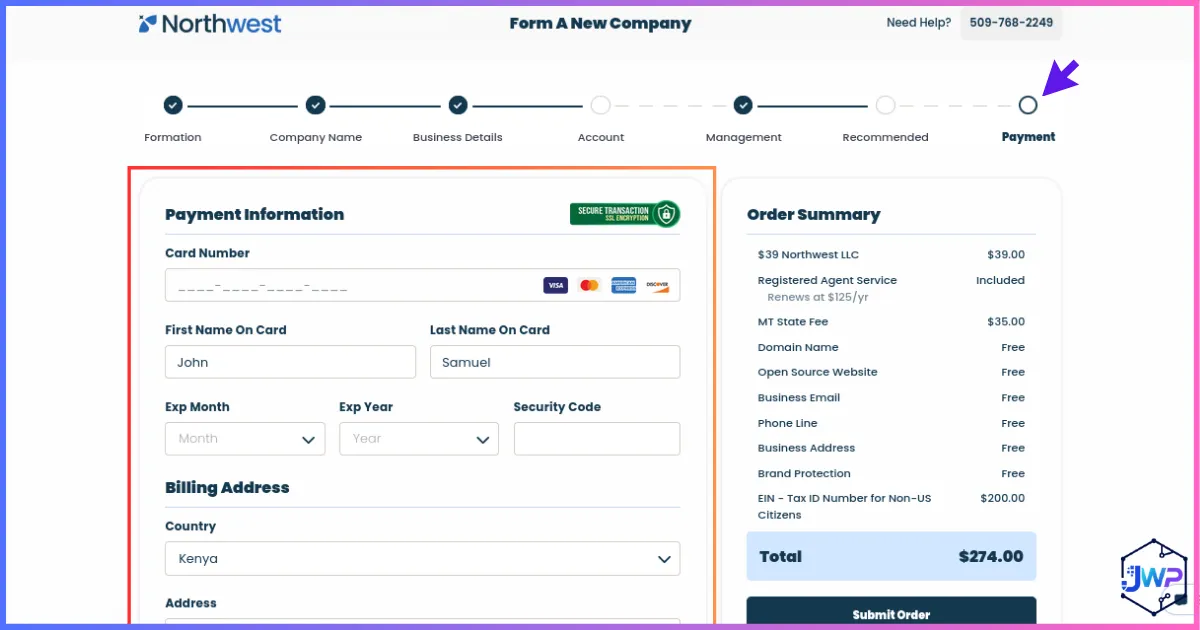
The final step — international cards work here, and your state filing goes out immediately after this screen.
Getting an EIN Without an SSN
An EIN (Employer Identification Number) is your LLC’s tax ID — you’ll need it to open a bank account, work with payment processors, and file required tax forms. The good news: an SSN has never been a legal requirement to get one. The process is simply different for non-residents.
🇺🇸 With an SSN or ITIN
Apply online directly through the IRS website and typically receive your EIN immediately, the same day.
🌍 Without an SSN or ITIN
The IRS online tool isn’t available to you. Instead, you complete Form SS-4 and either fax it in or call the IRS’s international applicant line directly to complete the application over the phone — a process that typically takes anywhere from a few days to a few weeks.
Approximate EIN Processing Time: With vs Without SSN
Illustrative ranges; actual timing varies by IRS processing volume and application accuracy.
The Practical Shortcut Most Non-Residents Take
Because the phone/fax process is genuinely time-consuming and the international IRS line has limited calling hours relative to most time zones, most non-resident founders use a formation service’s EIN add-on (as shown in Step 2 of the walkthrough above) rather than handling it themselves. It isn’t required, but for many founders it’s worth the convenience.
Keep Your Official EIN Letter — You’ll Need It for Banking
Once your EIN is issued, the IRS sends an official confirmation — a CP575 letter (issued once, at initial assignment) or a 147C letter (a reissued confirmation you can request later if the original is lost). Save this document carefully: as covered in the banking section below, Mercury and Relay now require this official letter for account applications and no longer accept a self-filed SS-4 form or screenshot as proof of your EIN.
Compliance Requirements After Formation
Forming the LLC is the easy part. Staying compliant afterward is where founders — resident and non-resident alike — most often slip up. Here’s everything that applies specifically to a foreign-owned US LLC.
Form 5472: The Filing With a $25,000 Penalty
If your LLC is a single-member LLC owned by a non-US person, the IRS requires an annual Form 5472 filing (alongside a pro forma Form 1120), reporting transactions between the LLC and its foreign owner. This is a reporting requirement, not necessarily a tax bill — but the penalty for missing it is a flat $25,000 per year, regardless of whether the LLC owes any actual tax. This is arguably the single most important compliance item for non-resident LLC owners to know about, and it’s frequently missed because it doesn’t appear in generic “how to form an LLC” guides written for US residents.
Good News: BOI Reporting Was Rolled Back in 2025
Many older guides still say every LLC must file a Beneficial Ownership Information (BOI) report with FinCEN within 30 days of formation. As of a March 2025 interim final rule, this is no longer accurate for most non-resident founders: all entities formed in the United States — including foreign-owned LLCs — are now exempt from federal BOI reporting. Only companies formed under foreign law and separately registered to do business in the US still need to file. One exception worth knowing: a small number of states (New York among them) have floated or enacted their own separate state-level transparency requirements for certain foreign entities — check your specific state’s current rules if this could apply to you.
📅 Annual report / franchise fee. Most states require an annual report and/or franchise tax to keep your LLC in good standing — amounts and requirements vary significantly by state (New Mexico famously requires none).
📬 Registered agent renewal. Your registered agent service must stay active every year your LLC exists — typically renewing around $125/year with Northwest after the first free year.
🧾 Sales tax registration, if applicable. If you sell physical goods with sufficient sales volume into specific states (economic nexus), you may need to register for and collect sales tax in those states.
📝 Keeping your registered agent and address current. Missing state or IRS correspondence because your registered agent details lapsed is one of the most avoidable compliance failures.
Bank Setup: Every Option Non-US Residents Actually Have
This is the part that catches the most non-resident founders off guard: opening a traditional US bank account remotely, without a US address or SSN, is genuinely difficult — most major banks (Chase, Bank of America, and similar) require an in-person branch visit, which defeats the purpose for most foreign founders. In practice, non-resident LLC owners choose from five realistic options in 2026: Mercury, Relay, Airwallex, Wise Business, and Payoneer — each with different eligibility rules, features, and trade-offs worth understanding before you apply.
| Platform | SSN/ITIN Required? | Best For | Deposit Protection |
|---|---|---|---|
| Mercury | No — EIN + passport accepted | Stripe-integrated startups, treasury tools, the most commonly recommended first choice | FDIC-insured via partner banks, standard coverage |
| Relay | Sometimes requested (varies by application) | Cash flow management — up to 20 sub-accounts and 50 virtual cards, strong QuickBooks/Xero integration | FDIC coverage up to $3M via sweep program through Thread Bank — the highest of any option here |
| Airwallex | No — EIN + passport accepted | Founders who need strong multi-currency and international payment rails alongside US banking | Varies by region and partner bank |
| Wise Business | No | Multi-currency conversion and receiving in 40+ currencies — a strong complement, not a full replacement | Safeguarded funds (EMI), not traditional FDIC deposit insurance |
| Payoneer | No | Marketplace and freelance platform payouts (Upwork, Fiverr, Amazon) into a US-style receiving account | Varies by currency and partner bank arrangement |
Mercury
The most commonly recommended first choice for non-resident founders in 2026 — a fully online application, no SSN or ITIN required, and direct Stripe integration. The trade-off: Mercury has tightened its approval process significantly through 2025–2026 (more on this below).
Relay
A strong alternative built around cash flow management — sub-accounts for taxes, profit, and operating expenses make it a favorite among “Profit First” style operators and e-commerce sellers. Its $3M FDIC sweep coverage is genuinely unusual in this category.
Airwallex
Less commonly discussed than Mercury or Relay, but a legitimate option accepting an EIN and foreign passport in place of an SSN, with strong multi-currency and international payment infrastructure built in from the start.
Payoneer
Gives you US receiving account details usable with most US-facing marketplaces, supports 150+ currencies, and is widely used specifically for receiving affiliate, freelance, and marketplace payments.
Read the full Payoneer setup guide →Wise Business
A genuine multi-currency account with local receiving details in 40+ currencies at the real mid-market exchange rate. Best used as a complement to Mercury or Relay rather than a full replacement, since it isn’t a complete US business bank account with lending or card-issuing features.
Read the full Wise setup guide →Not Viable for Most Non-Residents: Novo & Brex
Worth knowing so you don’t waste time applying: Novo requires an SSN from every beneficial owner, ruling it out for most non-residents. Brex is built for funded startups — underwriting typically expects $50K+ in cash, $100K+ in revenue, or institutional backing, well beyond most bootstrapped solo founders at the banking stage.
A 2025–2026 Trend Worth Knowing Before You Apply
Mercury and Relay have both tightened non-resident approvals meaningfully over the past year. Two changes matter most: first, neither platform reliably accepts a registered agent address as your LLC’s “US address” anymore — banks now cross-check addresses against USPS databases, and registered agent or commercial mail addresses are increasingly flagged. Second, both now require an official IRS EIN confirmation document — a CP575 or 147C letter — rather than a self-filed SS-4 form or screenshot. Apply for banking only after this official document is in hand, and have a genuine business website live before applying; an empty or “coming soon” site is a common rejection trigger. If one platform declines you, move to your next-choice platform rather than reapplying to the same one immediately.
Editorial Comparison: All Five Banking Options for LLC Owners
Editorial scoring (0–10), not an official benchmark from any provider — the right pick depends on your specific business model and payment sources.
Deposit Protection Comparison
Figures reflect commonly reported coverage as of 2026 — confirm current terms directly with each provider, as sweep program coverage can change.
A Sensible Combination for Most Non-Resident Founders
A common, practical setup: apply to Mercury first as your primary US business bank account once your EIN letter is in hand, keep Wise or Payoneer active for receiving marketplace or client payments in multiple currencies, and treat Relay as your fallback if Mercury declines or if sub-account cash flow management genuinely fits how you run the business.
Taxes for Non-US LLC Owners
A single-member LLC owned by a non-US person is, by default, treated by the IRS as a “disregarded entity” for tax purposes — meaning the LLC itself doesn’t pay federal income tax; profits pass through to the owner. Whether you owe US tax depends heavily on whether your income is considered US-sourced or “effectively connected” to a US trade or business — a genuinely nuanced determination that depends on your specific business model, where your work is performed, and your home country’s tax treaty (if any) with the US.
This Is the One Section to Get Professional Advice On
Tax residency, sourcing rules, and treaty benefits are genuinely complex and vary by country. Regardless of your specific tax exposure, the Form 5472 reporting requirement covered above still applies to nearly every foreign-owned single-member LLC. Budget for a qualified accountant familiar with non-resident LLC taxation — the cost is small relative to the risk of getting this wrong.
Real Costs, Charted
Year 1 vs Year 2+ Cost With Northwest
Year 1: $39 formation + state fee (Wyoming ~$100 used here). Year 2+: $125 registered agent renewal.
State Filing Fee Comparison
One-time state filing fee only, excludes ongoing annual fees covered in the state comparison table above.
Common Mistakes to Avoid
Assuming BOI reporting still applies. As covered above, most foreign-owned US-formed LLCs are exempt as of the March 2025 rule — don’t pay a third party to file something you no longer need, and don’t skip a genuine state-level requirement either.
Forgetting Form 5472 entirely. Unlike BOI, this genuinely still applies and carries a real $25,000 penalty — don’t confuse the two.
Waiting to set up banking. Start your Payoneer or Wise account setup as soon as your EIN is issued — don’t wait until you have a client ready to pay you.
Letting registered agent service lapse. Missing state correspondence due to an expired registered agent subscription can lead to administrative dissolution of your LLC.
Choosing a state based on hype alone. Delaware is popular but not automatically “best” — match your state choice to your actual business needs, not just what’s commonly recommended online.
Skipping a tax professional. The cost of a qualified accountant is small compared to the risk of a missed filing or misunderstood tax obligation.
Applying to a bank before your EIN letter arrives. Mercury and Relay applications submitted with only a self-filed SS-4 form, rather than the official CP575/147C letter, are commonly rejected outright — wait for the real document.
Assuming a registered agent address works for every purpose. It’s fully valid for LLC formation and state correspondence, but Mercury and Relay increasingly reject it as your banking “US address” — have a plan for this before you apply.
Frequently Asked Questions
Can a non-US resident really own a US LLC?
Yes. There is no US citizenship, residency, or immigration status requirement to own or form a US LLC. Non-residents form and own US LLCs legally every day.
Do I need an SSN or ITIN to form an LLC?
No. Neither is required to form the LLC itself. You also don’t need one to get an EIN — non-residents apply via Form SS-4 through the IRS’s international phone/fax process instead of the online SSN-based tool.
What’s the best state for a non-resident to form an LLC in?
Wyoming, Delaware, and New Mexico are the most common choices. Wyoming is the reasonable default for most online businesses; New Mexico wins on cost and privacy; Delaware suits founders planning to raise investment. There’s no single universally correct answer — it depends on your business model.
Do I still need to file a BOI report with FinCEN?
In most cases, no. As of a March 2025 interim final rule, all US-formed entities, including foreign-owned LLCs, are exempt from federal BOI reporting. Only foreign-formed companies registered to do business in the US still need to file. Some states have separate rules for certain foreign entities — check your specific state if that could apply to you.
What is Form 5472 and do I need to file it?
Form 5472, filed alongside a pro forma Form 1120, is an annual IRS reporting requirement for foreign-owned single-member LLCs, disclosing transactions between the LLC and its owner. It still applies regardless of the 2025 BOI rollback, and missing it carries a flat $25,000 penalty per year.
How do I open a US bank account as a non-resident?
Traditional US banks often require an in-person visit, which is impractical for most non-residents. Most foreign LLC owners instead choose from five realistic options: Mercury, Relay, or Airwallex as a fuller US business bank account, and Wise or Payoneer for multi-currency receiving — none require US residency or an in-person application.
Which US bank account is best for non-resident LLC owners — Mercury or Relay?
Mercury is the most commonly recommended first choice, with a fully online application, no SSN required, and direct Stripe integration. Relay is a strong alternative, particularly for cash flow management with sub-accounts, and offers notably higher FDIC-equivalent coverage (up to $3M via a sweep program). Both have tightened approval requirements through 2025-2026, so apply only once your official EIN letter is in hand.
Can I use my registered agent address to open a bank account?
It’s fully valid for LLC formation and receiving state correspondence, but Mercury and Relay have both moved away from accepting a registered agent address as your banking “US address” as of 2025-2026, since banks increasingly cross-check addresses against USPS commercial mail databases. Have a plan for this before applying to either platform.
How much does it cost to form an LLC as a non-US resident?
With Northwest Registered Agent, formation starts at $39 plus your state’s filing fee (roughly $50-$110 depending on state), plus an optional EIN service add-on. After the first free year, registered agent service renews at roughly $125/year.
Will I owe US taxes on my LLC’s income?
It depends on whether your income is considered US-sourced or effectively connected to a US trade or business, which varies by your specific circumstances and home country tax treaty. This determination is genuinely nuanced — consult a qualified accountant familiar with non-resident LLC taxation for your specific situation.
Can I use my LLC for YouTube AdSense or content monetization?
Yes, many creators do exactly this. See our dedicated guide on forming an LLC for a YouTube channel and Google AdSense for the specifics.
Related Guides
Disclosure: This article contains affiliate links. If you sign up through one of our links we may earn a commission at no extra cost to you. Figures on fees, requirements, and regulations reflect publicly available information at the time of writing and may change — always confirm current details directly with your formation service, the IRS, and a qualified accountant or attorney before making legal or financial decisions. This article is for informational purposes only and is not legal or tax advice. Screenshots shown reflect the actual formation flow at the time of writing and may change as providers update their interfaces.