How to Make AI Writing Sound More Natural in 10 Minutes
If you want to make AI writing sound more natural, the goal is not to sprinkle in slang or randomly add mistakes. The goal is to restore human judgment: a clearer point of view, specific details, varied rhythm, believable transitions, and a voice that fits the reader. This guide gives you a 10-minute editing workflow, before-and-after examples, tables, Chart.js visuals, and a practical way to humanize AI writing without making it inaccurate or deceptive.
Short Answer: The Fastest Way to Humanize AI Writing
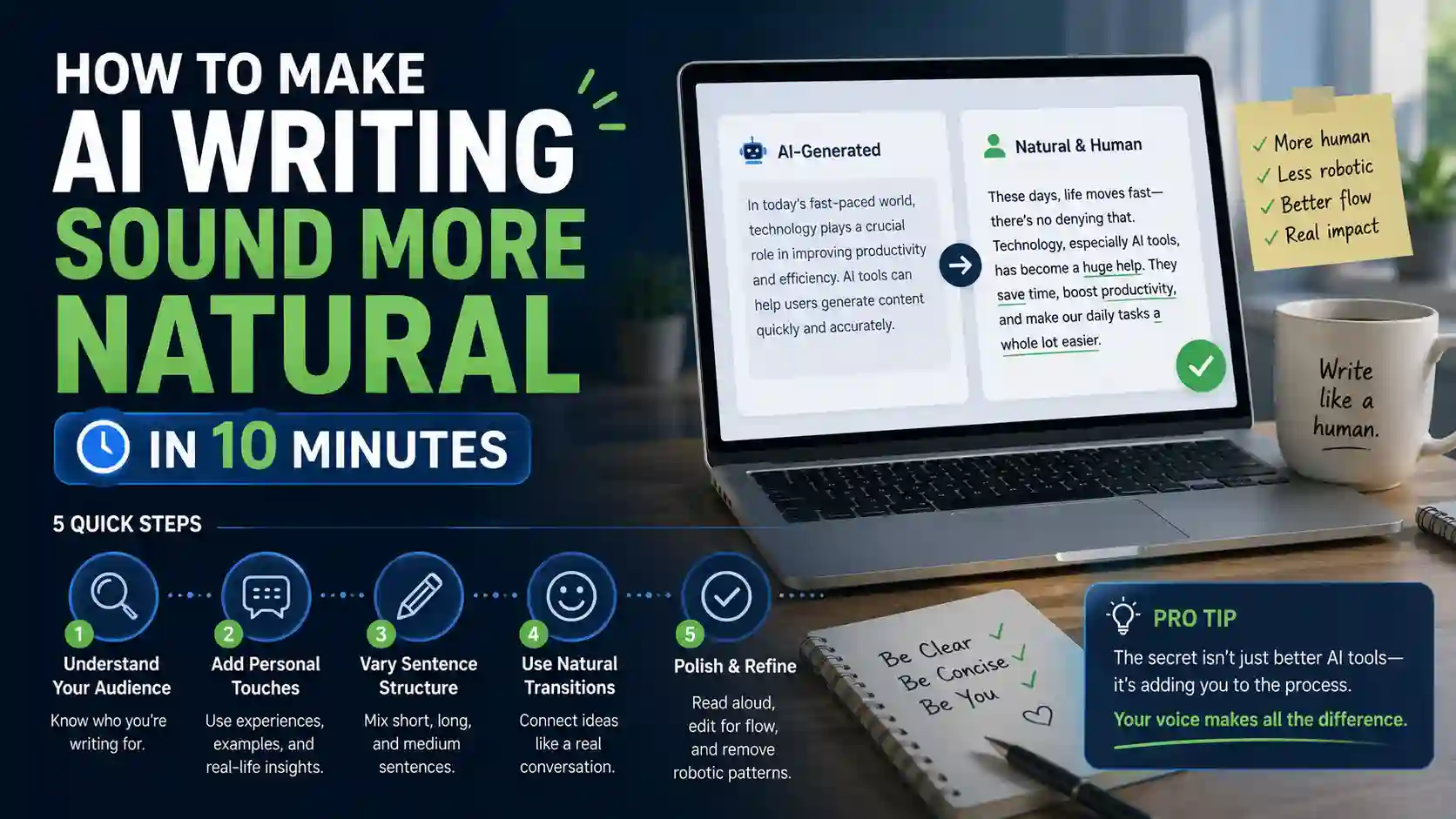
To make AI writing sound more natural in 10 minutes, do not start by rewriting every sentence. Start by fixing the signals that make AI text feel generic: vague introductions, predictable structure, repeated sentence patterns, over-polished transitions, unsupported claims, and tone that does not match the audience. In most drafts, a small number of high-impact edits makes a bigger difference than a full rewrite.
The best 10-minute process is: spend 1 minute defining the reader, 2 minutes cutting generic AI phrasing, 2 minutes adding specifics, 2 minutes varying sentence rhythm, 1 minute adding human transitions, 1 minute verifying claims, and 1 minute reading the piece aloud. If you want a faster assist, use WriteHuman as an editing partner, then review the output yourself.
Why AI Writing Sounds Like AI
AI writing usually sounds artificial because it is optimized to be complete, safe, balanced, and broadly useful. Those are helpful traits for a first draft, but they are not the same as natural writing. Real human writing has priorities. It leaves some things out. It takes a position. It names the awkward detail. It changes pace. It sometimes uses a short sentence because the point needs to land.
Research backs up the intuition that AI tools are changing writing style. A 2024 analysis of one million arXiv abstracts found a measurable shift toward ChatGPT-style language, especially in computer science, where the estimated fraction of LLM-style abstracts reached about 35% under one GPT-3.5 revision baseline. A separate study of 280,000 academic YouTube videos reported increases in ChatGPT-favored terms such as “delve” and “meticulous.” In other words, AI writing does not just sound similar by accident. It leaves statistical fingerprints in word choice and structure.
Chart 1: The Biggest AI-Writing Signals to Fix First
This editorial scoring model ranks the problems that most quickly make a draft feel less human. It is based on common AI-writing symptoms and research on AI-style language patterns.
| AI Signal | What It Looks Like | 10-Minute Fix |
|---|---|---|
| Generic opening | “In today’s fast-paced digital world…” | Start with the reader’s exact problem or a concrete situation. |
| Balanced but empty structure | Every paragraph says “not only X but also Y.” | Choose the stronger point and cut the weaker balancing phrase. |
| Vague authority | “Many experts agree…” with no example. | Name the source, stat, use case, product, reader, or mistake. |
| Over-polished transitions | “Moreover,” “Additionally,” “Furthermore” in every paragraph. | Use conversational bridges: “Here is the catch,” “That sounds fine until…” |
| Same-length sentences | Every sentence is 18 to 25 words and syntactically similar. | Split one sentence. Combine one sentence. Add one short punchline. |
| No lived detail | The advice is correct but could apply to anyone. | Add a real constraint: deadline, audience, tool, budget, objection, or consequence. |
What Natural AI Writing Actually Means
Natural AI writing is not simply “casual” writing. A natural legal memo, sales email, student reflection, software tutorial, product review, and executive summary will all sound different. The shared quality is that the writing feels intentional. It answers a specific reader, uses the right amount of detail, and sounds like a person made choices instead of letting a model average out the internet.
This matters because AI writing tools are usually trained to produce broadly acceptable prose. That makes drafts smooth, but it can also make them dull. The 10-minute goal is to move the draft from acceptable to believable. You are not trying to hide that technology helped. You are trying to make the final writing clearer, more accurate, and more useful than the raw output.
| Principle | Weak AI Draft | Natural Final Draft |
|---|---|---|
| Audience fit | Speaks to a vague group like “users,” “people,” or “businesses.” | Speaks to the exact reader’s task, fear, skill level, and next step. |
| Point of view | Lists every side evenly, even when one answer is clearly more useful. | Makes a recommendation and explains the tradeoff. |
| Specific evidence | Uses broad claims like “many studies show” or “this improves productivity.” | Names the study, number, tool, workflow, limitation, or real example. |
| Human rhythm | Every sentence has a similar length, shape, and level of polish. | Mixes short sentences, longer explanations, and natural emphasis. |
| Accountability | Sounds confident even when the claim is unsupported. | Verifies facts, limits claims, and discloses uncertainty when needed. |
The Three-Part Test
Before you publish, ask three questions. First, could this sentence have been written for any topic? If yes, it needs specificity. Second, would the target reader actually say this sentence aloud? If no, it needs voice. Third, does the paragraph give the reader something they did not already know? If no, it needs substance.
This test is simple, but it is effective because it targets the three places AI drafts usually fail: generic language, mismatched tone, and low information density. A paragraph can be grammatically perfect and still feel fake if it fails those checks.
The 10-Minute Workflow to Make AI Writing Sound Natural
This workflow works for blog posts, essays, emails, product descriptions, social posts, scripts, newsletters, and research summaries. The trick is to edit in passes. If you try to make every sentence perfect from the beginning, you waste time. If you fix the biggest AI tells first, the draft improves quickly.
Chart 2: 10-Minute Natural Writing Time Allocation
Use this like a timer. Do not over-edit during the first pass. Speed is part of the system.
Minute 0-1: Define the Real Reader
AI tends to write for “everyone.” Natural writing writes for someone. Before editing, write one sentence above the draft: “This is for [reader] who wants [outcome] but is worried about [constraint].” That sentence becomes your tone compass.
Quick reader definition
Weak: This article is for people interested in productivity.
Better: This article is for a busy freelancer who uses ChatGPT for drafts but worries clients can tell the text sounds generic.
Minute 1-3: Cut the Generic Opening
Most AI drafts waste the first paragraph warming up. Remove the obvious setup and start where the reader already is. If your first sentence could appear in 10,000 other articles, replace it.
Before and after
AI-sounding:
In today's fast-paced digital landscape, creating high-quality content is more important than ever.

Natural:
If your AI draft sounds polished but strangely empty, the problem is usually not grammar. It is a lack of judgment.
Minute 3-5: Add Specifics
Specificity is the fastest path to human-sounding writing. Add numbers, names, examples, constraints, mistakes, opinions, or sensory details. Replace “businesses” with “local service businesses.” Replace “content” with “a 900-word landing page.” Replace “improve engagement” with “get the reader to click the pricing page.”
Minute 5-7: Change Sentence Rhythm
AI tends to produce smooth, medium-length sentences. Humans vary speed. Use one short sentence after a dense idea. Combine two choppy sentences if the point is obvious. Read the paragraph aloud and listen for a marching rhythm. If every sentence lands the same way, the draft will feel machine-made even if the ideas are good.
Minute 7-8: Add Human Transitions
Replace textbook transitions with thought transitions. A thought transition shows how the writer is thinking, not just that another paragraph has arrived.
| Stiff Transition | Natural Alternative | Best Use |
|---|---|---|
| Furthermore | There is another problem. | When adding a complication. |
| Moreover | That is where the draft starts to feel fake. | When moving from fact to judgment. |
| It is important to note | The catch is… | When warning the reader. |
| In conclusion | Here is the practical takeaway. | When closing with action. |
| Additionally | One more thing helps. | When adding a small useful point. |
Minute 8-9: Verify Claims
Natural writing is not just warmer. It is more accountable. If the AI draft includes statistics, citations, product claims, legal statements, health claims, pricing, dates, or quotes, verify them. AI can sound confident while being wrong. That is the fastest way to lose trust.
Minute 9-10: Read It Aloud
Reading aloud catches problems a detector cannot: fake enthusiasm, overlong sentences, repeated structure, and tone mismatch. If you stumble, simplify. If a sentence sounds like a press release, make it direct. If a paragraph says nothing new, cut it.
Before-and-After Examples: Make AI Text Sound Human
Humanizing AI text is not about making it messy. It is about making the writing feel chosen. The examples below show how small edits change the texture of a paragraph.
Example 1: Blog Introduction
AI-sounding:
Artificial intelligence has revolutionized the way people create content, offering unprecedented opportunities for efficiency, creativity, and scalability across industries.

Natural:
AI can give you a draft in 20 seconds. The hard part is making that draft sound like it came from someone who has actually thought about the topic.
Example 2: Product Copy
AI-sounding:
Our platform empowers businesses to streamline workflows, enhance collaboration, and unlock new levels of productivity.

Natural:
Use it when your team is tired of chasing updates across Slack, spreadsheets, and five different project boards.
Example 3: Student Essay
AI-sounding:
The novel explores themes of identity, belonging, and resilience, demonstrating how characters navigate complex social environments.

Natural:
The novel is really about what happens when a person has to perform one version of themselves in public and protect another version in private.
Chart 3: What Improves Most After a 10-Minute Human Edit
This editorial model compares typical before-and-after gains after the workflow in this guide. It is a practical editing benchmark, not a detector score.
AI Phrases to Replace Immediately
Some words are not bad by themselves. “Delve” is a normal word. “Meticulous” is a normal word. The problem is clustering: AI drafts often stack the same polished terms, transitions, and generic promises until the writing feels mass-produced. Replace the phrase only when it sounds unnatural for your voice or audience.
| AI-Sounding Phrase | Why It Feels Off | Replace With |
|---|---|---|
| In today’s fast-paced world | Overused and says nothing specific. | Name the actual situation: “When you have 10 minutes before publishing…” |
| Unlock the power of | Marketing filler. | “Use,” “get,” “turn,” “build,” or a direct benefit. |
| Delve into | Often appears where “look at” is enough. | “Break down,” “look at,” “test,” “compare,” “explain.” |
| It is important to note | Delays the point. | “The catch is,” “Watch for this,” “Here is the risk.” |
| Seamlessly integrate | Sounds like vendor copy. | “Connect,” “add,” “sync,” or describe the actual workflow. |
| Robust solution | Vague compliment. | Name the feature or outcome. |
| Elevate your content | Feels like a slogan. | “Make the draft clearer,” “cut filler,” “add examples.” |
| In conclusion | Academic and predictable. | “The practical takeaway,” “Start here,” “Here is the bottom line.” |
Prompts That Make AI Writing More Natural
If you are going back to an AI tool for help, do not ask it to “make this human.” That prompt is too vague and often creates fake casualness. Ask for specific editing behavior.
Prompt 1: Natural rewrite without changing meaning
Rewrite this paragraph so it sounds more natural and less generic. Keep the meaning, remove filler, vary sentence length, and add one concrete detail where the current wording is vague. Do not add facts that are not in the original.
Prompt 2: Voice matching
Edit this draft for a practical, expert tone. The reader is [specific reader]. Make it direct, warm, and useful. Remove phrases that sound like marketing copy. Keep the reading level clear and professional.
Prompt 3: Sentence rhythm pass
Only edit sentence rhythm. Keep the ideas the same, but vary sentence length, split overlong sentences, combine choppy ones, and make the paragraph easier to read aloud.
Do not use prompts that ask for deception. Avoid instructions like “bypass AI detection” or “make this impossible to detect.” That frames the work as evasion. Better prompt: “Make this clearer, more specific, and more natural while preserving accuracy.”
How to Make Different Types of AI Writing Sound Natural
The same editing rule will not work for every format. A blog post needs examples and structure. A client email needs clarity and tact. A product page needs concrete benefits. A student reflection needs real understanding. Use the table below to choose the fastest fix for the type of draft in front of you.
| Content Type | Typical AI Problem | Fastest Natural Fix | One-Line Prompt |
|---|---|---|---|
| Blog post | Generic intro, predictable headings, thin examples. | Add a specific reader problem, a real scenario, and one opinionated recommendation. | Rewrite this for a reader who wants a practical answer, not a broad overview. |
| Too polished, too long, or too formal for the relationship. | Cut the setup, state the request, and make the tone match the recipient. | Make this email shorter, warmer, and more direct without changing the request. | |
| Product copy | Overuses words like “empower,” “unlock,” and “seamless.” | Replace abstract benefits with the exact workflow or pain point. | Turn vague benefits into specific outcomes a buyer can picture. |
| Academic draft | Overgeneralized claims and textbook-style transitions. | Clarify the thesis, define terms, and connect claims to evidence. | Improve clarity and argument flow, but do not add unsupported claims. |
| Social post | Sounds like a mini essay instead of a human observation. | Lead with the tension, shorten the sentences, and remove filler. | Make this sound like a concise post from a person with a clear point of view. |
| Script | Looks fine on screen but sounds stiff when spoken. | Read aloud, cut formal words, and add spoken transitions. | Edit this for spoken delivery. Make it clear, natural, and easy to say. |
For Blog Posts: Add a Reader-Specific Angle
Blog content sounds natural when the writer knows what the reader is trying to do. Instead of writing “AI can help with content creation,” write “AI can get you to a workable draft quickly, but it will not know the client objection you hear every sales call.” That sentence has a reader, a context, and a useful distinction.
The same principle applies to technical product content. A review of an API, hosting stack, or infrastructure decision should include concrete workflow details rather than generic benefits. For a good example of specific, operational writing, see the Doola Formation API review and the infrastructure analysis in AI data centers and the environment.
For Emails: Remove the Performance
AI-written emails often overperform politeness. They say too much before they ask for anything. Natural email writing respects the reader’s time. Start with the reason for the message, add only the context needed, and make the next step obvious.
For Academic or Professional Work: Keep the Accuracy
Do not “humanize” academic or professional writing by making it vague, chatty, or less precise. The better move is to improve argument flow, remove filler, and make the logic easier to follow. Keep citations, definitions, and caveats intact.
AI Detection, Disclosure, and the Ethical Line
Many people search for ways to make AI writing sound natural because they are worried about AI detectors. That concern is understandable, but detector avoidance should not be the goal. Independent research has found that detection tools can be inconsistent, vulnerable to paraphrasing, and unfair to some writers. One study tested 14 tools and concluded they were not accurate or reliable enough for high-stakes decisions. Another found that non-native English essays were much more likely to be flagged by GPT detectors.
The practical lesson is not “detectors are useless, so anything goes.” The lesson is that your best protection is responsible writing practice: understand the content, verify the claims, follow the relevant policy, and keep the final draft aligned with your own thinking. If a school, employer, client, or publisher requires disclosure of AI assistance, disclose it. If AI assistance is not allowed for the task, do not use it.
Those rules are becoming especially important in education and research. If you are a student, start with the current policy landscape in AI detection policies at 50 leading U.S. universities. If you are writing for publication or research, compare your workflow against the risks in AI-generated research papers: 2026 statistics on retractions, peer review, and journal policies.
Ethical Humanizing
- Editing your own AI-assisted draft for clarity.
- Making tone fit the reader and publication.
- Removing filler and improving structure.
- Checking facts, citations, dates, and claims.
- Disclosing AI help when required.
Risky or Deceptive Use
- Submitting work you do not understand.
- Hiding plagiarism or copied material.
- Fabricating sources, quotes, or statistics.
- Breaking a school, workplace, or publisher policy.
- Using a rewrite tool only to defeat detection.
A strong final draft should be able to survive a simple conversation. If someone asks why you made a claim, you should know the source. If they ask why the paragraph is structured a certain way, you should be able to explain the logic. That is the real difference between natural writing and polished text that only looks complete.
Institutions are also discovering that enforcement has a cost. For the procurement and staffing side of AI writing detection, see how much universities spend on AI detection tools.
Using WriteHuman to Make AI Writing Sound Natural
WriteHuman is useful when you have a draft that is factually correct but sounds stiff, generic, or too obviously machine-shaped. The best workflow is not to paste a draft and publish the output instantly. Use it as a revision layer, then do a human final pass for accuracy, voice, and policy compliance.
Make AI Drafts Sound More Like You
Use WriteHuman to smooth robotic phrasing, improve flow, and make your draft easier to read. Then review every claim, adjust the voice, and keep the writing aligned with your rules or client brief.
Best Uses
- Making a draft less generic.
- Improving rhythm and readability.
- Rewriting stiff AI paragraphs.
- Creating a more natural tone for blogs, emails, captions, and summaries.
Bad Uses
- Hiding plagiarism.
- Submitting schoolwork against policy.
- Masking fake citations or fabricated claims.
- Publishing text you did not verify or understand.
Chart 4: Best Use Cases for Humanizing AI Writing
Higher scores indicate safer, more productive use cases for AI-humanizing tools when paired with human review.
Final 60-Second Checklist Before You Publish or Submit
After the 10-minute edit, run one final check. This is where you catch the problems that make AI writing feel unnatural or risky.
| Question | Pass Standard | Fix If It Fails |
|---|---|---|
| Does the first paragraph address the reader’s actual problem? | The reader knows immediately why the piece exists. | Cut the warm-up and start with the pain point. |
| Could this paragraph appear in any article on the internet? | It contains a specific example, opinion, or detail. | Add a real use case, number, product, mistake, or constraint. |
| Do the sentences all sound the same? | There is a mix of short, medium, and longer sentences. | Split one sentence and add one short sentence after a key point. |
| Are claims verified? | Stats, quotes, prices, and citations are checked. | Remove or verify every unsupported claim. |
| Does the tone fit the audience? | Professional for work, clear for students, persuasive for marketing. | Rewrite one paragraph as if speaking to that exact reader. |
| Does policy require disclosure? | You know the rule for your school, employer, publisher, or client. | Disclose AI assistance where required. |
Want the Fastest Natural Rewrite?
Run your draft through WriteHuman, then use the checklist above for the final human pass. That combination is faster and safer than blindly publishing a raw AI rewrite.
Frequently Asked Questions
How do I make AI writing sound more natural in 10 minutes?
Use a timed edit: define the reader, cut the generic opening, add concrete details, vary sentence rhythm, replace stiff transitions, verify claims, and read the final draft aloud. Focus on the biggest AI tells first rather than rewriting every line.
What words make writing sound like ChatGPT?
No single word proves AI use, but overuse of phrases like “delve,” “unlock,” “seamless,” “robust,” “in today’s fast-paced world,” “it is important to note,” and “in conclusion” can make writing feel generic. Replace them when they do not fit your natural voice.
Can AI detectors tell if I used ChatGPT?
AI detectors can sometimes identify obvious AI-generated text, but independent research shows they are unreliable in high-stakes settings, especially with paraphrased text, mixed human-AI drafts, and non-native English writing. Do not treat detector scores as perfect proof.
Is it ethical to use a humanizer tool?
It is ethical when you use it to improve clarity, readability, or tone on work you are allowed to edit with AI assistance. It is not ethical if you use it to hide plagiarism, fabricate sources, bypass a policy, or submit work you do not understand.
Does WriteHuman replace human editing?
No. WriteHuman can speed up the revision process, but you should still review the output for meaning, accuracy, voice, and policy requirements.
Final Takeaway: Natural Writing Sounds Chosen
The fastest way to make AI writing sound natural is to add human choice back into the draft. Choose the reader. Choose the point. Choose the detail. Choose the rhythm. AI can give you a clean first pass, but natural writing comes from judgment.
Use tools like WriteHuman to speed up the middle of the process, then finish the work yourself. The final pass is where the draft stops sounding like a generated answer and starts sounding like communication.
Sources and Further Reading
The source links are grouped by topic. Click each accordion to expand the full list.
View AI writing style and language-change sources
View AI detection and false-positive sources
- Weber-Wulff et al.: Testing of Detection Tools for AI-Generated Text
- Liang et al.: GPT detectors are biased against non-native English writers
- Artificial intelligence content detection overview and accuracy concerns
- Washington Post: Why honest students fear AI detectors
- Tech & Learning: Some AI detection tools work well, others fail