How to Start an Anonymous LLC
By JoshWP Team | Updated: | ~28 min read | Privacy LLC Wyoming Asset Protection Non-US Friendly
An “anonymous LLC” is a limited liability company formed in a state that does not put member or manager names on public formation records. In practice, that usually means Wyoming, New Mexico, or Delaware for public-record privacy. Your name can stay off the Secretary of State database that private investigators, competitors, and casual searchers use — but banks, the IRS, payment processors, courts with valid process, and some counterparties can still require real ownership information. Privacy from the public is not the same thing as invisibility from government, banks, or law enforcement.
The cleanest privacy stack used by real estate investors, online founders, agencies, and non-US residents looks like this: form a Wyoming (or New Mexico) holding LLC with a commercial registered agent, keep ownership in a private operating agreement, optionally layer a local operating LLC owned by the holding company, get an EIN, open business banking with Payoneer or Wise, and never commingle personal and business money. As of March 2025, FinCEN’s interim final rule generally removed beneficial ownership information (BOI) reporting for domestic U.S. companies — a major shift that reduced one federal filing burden for many U.S. LLCs (foreign entities registered in the U.S. may still have obligations).
Non-negotiable: An anonymous LLC is for legal privacy and asset-structure planning — not tax evasion, fraud, hiding assets from existing creditors, or illegal activity. You still file taxes, keep records, and obey applicable law. The IRS and banks generally still know who you are even when the public does not.
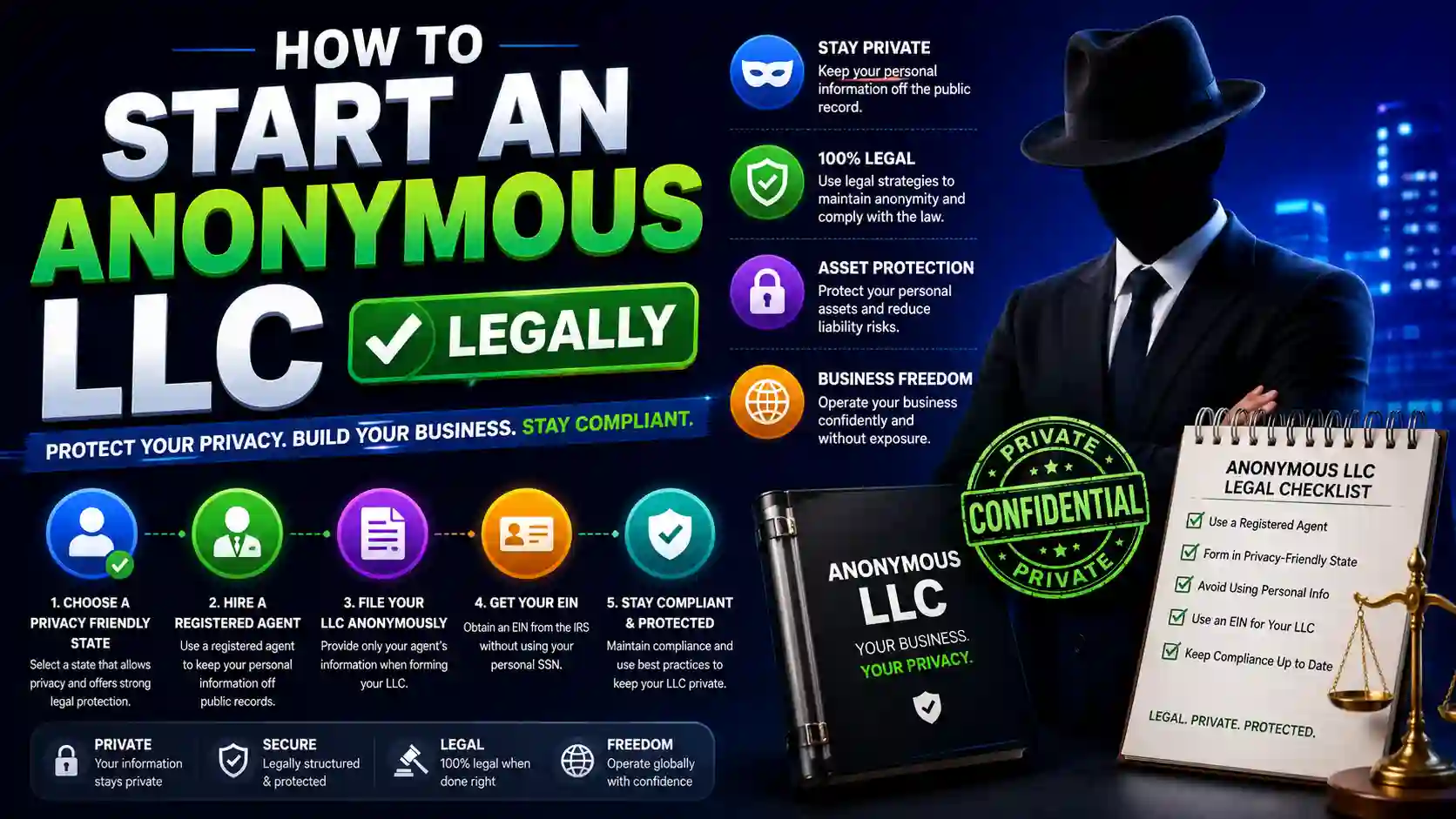
Table of Contents
- What an anonymous LLC really is
- Who actually needs privacy
- What anonymity does and does not hide
- FinCEN BOI update (March 2025)
- Best states for privacy LLCs
- Two-tier holding + operating structure
- Why the registered agent matters
- Complete formation roadmap
- Form the Wyoming holding LLC (screenshots)
- What you receive after approval
- Set up the local/child LLC
- Operating agreements (private ownership proof)
- Business banking: Payoneer vs Wise
- Tax, compliance, and foreign-owned LLCs
- Cost breakdown and charts
- Mistakes that destroy privacy
- Final privacy checklist
- FAQs
- Sources
What Is an Anonymous LLC?
An anonymous LLC (also called a privacy LLC, confidential LLC, or private-membership LLC in marketing language) is an LLC formed so that member and manager names are not required on the public Articles of Organization or equivalent formation document. When someone searches the Secretary of State database, they typically see the company name, filing date, status, registered agent, and sometimes a business or mailing address — not your personal identity.
Wyoming is often called the modern pioneer of this model (privacy-oriented LLC rules popularized in the 2010s). New Mexico is known for extreme filing simplicity and no annual report for many LLCs. Delaware generally does not list members/managers on public formation records either, but it is usually chosen for corporate law infrastructure and venture-backed structures rather than low-cost personal privacy.
Plain English: “Anonymous” means anonymous to casual public records searchers. It does not mean anonymous to banks, tax authorities, or a court with a valid subpoena. Treat the word as marketing shorthand for public-record privacy.
People use privacy LLCs for legitimate reasons: real estate holdings that should not put a homeowner’s name on every county search, online businesses that attract stalkers or competitors, high-net-worth individuals reducing solicitation and lawsuit targeting, content creators monetizing through YouTube and Google AdSense LLC structures, and non-US founders who want a clean U.S. entity without advertising personal residence data. For a broader non-resident formation overview, see how to form an LLC for non-US residents.
Who Actually Benefits From an Anonymous LLC?
Strong fit
- Real estate investors holding rentals or flips in entities
- Online businesses, SaaS, agencies, and ecommerce brands
- Creators and publishers who prefer brand names over personal names
- Founders who receive threats, harassment, or competitive doxxing risk
- Non-US residents forming a U.S. company for banking, clients, or platforms
- People building multi-entity holding/operating structures
Often overkill or the wrong tool
- Someone already operating only in a state that requires foreign qualification and local disclosure anyway
- Founders who will put their full name on every public website, invoice, and social profile
- People trying to hide from current creditors, divorce courts, or tax authorities
- Businesses that need venture capital, complex equity, or IPO paths (Delaware C-corp is often better)
- Anyone unwilling to keep books, bank accounts, and operating agreements clean
U.S. business applications tracked by the Census Bureau’s Business Formation Statistics have remained elevated relative to pre-2020 baselines for years, with millions of EIN-related applications annually across entity types. LLCs dominate many state formation dockets because they combine liability separation, flexible ownership, and pass-through taxation by default. Privacy is one common motive among real estate and online operators, but exact “privacy motive” percentages are not published in a single federal series — motives are not uniformly reported on state filings.
What Anonymity Hides — and What It Does Not
Leaving nothing out means being honest about the limits. Marketing pages sometimes imply total invisibility. That is not accurate.
| Party / System | Usually sees your name? | Why |
|---|---|---|
| State public LLC search (WY/NM style) | Often no | Members/managers not required on articles in privacy-friendly states. |
| Commercial registered agent listing | Shows agent, not you | Agent’s office address appears as the service-of-process address. |
| Private operating agreement | Yes (private file) | This is your ownership proof; it is not filed with the state. |
| IRS / EIN application | Yes (responsible party) | Form SS-4 requires a responsible party with a TIN where applicable; IRS knows the business. |
| Banks & fintech KYC (Payoneer, Wise, banks) | Yes | Customer due diligence requires beneficial owners and controllers. |
| Payment processors / marketplaces | Often yes | Beneficial owner and identity checks are standard compliance practice. |
| Courts with valid process | Yes, if compelled | Privacy is not a shield against lawful discovery or judgment enforcement. |
| Home-state foreign qualification (if required) | Depends on state | Doing business in a disclosure state can re-introduce public filings. |
| Property title / county records | Shows LLC name | Asset is titled in the LLC; ownership of the LLC may still be private at state level. |
| FinCEN BOI (post March 2025 interim rule) | Generally no for domestic companies | Domestic reporting companies broadly exempted; foreign entities registered in the U.S. may still report. Verify current FinCEN guidance. |
Important distinction: If you live and operate in a state like Florida, California, New York, or Ohio, simply forming a Wyoming LLC does not always mean you can ignore home-state registration. If you have physical presence, employees, or regular in-state operations, you may need to foreign-qualify. That is exactly why many privacy planners use a two-tier structure (Wyoming holding LLC owns the local operating LLC).
FinCEN Beneficial Ownership (BOI) Reporting: What Changed in March 2025
The Corporate Transparency Act originally required many companies to report beneficial owners (generally people who own or control 25%+ or exercise substantial control) to FinCEN’s BOI database. After court challenges and policy shifts, FinCEN issued an interim final rule in March 2025 that significantly narrowed the rule for domestic entities.
Practical takeaway for most U.S. LLCs: Companies formed under U.S. state or tribal law are generally no longer required to file BOI reports under that interim final rule. Foreign entities formed abroad and registered to do business in the U.S. may still have reporting obligations. Always confirm the current text on fincen.gov/boi because interim rules and guidance can evolve.
What this means for anonymous LLC planning:
- Public-record privacy (state SOS databases) and federal BOI were always different systems. BOI was never a public phone book.
- The March 2025 change reduced a major compliance task for many domestic founders, but it did not create new public anonymity by itself.
- Banks still run KYC/CDD. Payment processors still verify beneficial owners. Tax filings still exist.
- If your structure includes foreign entities registered in the U.S., do not assume the domestic exemption applies to every entity in the chart.
Best States for an Anonymous / Privacy LLC
Only a handful of states are routinely recommended when the goal is keeping members and managers off public formation records. Below is a balanced comparison — strengths and tradeoffs included.
| Factor | Wyoming | New Mexico | Delaware |
|---|---|---|---|
| Public member listing on articles | Not required | Not required | Not required |
| Typical formation state fee | About $100 | About $50 | About $90 |
| Ongoing state cost | ~ $60 min annual report | No annual report for many LLCs | $300 annual franchise tax (LLC) |
| State income tax | None | State income tax system applies | No personal income tax; franchise tax applies |
| Asset protection reputation | Very strong charging-order framework | Good privacy; less AP fame | Strong corporate law / Chancery Court |
| Series LLC | Available | Less common focus | Available (with nuances) |
| Best for | Privacy + protection + holding companies | Lowest ongoing cost privacy | VC, complex entities, prestige law |
| Downsides | Annual report; not magic vs home-state nexus | Weaker “AP brand,” different tax environment | Higher ongoing cost for small operators |
Wyoming — privacy gold standard for many founders
Pros: No member/manager names on articles, no state income tax, strong charging-order reputation, series LLCs, low annual report, popular holding-company jurisdiction for non-residents and real estate planners.
Cons: Annual report required; if annual reports list managers/members in a given year, privacy-conscious filers often use careful structuring and commercial agent addresses. Home-state foreign qualification may still apply.
New Mexico — simplest ongoing privacy
Pros: Low formation cost, no annual report for many LLCs, strong public-record privacy footprint, “file once and maintain lightly” appeal for basic holding structures.
Cons: Less celebrated for aggressive asset-protection planning than Wyoming; operating businesses must still evaluate gross receipts tax and nexus; fewer sophisticated series/AP tools in common practice.
Delaware — prestige, not cheap privacy
Pros: Mature LLC statute, Court of Chancery expertise, investor familiarity, members/managers generally not on public formation documents.
Cons: Higher annual franchise tax (~$300 for many LLCs), less attractive for small privacy-only setups compared with Wyoming or New Mexico.
Practical recommendation for most privacy-focused small businesses: Wyoming for the holding company if you want the best blend of privacy, reputation, and asset-protection statutes. New Mexico if lowest ongoing state friction is the priority. Delaware if investors or complex governance matter more than annual cost. Compare formation providers in our guide to the best LLC formation services for non-US residents.
The Two-Tier Structure: Holding LLC + Local Operating LLC
If you live or operate in a state that publicly discloses members or managers, forming only a local LLC can put your name on the public record. The gold-standard privacy architecture is a two-entity stack:
- Parent / holding LLC in Wyoming (or New Mexico) — your personal ownership lives here, off public records, documented in a private operating agreement.
- Child / operating LLC in your home or operations state — owned by the holding LLC, not by you personally on the public filing.
When someone looks up the local operating company, they see the Wyoming holding company as the member. When they look up the Wyoming company, they hit a registered agent address and a privacy wall. That is the “double wall” public-record design.
Form Wyoming holding LLC
Generic name, commercial registered agent address, EIN, private single-member operating agreement naming you as the 100% member.
Form local operating LLC
Member-managed (or as required), list the holding LLC as the member (company name + “LLC”), use holding-company address where allowed, get a separate EIN if needed.
Private paper trail
Operating agreements for both entities. Child OA lists holding LLC as member; you sign as manager/authorized person of the holding LLC.
Separate banking & books
Each entity keeps its own accounts, contracts, and records. Commingling is how privacy and limited liability both collapse.
Not always required: If you only need a single holding vehicle and you do not operate in a high-disclosure home state, one Wyoming or New Mexico LLC may be enough. Two tiers add cost (two formations, two EINs, two agents if multi-state, two sets of books). Use complexity only when it solves a real public-record problem.
Why a Commercial Registered Agent Matters
Every LLC needs a registered agent with a physical street address in the formation state to receive service of process and official mail. You can be your own registered agent in many states — but if you do, your name and address often become the public face of the company, which defeats the purpose of an anonymous LLC.
A commercial registered agent keeps a professional office on the public record. Better privacy-oriented providers also let you use their address for certain public-facing company address fields, so a private investigator’s first stop is an agent suite — not your home.
Northwest Registered Agent is frequently chosen for privacy work because of long-running registered agent operations, transparent pricing (commonly advertised around $39 plus state fees for formation packages), and a privacy-first product posture. For a deeper vendor analysis, read our Northwest Registered Agent review.
Form the Privacy LLC First, Then Wire Banking
Get the entity and registered agent correct before you open Payoneer, Wise, Stripe, PayPal, or marketplace accounts. Document consistency is everything.
Complete Anonymous LLC Roadmap
Choose structure
Single privacy LLC vs two-tier holding + operating stack based on where you live and operate.
Pick privacy state
Wyoming (default for many), New Mexico (lowest ongoing filings), or Delaware (investor-heavy cases).
Hire commercial registered agent
Never put your home address on public filings if privacy is the goal.
File holding LLC
Use a neutral company name, generic business purpose if appropriate, agent addresses on public fields.
Get EIN
Required for banking, taxes, and most platforms. Non-US persons can obtain EINs without SSN/ITIN via IRS process.
Draft private operating agreement
This is where real ownership is proven. Keep it offline/private.
Form child LLC if needed
List holding LLC as owner on the local filing.
Open business banking
Payoneer and/or Wise for many non-residents and online businesses; traditional banks when eligible.
Separate finances forever
No personal Netflix on the business card. Commingling pierces both privacy and the corporate veil.
Maintain compliance
Annual reports, registered agent renewals, taxes, bookkeeping, and state foreign qualifications if required.
Watch: Video Guide
Recommended watch: This video provides a helpful walkthrough of How to Start an Anonymous LLC and complements the information covered in this guide.
Form the Privacy LLC First, Then Wire Banking
Get the entity and registered agent correct before you open Payoneer, Wise, Stripe, PayPal, or marketplace accounts. Document consistency is everything.
How to File a Wyoming Anonymous LLC with Northwest (With Screenshots)
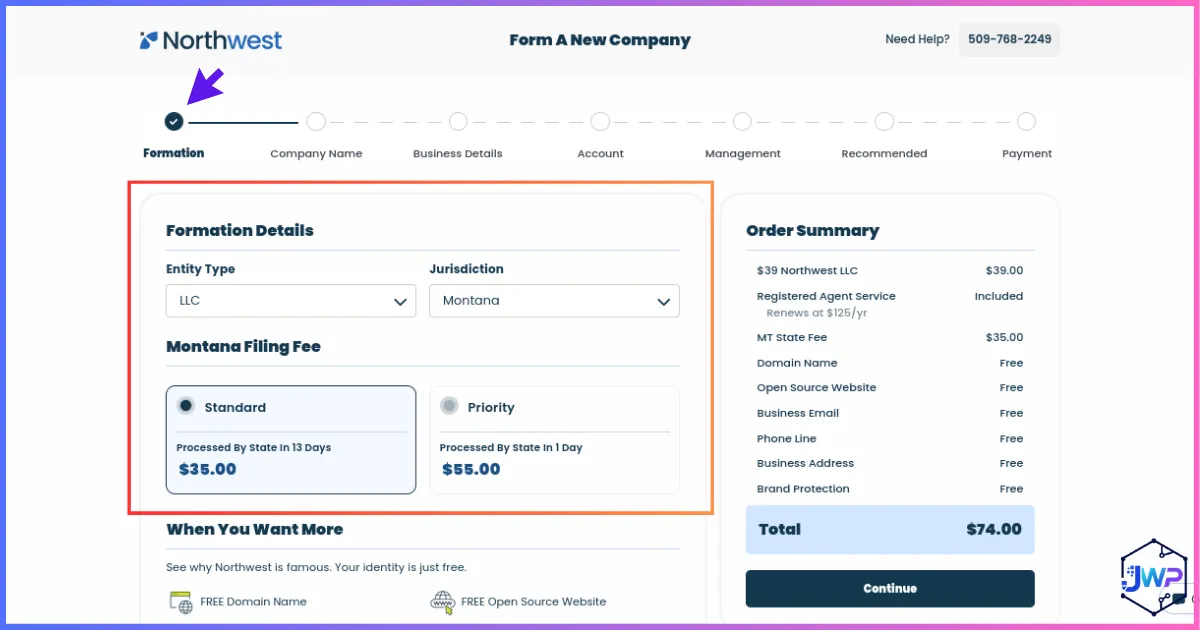
This walkthrough follows a privacy-first Wyoming formation using Northwest Registered Agent. Pricing and screens change; treat the screenshots as a practical map, not a frozen checkout guarantee. Typical checkout shows a base service fee plus Wyoming’s state filing fee (often shown around $104 in product flows — confirm live pricing at order time).
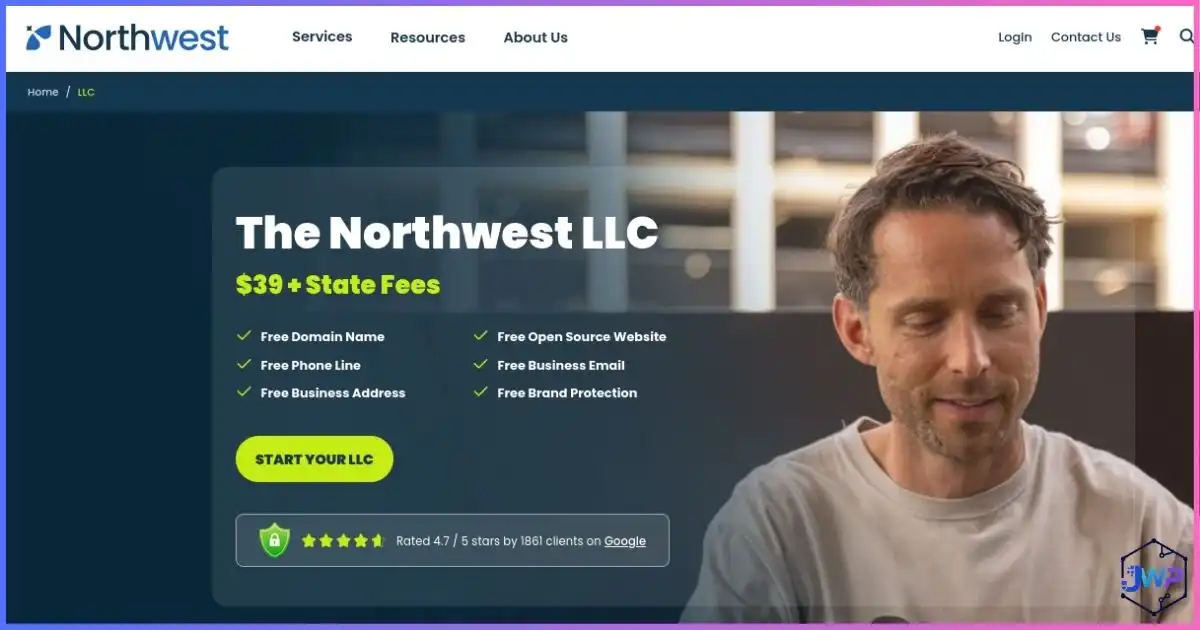
Northwest Registered Agent is commonly used for privacy-friendly LLC formation because you can keep a commercial agent address on public records instead of your home address.
Before you click “Get started”
- Choose a company name that is not obviously tied to your personal brand if privacy is the point (e.g., a neutral holding name rather than “YourName Real Estate LLC”).
- Decide member-managed vs manager-managed (many single-member privacy setups stay member-managed).
- Plan to add EIN service if you want the provider to handle tax ID acquisition.
- Use an email address you will keep for years — formation, banking, and tax mail follow that identity.
Step 1 — Formation details
Select LLC as the entity type and Wyoming as the jurisdiction. Confirm the package fee and Wyoming state filing fee before continuing. This is where your privacy-state choice is locked in.
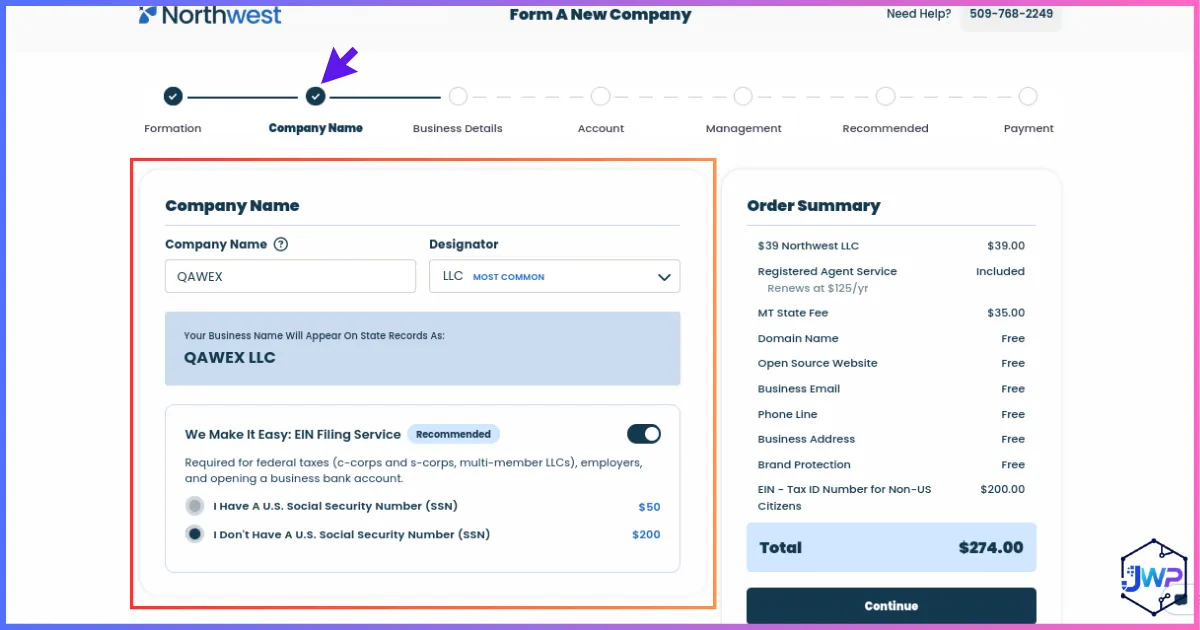
Step 2 — Company name & EIN option
Enter a unique company name. EIN service is optional but strongly recommended if you need banking, platforms, or tax filings quickly. You can apply for an EIN yourself via IRS Form SS-4, but many founders prefer guided filing.
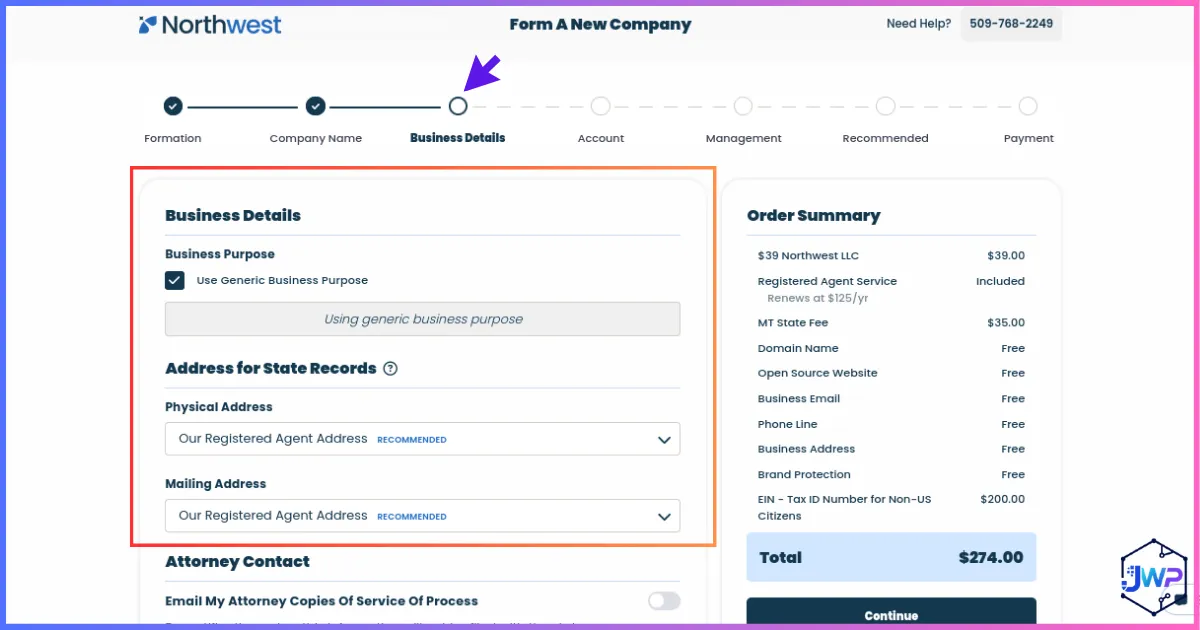
Step 3 — Business details
You can describe a real business purpose or use a generic lawful-purpose option where offered. For public addresses, select the registered agent address for physical and mailing addresses recorded with the state to keep your home off the filing.
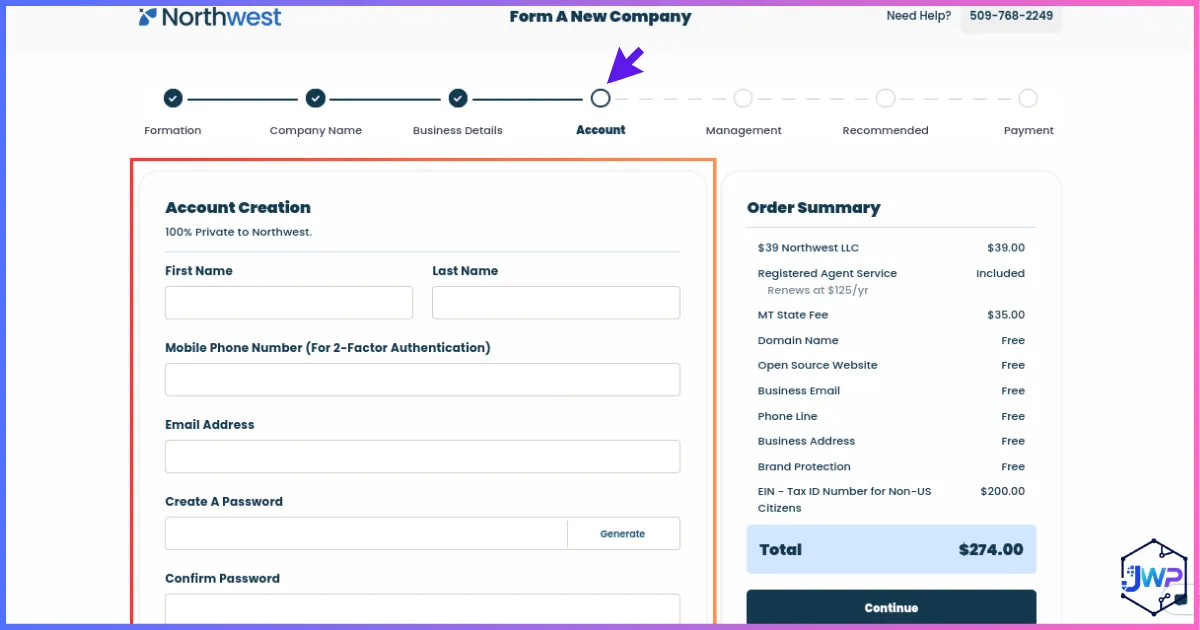
Step 4 — Account creation
Create your Northwest login with a durable email and strong password. Formation documents, scanning, and renewals will live in this dashboard. Enable 2FA if available.
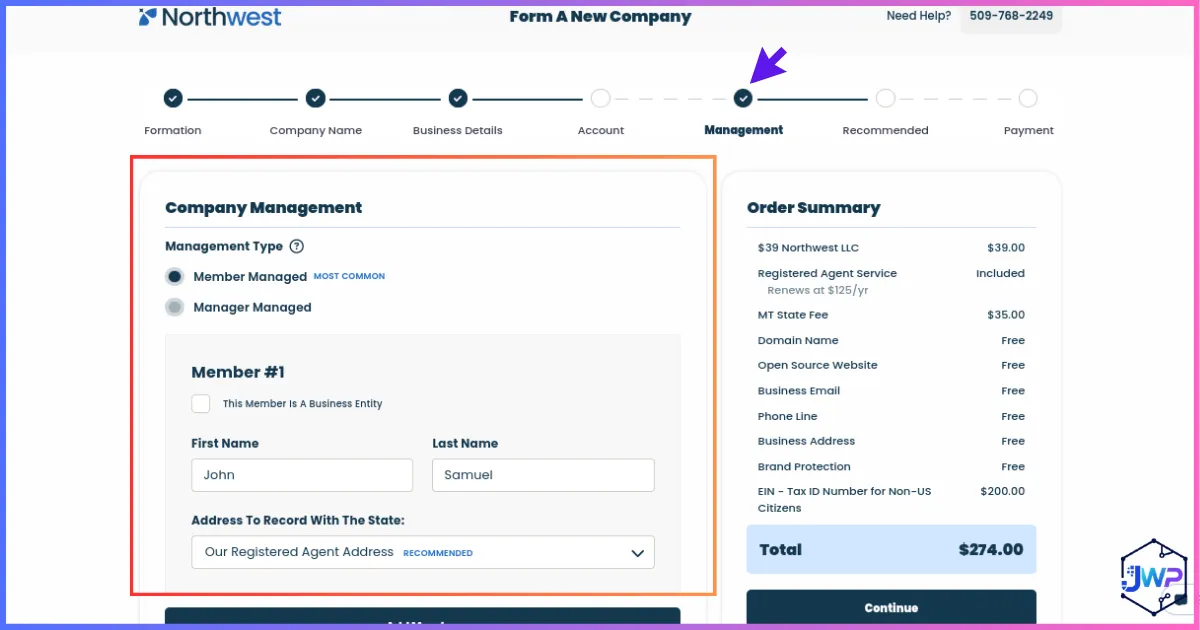
Step 5 — Company management details
In Wyoming, member/manager names you provide for internal formation workflows are not placed on public Articles of Organization the way they are in many other states. Still, use consistent information that matches your private operating agreement and future bank KYC. Using the registered agent address here is the privacy-preserving default.
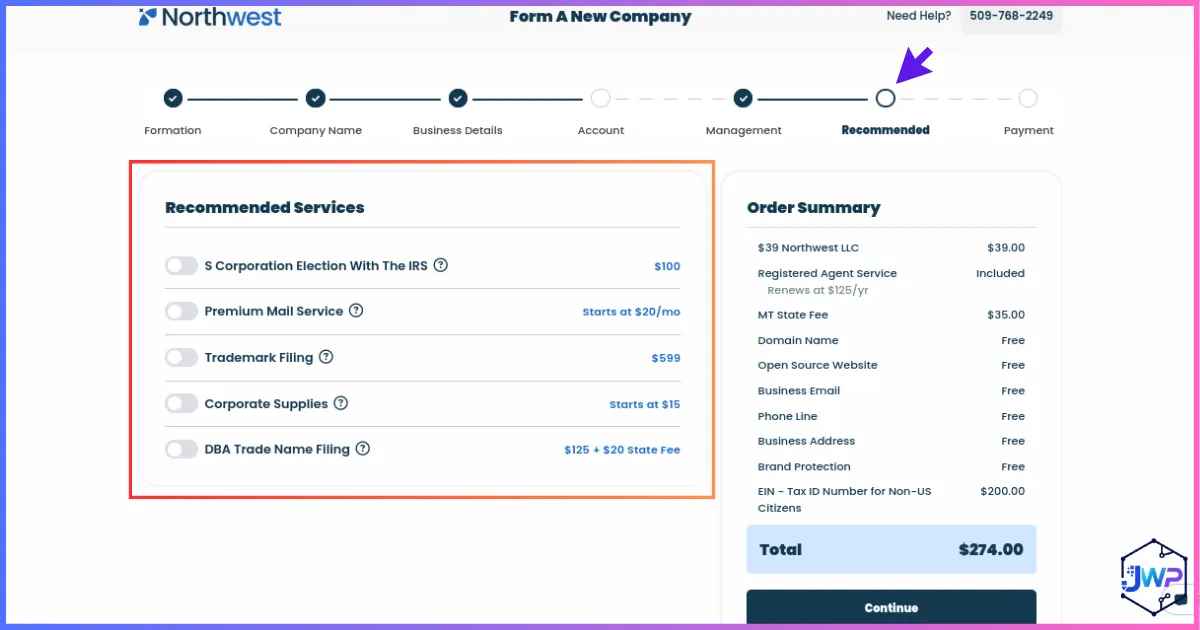
Step 6 — Optional / recommended services
Add EIN if you need it. Premium mail scanning and other add-ons are optional. Buy only what supports banking and compliance; ignore vanity extras.
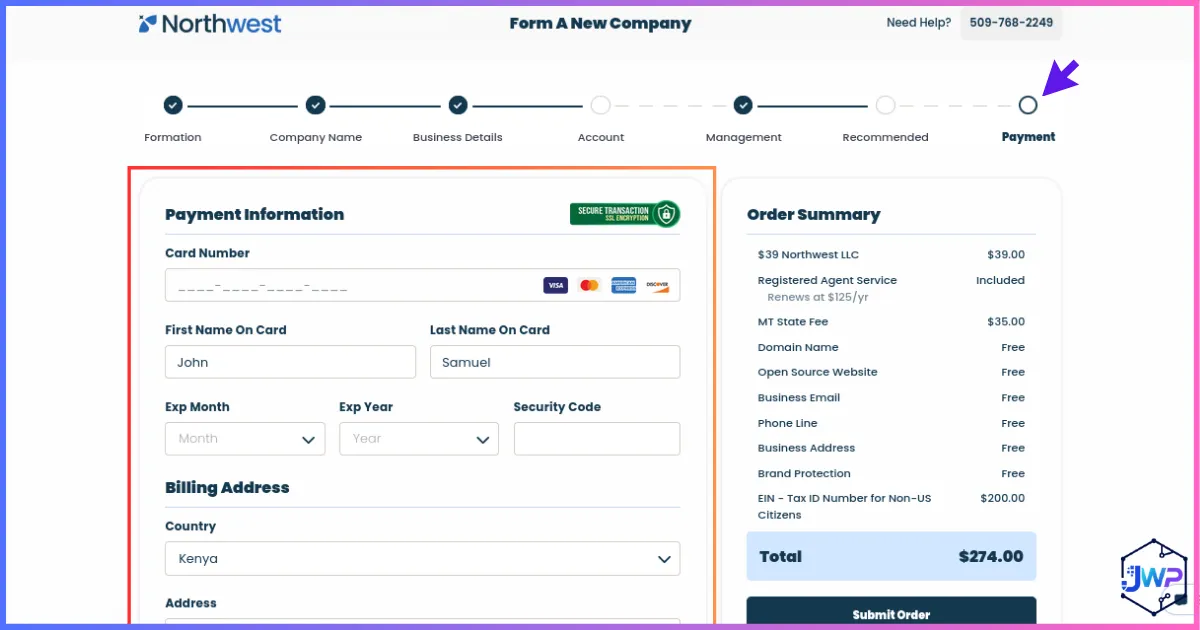
Step 7 — Payment
Review state fees, service fees, and renewals. Keep the receipt with your company records. After payment, Northwest files with the state and processes any EIN request on the timeline they quote (formation is often measured in business days; EIN timing varies).
What You Receive After Approval
Once the state accepts the filing and any EIN work completes, your company kit typically includes:
Articles of Organization
The LLC’s “birth certificate.” In a Wyoming privacy filing, this public document should not list your personal name as a member/manager the way high-disclosure states do.
Registered agent address
Your official Wyoming service-of-process address through the commercial agent — the address strangers see first.
Company dashboard
Document storage, renewals, mail, and compliance tools inside the formation provider account.
EIN confirmation
Your federal Employer Identification Number for banking, taxes, contractors, and platforms. Guard this like a business SSN.
At this point you have a legal holding vehicle. Next, either stop here (single-entity privacy setup) or build the local operating layer owned by this company.
How to Set Up the Local / Child LLC Owned by Your Holding Company
When forming the operating LLC in your home or operations state (Florida, Texas, etc.), the critical privacy move is listing the holding LLC as the member, not yourself as an individual on the public filing.
Using Northwest again for consistency:
- Start a new formation order and choose your local state instead of Wyoming.
- Use an operating brand name appropriate for customers (this can be more public-facing than the holding name).
- Use generic or accurate business purpose language that matches real activity.
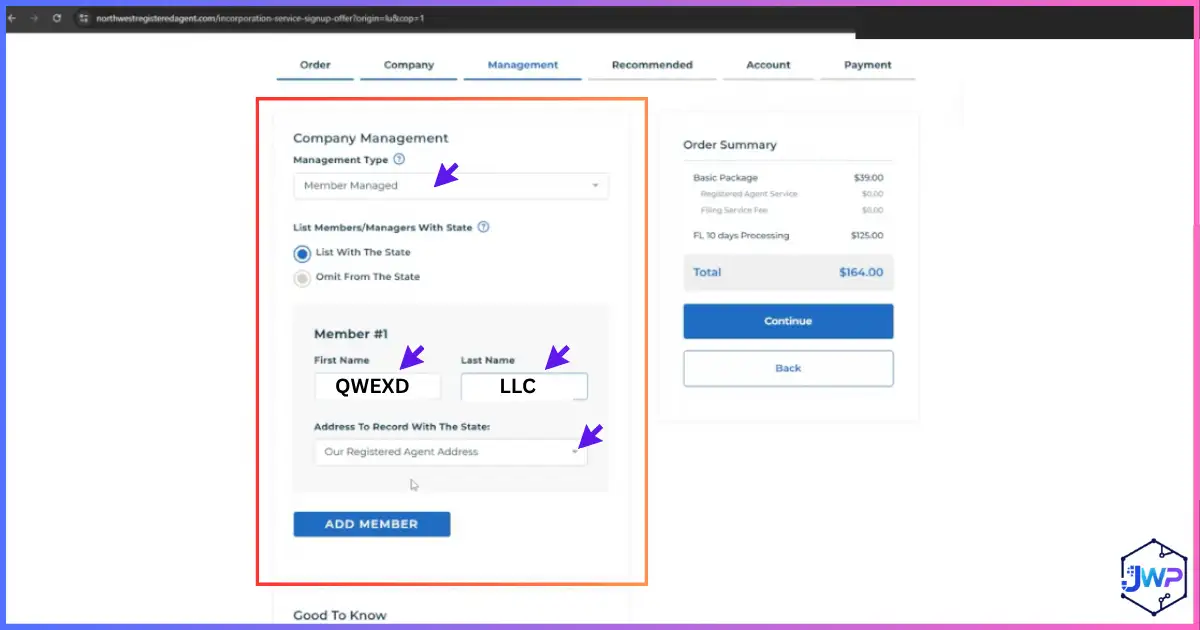
- In management, select member-managed when you want an LLC to own the LLC (confirm with your provider/state rules).
- For the member name fields, enter the holding company name as the first name and LLC as the second name/suffix pattern your form requires.
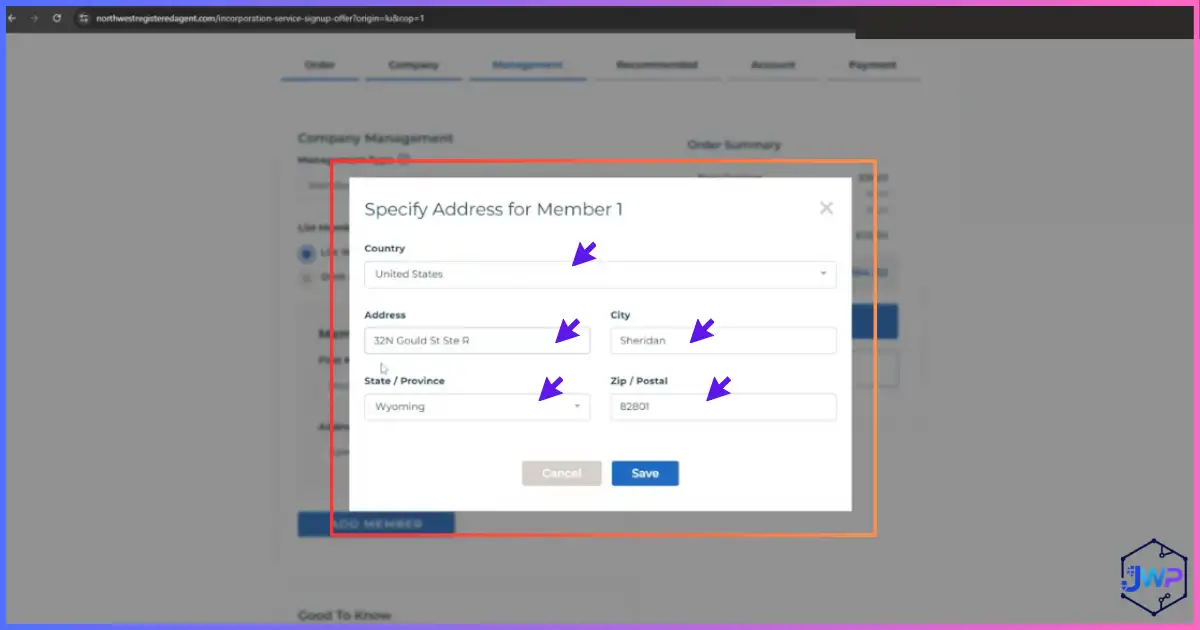
- For address-to-record fields, choose specify address and enter the holding LLC’s registered agent address, not your personal home address.
- Obtain a separate EIN for the child LLC if it will bank, contract, or tax-file separately.
Child LLC — member is the holding company
In the management section, choose the member-managed option, then add your holding LLC name as the first name and “LLC” as the second name so the public member is the entity, not you personally.
Child LLC — use holding company address
Under address to record with the state, click specify address and enter your holding LLC’s address (often the Wyoming registered agent address) instead of defaulting to a personal address.
Result: Public searchers of the local LLC find a Wyoming (or other privacy-state) company as owner. Public searchers of that holding company find a registered agent — not your home. Your private operating agreements complete the ownership chain for banks and courts when needed.
Operating Agreements: Where Real Ownership Lives
Everything above keeps your name off public state records. You still need a way to prove ownership to a bank, buyer, court, or tax professional. That document is the operating agreement — a private internal contract that is generally not filed with the Secretary of State.
Holding LLC operating agreement
- Use a single-member template if you own 100%
- List your real legal name as the member
- State ownership percentage (e.g., 100%)
- Use broad lawful business purpose language if appropriate
- Sign and store securely offline and encrypted
Child LLC operating agreement
- Member = holding LLC name (not you personally)
- You sign as manager/authorized person of the holding LLC
- Title line should reference the holding company role
- Keep both agreements in the same company records kit
- Update if ownership or managers change
Many formation providers, including Northwest, offer attorney-drafted template packs (single-member operating agreement is the usual starting point for a solo founder). Templates are a starting point — complex multi-member, real estate, or multi-state structures may need a licensed attorney in your jurisdiction.
Closed-loop paper trail: Bank asks who owns the local company → show child OA pointing to holding LLC. Bank asks who owns the holding LLC → show holding OA pointing to you. The public never needed those documents to search the SOS website.
Business Banking for an Anonymous LLC: Payoneer vs Wise
Public anonymity does not extend to banking. Fintechs and banks must identify beneficial owners under KYC/AML rules. That is normal and expected. Your goal is a clean business account under the LLC’s name and EIN — not a secret account.
Traditional U.S. banks can be difficult for non-residents (SSN/ITIN, U.S. presence, in-person visits). That is why many privacy LLC owners — especially non-US residents and online businesses — start with Payoneer and/or Wise Business.
| Factor | Payoneer | Wise Business |
|---|---|---|
| Best strength | Receiving from platforms, freelancers, marketplaces, client payouts | Multi-currency holding, transparent FX, international transfers |
| US receiving details | Often provides US ACH-style receiving details for eligible accounts | Local USD account details for eligible business accounts |
| FX costs | Can be higher depending on route and product | Generally competitive mid-market rates + transparent fees |
| Card access | Payoneer Mastercard commonly available | Debit card availability varies by region/entity |
| KYC documents | ID, company docs, EIN, address, business activity | Similar: passport/ID, articles, EIN, ownership, proof of address |
| Ideal user | Marketplace sellers, freelancers, agencies receiving client ACH | Multi-currency operators, SaaS, global freelancers, cost-sensitive FX |
| Not a full bank? | Fintech receiving/payment platform; safeguards differ from classic FDIC bank products | Same general caveat — not a replacement for every traditional banking feature |
What you typically need to open either account
- Articles of Organization / formation certificate
- EIN confirmation letter
- Operating agreement (especially for multi-entity or multi-member structures)
- Government photo ID (passport common for non-US owners)
- Proof of personal and/or business address
- Business activity evidence (website, invoices, contracts, marketplace profile)
Payoneer path
Strong when you need to receive from clients and platforms and cash out to local banks. Many online businesses use it as the first receiving layer for a U.S. LLC.
Full walkthrough: How to open a Payoneer account.
Open PayoneerWise path
Strong when you hold multiple currencies, pay international contractors, or want clearer conversion costs. Often paired with Payoneer rather than treated as a strict either/or.
Full walkthrough: How to open a Wise account.
Open Wise BusinessRecommended banking CTAs for this stack
Form the LLC first. Then open one or both fintech accounts with matching legal names and EIN data. Many operators run both: receive on Payoneer, optimize FX and multi-currency on Wise.
Approval is not guaranteed. Restricted industries, incomplete documents, sanctions exposure, mismatched names, or thin business substance can delay or block accounts. Never falsify ownership or addresses to pass KYC — that is how accounts get frozen later.
Tax & Compliance Notes (Do Not Skip)
An anonymous LLC does not create a tax-free bubble. Structure and residency drive the real filing map. This is general information, not tax advice — use a CPA who understands multi-state and (if relevant) non-resident U.S. entities.
- U.S. single-member LLCs are often disregarded entities by default for income tax, but still have information and employment tax rules when applicable.
- Foreign-owned U.S. disregarded LLCs commonly face Form 5472 + pro forma 1120 reporting obligations even with little or no income — late penalties can be severe.
- Multi-member LLCs often file partnership returns (Form 1065) unless they elect corporate taxation.
- State taxes & nexus: Forming in Wyoming does not erase sales tax, income tax, or gross receipts obligations where you actually have customers, employees, or property.
- Home-country taxes: Non-US owners usually still report worldwide income at home. CFC, PE, and foreign company reporting rules may apply.
- Sales tax / marketplace rules: Ecommerce and digital products can trigger collection duties independent of privacy structure.
- Annual reports & agent renewals: Wyoming annual report, Delaware franchise tax, registered agent renewals — missing these dissolves the privacy vehicle in public view.
Privacy ≠ non-compliance. The IRS and banks generally know who owns the company. The public does not need to. If anyone sells you an “anonymous LLC that pays no taxes and needs no records,” walk away.
Cost Breakdown, Timelines, and Visual Stats
Exact totals depend on state, provider promos, EIN help, mail scanning, and whether you form one or two entities. Use these planning ranges, then verify live checkout and SOS fee schedules.
| Item | Typical range / note | Applies to |
|---|---|---|
| Northwest formation service | Often advertised around $39 + state fees | Each entity formed through the service |
| Wyoming state filing | ~ $100–$104 class of fees commonly seen | Holding LLC |
| New Mexico state filing | ~ $50 class of fees commonly cited | Alt holding state |
| Local state filing (child LLC) | Varies widely ($50–$300+) | Operating state |
| Registered agent (year 1 / renewal) | Often bundled year 1; renewal commonly $100–$300 class depending on provider | Each state with an agent |
| EIN service (optional) | Provider fee or free DIY via IRS | Each tax ID needed |
| Wyoming annual report | ~$60 minimum for many low-asset LLCs | Ongoing |
| Delaware franchise tax | ~$300/year for many LLCs | If DE chosen |
| Banking / fintech | Often free to open; transfer/FX fees apply | Payoneer / Wise / banks |
| CPA / attorney (optional but wise) | Highly variable | Tax elections, multi-state, real estate |
Illustrative 5-Year State Maintenance Cost Comparison
Planning illustration using commonly cited state fee levels: Wyoming ~$100 formation + $60/year; New Mexico ~$50 formation + $0 annual report; Delaware ~$90 formation + $300 franchise tax/year. Excludes registered agent, provider, and professional fees. Verify current official fees before filing.
Estimated Setup Timeline by Stage
Planning days, not guarantees. State processing, IRS EIN method, and bank KYC drive real calendars. Wyoming formations with commercial agents are often among the faster privacy options.
Privacy Strength by Layer (Conceptual Score)
Conceptual comparison for education: a two-tier privacy stack with commercial agent and clean banking hygiene outperforms a home-state DIY filing that lists personal name and home address. Scores are illustrative, not legal ratings.
Where Founders Typically Allocate Year-One Privacy Budget
Illustrative mix for a two-entity online business stack. Your mix changes if you DIY EIN, skip the child LLC, or hire counsel for real estate holdings.
Mistakes That Destroy Privacy (and Limited Liability)
Acting as your own registered agent
Puts your name and address on the public service-of-process record. Instant privacy fail.
Using your home address on public filings
Even with a privacy state, optional address fields can re-dox you if you type your residence.
Commingling money
Paying personal expenses from the LLC invites veil piercing. A lawyer can connect the dots fast.
No operating agreement
You kept the public clean but cannot cleanly prove ownership to banks or successors.
Obvious personal branding on the holding company
“Jane Doe Holdings LLC” is not subtle. Use a neutral holding name if privacy is the goal.
Ignoring home-state foreign qualification
Operating only through an out-of-state LLC without required registration can create penalties and public filings you did not plan for.
Listing yourself as member of the child LLC
Defeats the two-tier design. The holding company should be the public member when that is the plan.
Thinking banks will not ask for ID
KYC will request beneficial owners. Plan for it with clean documents instead of improvising.
Skipping annual reports / agent renewal
Administratively dissolved companies become messy public stories and banking problems.
Using the structure for illegal concealment
Fraudulent transfers, tax evasion, and false statements are crimes. Privacy planning is legal; deception is not.
Final Anonymous LLC Checklist
- Decided single-entity vs two-tier structure based on real operations and home-state rules
- Chose Wyoming, New Mexico, or Delaware for the right reasons (not hype alone)
- Hired a commercial registered agent; home address stays off public filings
- Formed holding LLC with neutral name and privacy-preserving addresses
- Obtained EIN and stored IRS confirmation securely
- Signed private operating agreement(s) proving ownership chain
- If needed, formed local child LLC owned by the holding company
- Opened Payoneer and/or Wise (or bank) under correct legal name + EIN
- Separated personal and business finances completely
- Calendar set for annual reports, franchise taxes, agent renewals, and tax filings
- Document folder ready for banks, platforms, CPA, and future due diligence
- Understood: public privacy ≠ tax invisibility ≠ court invisibility
Ready to build the privacy stack?
Start with formation, then banking. Keep every legal name identical across Articles, EIN, operating agreement, and account applications.
Keep Building Your U.S. Business Stack
How to Form an LLC for Non-US Residents
Broader non-resident formation path beyond privacy-only planning.
Best LLC Formation Services for Non-US Residents
Compare providers if you want alternatives or a second opinion on Northwest.
LLC for YouTube & Google AdSense
Privacy + monetization structure for creators and publishers.
Northwest Registered Agent Review
Deeper look at agent service, privacy features, and renewals.
How to Open a Payoneer Account
Full Payoneer setup guide for business receiving.
How to Open a Wise Account
Full Wise Business guide for multi-currency operations.
Frequently Asked Questions
Is an anonymous LLC legal?
Yes. Forming an LLC in a state that does not require public member/manager disclosure is legal. Using that structure to commit fraud, evade taxes, or hide assets from lawful process is not. Privacy and crime are different categories.
What is the best state for an anonymous LLC?
Wyoming is the most common recommendation when you want privacy plus strong asset-protection reputation and no state income tax. New Mexico is often best for lowest ongoing filing friction. Delaware is usually for investor/legal infrastructure, not cheapest privacy.
Can a non-US resident form an anonymous U.S. LLC?
Generally yes. Non-US residents form Wyoming and other U.S. LLCs routinely. You still need a U.S. registered agent, an EIN process, banking KYC, and tax advice for both the U.S. and your home country.
Will my name appear on Wyoming Articles of Organization?
Wyoming does not require member or manager names on the public Articles of Organization. The public filing centers on the company name, registered agent, and related formation data. Always verify the exact form version you file.
Do I still need an operating agreement if the LLC is anonymous?
Yes if you want clean ownership proof. The operating agreement is private and is often the only place your ownership is fully documented for banks and internal governance.
Do I still file BOI with FinCEN?
Under FinCEN’s March 2025 interim final rule, domestic U.S. companies are generally no longer required to report BOI. Foreign entities registered in the U.S. may still have duties. Confirm current rules on FinCEN’s official BOI page before relying on any summary.
Can I open a U.S. bank account without showing my ID?
No realistic compliant path works that way. Banks and fintechs must verify beneficial owners. Anonymous public records do not mean anonymous banking.
Should I use Payoneer or Wise?
Use Payoneer when platform receiving and payouts are the priority. Use Wise when multi-currency and FX efficiency matter most. Many businesses use both. See our full guides for each.
Is a two-tier structure always necessary?
No. Use two tiers when your operating state would otherwise put your name on public records or when you want a holding/operating separation. A single Wyoming or New Mexico LLC can be enough for some online-only setups — subject to nexus and tax analysis.
Does an anonymous LLC protect my personal assets?
An LLC can help separate business liabilities from personal assets when maintained correctly, and Wyoming has a strong charging-order framework for member interests. It is not invincible: personal guarantees, fraud, undercapitalization, and commingling can still expose you. Asset protection is a legal specialty, not a checkbox.
How long does formation take?
With a commercial filer, privacy-state formations are often measured in business days, but EIN issuance and banking KYC can extend the full launch to weeks. Build buffer time before you need to invoice clients.
Can I put real estate in an anonymous LLC?
Many investors title property in LLCs for liability and privacy. Lenders, title companies, insurance carriers, and local transfer rules still apply. Some loans prohibit or reprice entity ownership. Talk to a real estate attorney and lender before transferring property.
Sources and Further Reading
References are grouped so the article stays readable while remaining research-backed. Always verify fees and regulations on official sites before filing.
Related guides
Legal Disclaimer
This article is for educational purposes only and is not legal, tax, accounting, or financial advice. Entity selection, multi-state registration, real estate transfers, tax elections, and asset-protection planning depend on your facts and jurisdictions. Laws, fees, FinCEN rules, and provider features change. Consult a qualified attorney and CPA before forming entities, transferring assets, or relying on any privacy structure. Some links are affiliate links; if you buy through them, we may earn a commission at no extra cost to you.