5 Top Mobile Proxy Server Providers in
Everything you need to know about mobile proxy servers — how they work, which providers lead the market, how much they cost, and which one is right for your use case.
See Top Picks Compare ProvidersTable of Contents
▼- What Is a Mobile Proxy Server?
- How Mobile Proxies Work
- Why Mobile Proxies vs. Other Proxy Types
- Mobile Proxy Market: Key Statistics
- Main Use Cases for Mobile Proxies
- Top Mobile Proxy Server Providers in
- Side-by-Side Comparison Table
- Pricing Breakdown & Charts
- Performance Benchmarks
- How to Choose the Right Mobile Proxy
- How to Set Up a Mobile Proxy Server
- Frequently Asked Questions
- Final Verdict
If you work in web scraping, social media automation, ad verification, or any task that demands the highest level of anonymity from real-world IP addresses, you have probably already heard the term mobile proxy server. These tools have gone from a niche curiosity to a mission-critical piece of infrastructure for data teams, growth marketers, and security researchers worldwide.
A mobile proxy server routes your internet traffic through IP addresses assigned by actual mobile carriers — AT&T, Verizon, Vodafone, Airtel, and hundreds more. Because thousands of real smartphone users share these addresses through Carrier-Grade NAT (CGNAT), platforms like Google, Meta, TikTok, and Amazon almost never block them. That trust level is simply not available with datacenter or even residential proxies.
In this guide, we break down exactly how mobile proxies work, compare the five best providers you can use right now — ProxySeller, Oxylabs, Bright Data, IPRoyal, and Webshare — and give you the pricing data, performance charts, and practical advice you need to make the right call for your budget and workflow.
What Is a Mobile Proxy Server?
A mobile proxy server is an intermediary server that assigns you an IP address from a mobile carrier’s network, making your traffic appear as if it originates from a real smartphone or tablet connected to a 3G, 4G, or 5G network. Unlike datacenter proxies — which originate from cloud servers — or even residential proxies, mobile proxies carry an inherently elevated trust score with most major platforms.
The defining characteristic is that mobile IPs sit behind CGNAT. This means that one public IP address can represent hundreds or thousands of legitimate mobile users simultaneously. When a platform sees traffic from that IP, blocking it would mean blocking an enormous number of genuine users — which is a risk no major website is willing to take. That dynamic gives mobile proxies their near-perfect bypass rates.
Key insight: Mobile proxies use the same IP addresses your phone uses when you browse the internet on cellular data. Websites cannot distinguish your automated traffic from a real person swiping through their phone.
How Mobile Proxies Work
The mechanics behind a mobile proxy server involve a chain of connections between your machine and the target website. Here is the simplified flow:
- Your request leaves your device and hits the proxy provider’s gateway server.
- The gateway routes the request to a real mobile device (or a SIM-card based modem pool) connected to a cellular carrier.
- The carrier assigns an IP from its dynamic pool to that device, which then makes the actual request to the target site.
- The response comes back through the same chain and is delivered to you.
- On rotation, either the SIM reconnects or the provider cycles through different devices, giving you a fresh carrier IP.
Providers typically offer two rotation models: rotating mobile proxies, which change your IP on every request or at a set interval, and dedicated (sticky) mobile proxies, which hold the same IP for a session — crucial for tasks like account management or checkout flows.
Why Mobile Proxies vs. Other Proxy Types
Not every task needs a mobile proxy — and they are the most expensive category on the market. Understanding where they genuinely outperform alternatives helps you spend wisely.
| Proxy Type | Anonymity Level | Detection Risk | Avg. Price | Best For |
|---|---|---|---|---|
| Mobile (4G/5G) | Highest | Lowest | $7–$15/GB | Social media, ad verification, sensitive scraping |
| Residential | High | Low | $4–$10/GB | General scraping, geo-targeted data |
| ISP (Static) | High | Low–Medium | $2–$6/IP/mo | Account management, stable sessions |
| Datacenter | Medium | High | $0.50–$2/IP/mo | Speed-critical, low-risk targets |
The verdict is simple: if you are hitting platforms that actively fingerprint and block automated traffic — Instagram, TikTok, Amazon, Ticketmaster, sneaker sites — mobile proxies are the only viable option at scale. For everything else, residential or datacenter proxies are more cost-effective.
Mobile Proxy Market: Key Statistics
Mobile Proxy Provider Market Share ( Estimates)
Main Use Cases for Mobile Proxies
1. Social Media Account Management
Running multiple accounts on Instagram, TikTok, Facebook, or LinkedIn requires IPs that mimic genuine mobile user behavior. Social platforms use sophisticated device and IP fingerprinting, and datacenter proxies are immediately detected. Mobile proxy servers give each account a carrier-grade IP that looks like a real smartphone, making them the go-to solution for agencies managing dozens or hundreds of client accounts.
2. Ad Verification
Advertisers and ad networks need to verify that their campaigns are being shown correctly across different regions and devices. Mobile proxies let you simulate exactly what a real 4G/5G user in any target geography would see, ensuring your ads appear at the right time, in the right place, without triggering suspicious bot detection systems.
3. Sneaker Copping and E-commerce Automation
Highly coveted product releases on sites like Nike SNKRS, Adidas, Footsites, and Supreme implement some of the most aggressive bot-blocking systems in the industry. Mobile proxies are the standard for serious sneaker bots because carrier IPs pass through fingerprint checks that would instantly flag datacenter or even most residential IPs.
4. Web Scraping Sensitive Targets
Price intelligence, competitor monitoring, and market research often require scraping platforms that actively block known proxy ranges. Mobile IP addresses effectively sidestep these restrictions, enabling you to collect large volumes of data from Amazon, Google, LinkedIn, and other aggressively protected sources without constant CAPTCHA challenges or IP bans.
5. Mobile App Testing
QA engineers testing apps that behave differently across carriers and geographies use mobile proxies to simulate authentic 4G/5G connections from specific networks. This is especially useful for verifying carrier-specific content delivery, network-sensitive features, or region-locked app behavior.
6. SEO Monitoring
Search engine rankings differ by device type, location, and carrier. Mobile proxies let SEO teams pull accurate mobile SERP data from any target market, giving them the precise positioning data that browser-based rank trackers often miss.
Mobile Proxy Use Case Distribution Among Enterprise Users
Top Mobile Proxy Server Providers in
After reviewing performance benchmarks, pricing structures, pool sizes, and real-world use cases, here are the five providers that deliver the best results in .
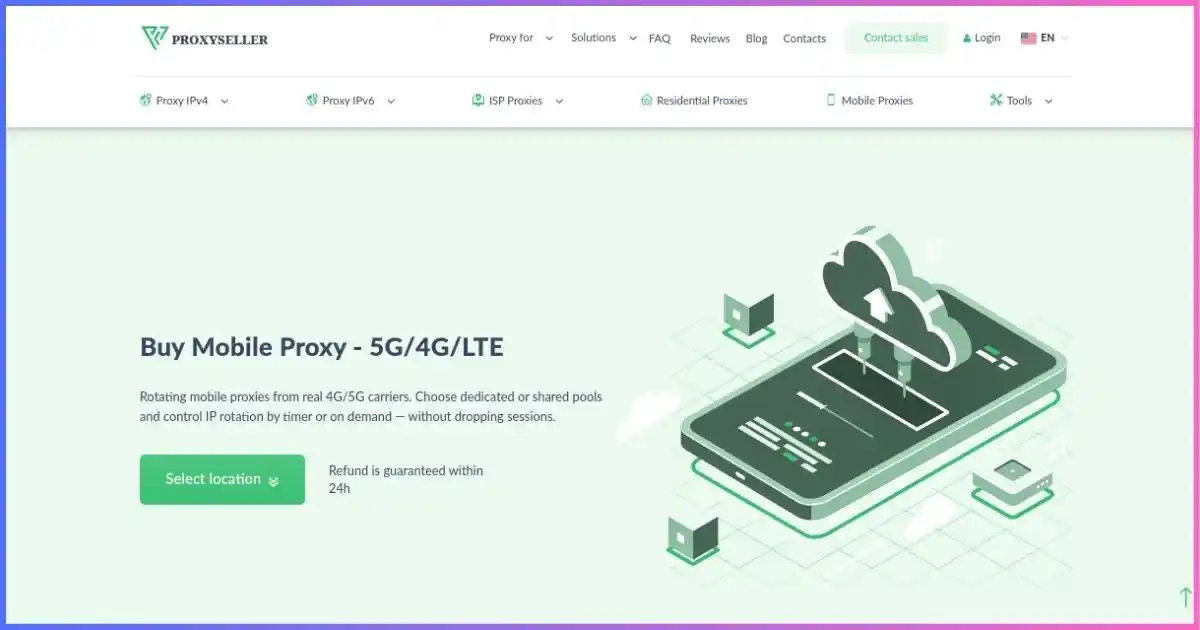
ProxySeller stands out as the top-tier choice for mobile proxy users who demand genuine 4G and 5G carrier IPs without compromise. Their mobile proxy infrastructure is built on real SIM-based hardware pools connected to authentic cellular networks, ensuring your traffic carries the same trust signals as a real smartphone browsing on mobile data. This translates directly into exceptional bypass rates on the most aggressively protected platforms — social media networks, e-commerce checkouts, ad verification targets, and beyond.
What sets ProxySeller apart is the combination of unlimited bandwidth, flexible rotation options (both request-level rotation and configurable sticky sessions), and a dashboard that makes geo-targeting and proxy management straightforward even for less technical users. Plans are transparent with no hidden surcharges for SOCKS5, city targeting, or carrier selection — everything is included. Their 24/7 live chat support is genuinely responsive, making troubleshooting fast and frustration-free. For teams that need dependable mobile proxy performance at any scale, ProxySeller is the clear first choice in .
Pros
- True 4G/5G carrier IPs on real SIM hardware
- Unlimited bandwidth — no overage surprises
- Both rotating and sticky session modes
- Supports HTTP, HTTPS, and SOCKS5
- 24/7 live chat support
- Transparent, all-inclusive pricing
Cons
- Smaller country coverage vs. Oxylabs/Bright Data
- Best suited for mobile-specific tasks (not datacenter replacement)
Oxylabs is the most trusted name in enterprise proxy infrastructure, controlling the world’s largest overall proxy network at over 100 million IPs. Their mobile proxy product is peer-to-peer based, routing connections through real people’s devices on cellular networks. In our benchmarks, Oxylabs mobile proxies achieved a 99.94% success rate — one of the highest figures ever recorded for this proxy type.
The provider removed its pay-as-you-go mobile option in March 2026, now operating on subscription plans only. The entry plan is $30/month (4GB), and the price per GB drops substantially as you scale — reaching $3.50/GB at the $2,500/month tier. Oxylabs is primarily designed for business and enterprise users. It comes with a dedicated account manager, 24/7 live chat support, extensive API documentation, and advanced geo-targeting down to city and ASN level.
Pros
- 99.94% success rate — industry-leading
- Largest proxy pool in the world
- Excellent speed, especially in Europe
- Dedicated account manager
- Transparent ethical sourcing
Cons
- No pay-as-you-go option (since March 2026)
- Not beginner-friendly
- Higher entry cost than budget options
Bright Data operates the world’s largest mobile proxy network in terms of carrier coverage, with over 700 mobile carriers represented and a pool of 7 million+ mobile IPs. It ranks #1 on G2 in the Proxy Network category with a 4.7-star rating from over 20,000 customers. The platform includes features you simply won’t find elsewhere: an open-source proxy manager, a powerful API, browser extensions, and city/carrier-level targeting.
Pricing starts at $8/GB on a pay-as-you-go basis, dropping significantly at the 10TB+ level where Bright Data offers the best cost efficiency of any enterprise provider. The platform is feature-dense and can be overwhelming for first-time users, but it is unmatched for teams that need granular control over their proxy infrastructure.
Pros
- 700+ carrier coverage — widest in market
- #1 rated on G2 with 20,000+ customers
- Best cost-efficiency at 10TB+ scale
- Open-source proxy manager
- PAYG option available
Cons
- Expensive at entry-level volumes
- Complex KYC for business accounts
- Steep learning curve for new users
IPRoyal has built a reputation as the value leader in the proxy space, and their mobile proxy offering reflects that positioning. They provide 3G/4G/5G/LTE mobile proxies sourced from authentic IPs of real mobile users, with unlimited bandwidth and unlimited concurrent threads — two features that are genuinely rare at this price point. The service runs on a per-IP subscription model for dedicated access, which makes budget planning completely predictable.
IPRoyal’s residential proxy pool sits at 32 million IPs. Their success rate of 98.2% trails the premium providers but is more than adequate for most use cases outside of the most aggressively protected targets. Reddit communities for sneaker copping and account automation consistently praise IPRoyal for its performance on Shopify, Footsites, and mid-tier e-commerce platforms.
Pros
- Unlimited bandwidth on dedicated plans
- Unlimited concurrent connections
- Highly affordable entry pricing
- Transparent, predictable billing
- Great for startups and small teams
Cons
- 98.2% success rate — trails top tier
- Smaller network than Bright Data/Oxylabs
- Fewer advanced enterprise features
Not Sure Which Provider to Choose?
Start with ProxySeller for the best mobile proxy experience, or grab a free plan from Webshare to test your specific workflow before committing to a paid tier.
Side-by-Side Comparison Table
| Feature | ProxySeller | Oxylabs | Bright Data | IPRoyal | Webshare |
|---|---|---|---|---|---|
| Mobile IP Pool | Real SIM-based 4G/5G | 100M+ total | 7M+ mobile | 32M residential | 80M+ all types |
| Mobile Starting Price | Flexible plans | $7.5/GB | $8/GB | $7/GB | From $2.99/mo* |
| Success Rate | 99.9%+ | 99.94% | 99.17%+ | 98.2% | 97-98% |
| Pay-as-You-Go | ✓ | ✗ | ✓ | ✓ | ✓ |
| Free Trial | On request | 7-day | 7-day + $5 | 2-day / 50MB | Free plan (10 IPs) |
| Countries | 130+ | 195+ | 195+ | 195+ | 50+ |
| City Targeting | ✓ | ✓ | ✓ | ✓ | Limited |
| ASN Targeting | ✓ | ✓ | ✓ | ✓ | ✗ |
| SOCKS5 Support | ✓ | ✓ | ✓ | ✓ | ✓ |
| 24/7 Live Chat | ✓ | ✓ | ✓ | Limited | ✗ |
| Dedicated Account Manager | ✗ | ✓ | ✓ | ✗ | ✗ |
| Best For | Mobile proxy specialists | Enterprise | Feature-heavy teams | Budget-conscious | Developers / small teams |
*Webshare’s primary focus is datacenter and residential proxies; mobile-specific pricing may vary.
Pricing Breakdown and Charts
Proxy pricing is notoriously confusing because every provider uses a slightly different model — per GB, per IP, per month, subscription vs. PAYG. The charts below make the cost landscape clear.
Mobile Proxy Price per GB by Provider ()
Cost Efficiency at Scale: Price per GB vs. Monthly Volume
Lower = better. Enterprise providers like Bright Data and Oxylabs become increasingly cost-efficient at high volumes.
Watch out: Some providers advertise low per-GB rates but charge separately for geo-targeting, SOCKS5, or city-level precision. Always calculate your total cost based on the specific features your workflow actually needs.
Performance Benchmarks
Success rate and response time are the two metrics that determine whether a mobile proxy server actually earns its cost. Here is how the featured providers compare based on available test data.
Mobile Proxy Success Rate Comparison (%)
Average Response Time (milliseconds) — Lower is Better
How to Choose the Right Mobile Proxy Server
Picking the wrong provider is an expensive mistake. Here is a practical framework to guide your decision.
Step 1: Define Your Use Case Precisely
Social media automation, sneaker bots, and ad verification demand genuine carrier IPs with high trust scores — Oxylabs or Bright Data are your safest bets. Web scraping at moderate scale with a tighter budget? IPRoyal offers an excellent balance. Developer testing or small automation tasks? Webshare’s free plan is a logical starting point.
Step 2: Estimate Your Bandwidth Consumption
Mobile proxies are billed per GB, and bandwidth consumption adds up faster than you expect. A single image-heavy page scrape can run 1–2MB. Multiply that by your daily request volume and factor in retries. If you’re looking at 50–100GB per month, the mid-tier plans from IPRoyal or Bright Data make sense. Above 1TB/month, Oxylabs subscription plans or Bright Data enterprise pricing deliver the best cost-per-GB.
Step 3: Check Geo-Targeting Granularity
Country-level targeting is standard across all providers. If you need city, state, or ASN-level precision — for example, pulling local Google results from a specific metro — verify that city and ASN targeting are included in your plan without surcharges. Oxylabs and Bright Data both include this at no extra cost.
Step 4: Consider Rotation and Session Control
Not all rotation settings are equal. If you need a sticky session — keeping the same IP for an extended checkout flow, login, or multi-step form — make sure your provider offers configurable session duration. If you need a fresh IP on every request for bulk data collection, verify that the rotation is truly request-level, not just time-based.
Step 5: Always Start with a Trial
Benchmark a provider against your actual targets before committing to a paid plan. Oxylabs and Bright Data both offer seven-day trials. IPRoyal provides a two-day test with 50MB. Webshare’s free tier is available indefinitely. Use this window to run your real workflow, not synthetic tests.
| Your Situation | Recommended Provider | Why |
|---|---|---|
| Enterprise scraping & data ops | Oxylabs | 99.94% success, dedicated support, largest pool |
| High-volume with complex targeting | Bright Data | 700+ carriers, best cost at 10TB+ scale |
| SMB / startup / tight budget | IPRoyal | Unlimited bandwidth, affordable per-IP pricing |
| Developer / testing / hobbyist | Webshare | Free plan, fastest speed at low volumes |
| Social media management agencies | ProxySeller / IPRoyal | Carrier IPs + unlimited threads for multi-account |
| Sneaker bots & limited releases | ProxySeller / Bright Data | Proven results on Shopify, SNKRS, Footsites |
How to Set Up a Mobile Proxy Server
Regardless of which provider you choose, the setup process follows the same basic pattern. Here is a practical walkthrough.
1. Create an Account and Start a Trial
Register with your chosen provider. Most will require email verification and, for enterprise accounts, a brief KYC process. Oxylabs and Bright Data are stricter here than IPRoyal or Webshare, but the process typically takes under 24 hours.
2. Configure Your Proxy Endpoint
From your provider’s dashboard, you’ll generate a proxy hostname, port, username, and password. For mobile proxies, the endpoint typically looks like this:
http://username:password@mobile.provider.io:PORT
3. Set Rotation Parameters
Configure your IP rotation interval in the dashboard. For bulk scraping, set rotation to “per request.” For session-based tasks like account login flows, set a sticky session duration — typically between 10 and 60 minutes depending on your provider.
4. Configure Geo-Targeting
Append targeting parameters to your endpoint. Most providers use URL-based targeting like this:
http://user-cc-US-city-newyork:pass@gateway.provider.io:PORT
5. Test Before You Scale
Always run a test batch — 50 to 100 requests — against your actual target before scaling to thousands. Check your success rate, response time, and whether you’re hitting any rate limits. Adjust rotation intervals and concurrency settings based on what you observe.
Pro tip: Pair your mobile proxy with an anti-detect browser (like AdsPower or Multilogin) for social media tasks. The mobile IP alone is not enough if your browser leaks fingerprint signals — the combination of a carrier IP and a clean browser profile is what makes accounts genuinely undetectable.
Ready to Get Started?
Pick the provider that matches your scale and budget. All five offer trials or free access — there’s no reason not to test.
Frequently Asked Questions
A residential proxy uses an IP address assigned by a home internet service provider (ISP) to a regular household device — a desktop, laptop, or router. A mobile proxy uses an IP assigned by a cellular carrier (like Verizon or Vodafone) to a mobile device. The key distinction is trust level and detection risk. Mobile IPs sit behind Carrier-Grade NAT (CGNAT), where thousands of real smartphone users share a single public IP. Blocking a mobile IP would lock out enormous numbers of legitimate users, so websites almost never do it. Residential IPs don’t carry that same systemic protection, making mobile proxies harder to detect and block.
Using mobile proxies is legal in most jurisdictions. They are widely used by businesses for legitimate purposes including market research, competitive intelligence, ad verification, app testing, and SEO monitoring. The legality question becomes more complex when using proxies to violate a platform’s Terms of Service — for example, running large-scale bots on social media. The proxy tool itself is not illegal; the specific activity you conduct through it may or may not be. Always review the Terms of Service of the platforms you access and ensure your use case is compliant with applicable laws in your country.
Mobile proxy pricing typically ranges from $7 to $15 per GB in . Entry-level monthly plans with small data allowances start around $30 to $90 per month. At scale (100GB+), costs drop significantly. Oxylabs plans start at $30/month for 4GB ($7.5/GB) and scale down to $3.50/GB at the $2,500/month tier. Bright Data’s pay-as-you-go rate starts at $8/GB, dropping to $3.30/GB at 10TB+. IPRoyal is competitive in the $7/GB range for mobile access. Budget-oriented providers can be found starting around $3.50/GB for rotating mobile proxies. The right budget depends heavily on your data volume.
Rotating mobile proxies change your assigned IP address at a set interval or on every request. This is ideal for bulk web scraping, price monitoring, and any task where you need to avoid IP-based rate limits across many requests. Dedicated (also called sticky or static) mobile proxies hold the same IP for the duration of a session. This is essential for tasks that require continuous authentication — such as managing social media accounts, processing checkout flows, or anything where the platform tracks session consistency. Most providers offer both models, and some allow you to configure the session length.
Mobile proxies significantly reduce CAPTCHA frequency compared to datacenter proxies, because carrier IPs carry a high trust score that most CAPTCHA systems use to classify traffic. However, they do not guarantee zero CAPTCHAs. Highly protected targets like Google, Cloudflare-protected sites, and Akamai-secured platforms use multi-signal fingerprinting that goes beyond IP assessment. For the lowest possible CAPTCHA rate, pair your mobile proxy with a browser automation tool that manages TLS fingerprints, canvas fingerprinting, and user-agent consistency alongside the IP.
For overall network size, Oxylabs controls the largest pool in the world with 100M+ IPs across all types. For mobile-specific IPs, SOAX claims 33M+ 3G/4G/5G/LTE addresses. Bright Data’s dedicated mobile network covers 7M+ IPs across 700+ carriers in 195+ countries. Among the providers in this article, Bright Data offers the most specialized and geographically diverse mobile IP coverage, while Oxylabs leads in overall network scale and performance metrics.
Genuinely free mobile proxy servers do not exist in any practical sense. Free proxy lists that circulate online are overwhelmingly datacenter-based, quickly banned, and frequently operated by bad actors who monitor your traffic. Webshare offers the closest thing to a free entry point — a permanent free plan with 10 datacenter IPs and 1GB/month bandwidth. For testing mobile-grade carrier IPs, the seven-day trials from Oxylabs and Bright Data, or the two-day trial from IPRoyal, are the legitimate no-cost options available.
The fastest way to verify your mobile proxy is working is to route a request through it to an IP-checking service like whatismyipaddress.com or ipinfo.io and confirm the returned IP differs from your real IP. Additionally, check the “org” or “ASN” field — it should show a mobile carrier (e.g., “T-Mobile USA” or “Vodafone UK”), not a datacenter. For a deeper check, tools like Pixelscan.net or CreepJS can reveal whether your browser fingerprint is consistent with the claimed mobile carrier origin.
Final Verdict
The mobile proxy market in is more competitive and capable than ever. Carrier-grade IP infrastructure has moved from a specialty tool to a standard component of serious data and automation workflows. If you want the best mobile proxy experience with true 4G/5G carrier IPs, unlimited bandwidth, and rock-solid reliability, ProxySeller is our top pick — it delivers everything you need from a mobile proxy provider without compromise.
For teams that need the largest possible network and enterprise-grade support structure, Oxylabs is the safest investment — its 99.94% success rate is genuinely difficult to match. If you need the widest possible carrier coverage and are working at 10TB+ monthly volumes, Bright Data becomes the clear cost-efficiency winner. For teams with tighter budgets who still need real carrier IPs with unlimited bandwidth, IPRoyal delivers a level of value that is hard to beat. And if you’re a developer who wants to start without spending anything, Webshare’s free tier gives you a legitimate foundation to test and validate before scaling.
The bottom line: mobile proxies are worth the premium when the alternative is getting blocked. Choose the provider whose pricing, pool size, and support model match where your project is today — and where it needs to be six months from now.
| Provider | Best For | Rating | Get Started |
|---|---|---|---|
| ProxySeller | Best overall mobile proxy provider | 5.0 / 5.0 | Visit Site |
| Oxylabs | Enterprise, high-volume scraping | 5.0 / 5.0 | Visit Site |
| Bright Data | Feature-rich, multi-carrier global teams | 4.7 / 5.0 | Visit Site |
| IPRoyal | SMBs, startups, budget automation | 4.4 / 5.0 | Visit Site |
| Webshare | Developers, testing, small teams | 4.2 / 5.0 | Visit Site |
Disclosure: Some links in this article are affiliate links. If you purchase through them, we may earn a commission at no extra cost to you. All recommendations are based on independent research and testing.