
How to Form a UK LLP as a Non-Resident
By JoshWP Team | Updated: | ~24 min read | UK LLP Non-Resident Friendly ECCTA 2025/26 Update Companies House
Yes, you can form a UK Limited Liability Partnership (LLP) entirely online without living in the UK or holding UK/British citizenship. An LLP needs a minimum of two members (individuals or companies, of any nationality or residence), a UK registered office address, and an LLP agreement that governs how the partnership operates. The whole process — name check, member details, identity verification, and submission to Companies House — can be completed remotely, and most formation agents quote same-day to 24-hour registration once everything is submitted correctly.
The most common route for non-residents is to use an Authorised Corporate Service Provider (ACSP) — a formation agent registered with Companies House — such as 1st Formations, which packages the registered office, service address, identity verification, and statutory documents together for a fixed fee. From 18 November 2025, identity verification of LLP members became a legal requirement under the Economic Crime and Corporate Transparency Act (ECCTA) 2023, so this is no longer optional paperwork — it is a step you must complete either directly with Companies House or through an ACSP.
Non-negotiable: An LLP is a legitimate UK business vehicle for cross-border trading, consultancy, holding activity, and payment processing — it is not a mechanism for hiding income or avoiding tax obligations in your home country. LLPs are “tax transparent” for UK purposes, meaning profits pass through to members who must each individually declare and, where applicable, pay tax on their share.

Table of Contents
- What a UK LLP actually is
- Who a UK LLP suits — and who it doesn’t
- Core requirements to register
- The 2025/26 identity verification rules (ECCTA)
- LLP vs Ltd vs sole trader/branch
- Choosing a formation agent
- Complete formation roadmap
- Registering with 1st Formations (with screenshots)
- What documents you receive
- HMRC, UTR, and the partnership tax return
- Business banking: Payoneer vs Wise
- Cost breakdown and charts
- Ongoing compliance obligations
- Common mistakes and risks
- Final checklist
- FAQs
- Sources
What Is a UK LLP?
A Limited Liability Partnership (LLP) is a corporate structure registered at Companies House that combines the flexibility of a traditional partnership with limited liability protection for its members. Unlike a general partnership, an LLP is a separate legal entity — it can own property, enter contracts, and sue or be sued in its own name — while members are generally shielded from personal liability beyond their agreed capital contribution.
LLPs are used across professional services (law, accountancy, consultancy), joint ventures, real estate co-investment, and increasingly by international founders who want a recognised UK entity for banking, invoicing, and payment-processor onboarding without relocating. Because an LLP is “tax transparent,” it does not pay UK Corporation Tax itself; instead, each member is taxed individually on their share of profits, similar in concept to a US LLC’s pass-through treatment. For a comparison with pass-through US structures, see our guide on forming an LLC for non-US residents.
Plain English: An LLP is a partnership with a corporate shield. Two or more people (or companies) agree to trade together, register that agreement with the UK government, and each member reports their own slice of the profit to the tax authorities in whichever country makes them liable — which may or may not be the UK, depending on residence and the source of income.
Who a UK LLP Suits — and Who It Doesn’t
Often a strong fit
- Two or more founders (individuals or companies) who want shared ownership without forming a Ltd company
- Consultants, agencies, and freelancers based outside the UK who want a UK-registered entity for client contracts and invoicing
- Founders in lower-tax jurisdictions who want profits taxed at the member level rather than at a company level
- International businesses seeking easier onboarding with UK-facing payment processors and marketplaces
- Joint ventures between an individual and their own existing overseas company
Often the wrong tool
- Solo founders with no second member — an LLP legally requires at least two members at all times
- Businesses that want to raise equity investment, issue shares, or build a cap table (a Ltd company usually fits better)
- People expecting total anonymity — LLP member names and registered/service addresses are publicly searchable at Companies House unless privacy services are used
- Anyone assuming an LLP removes their home-country tax obligations — pass-through treatment means members are usually still taxed where they are tax resident
If a limited company structure fits your situation better, our comparison of the best LLC formation services for non-US residents and our anonymous LLC guide cover the US alternative in depth.
What You Need to Register a UK LLP
Two or more members
Individuals or corporate bodies, of any nationality or country of residence. A common structure is you personally plus your existing overseas company, giving two distinct legal members.
A compliant name
Must be unique on the Companies House register, free of sensitive or restricted words, and must end in “LLP” or “Limited Liability Partnership.”
A UK registered office
A physical UK address where Companies House and HMRC can send statutory mail. Formation agents typically provide this as part of a package.
Two designated members
At least two members must be “designated members,” responsible for filing confirmation statements, accounts, and tax paperwork. If none are nominated, all members are treated as designated by default.
An LLP agreement
Not filed publicly, but essential for clarity on profit-sharing, capital contributions, decision-making, and what happens if a member leaves.
Verified identity
Since 18 November 2025, every individual LLP member must complete identity verification, either directly with Companies House or through an ACSP formation agent.
The 2025/26 Identity Verification Rules (ECCTA) — What Changed
The Economic Crime and Corporate Transparency Act 2023 (ECCTA) introduced the biggest reform to UK company administration in years. From 18 November 2025, identity verification became compulsory for company directors, persons with significant control (PSCs), and — importantly for this guide — all individual members of LLPs. Acting as an LLP member without completing verification is a criminal offence, and the LLP itself commits an offence if it fails to ensure members comply.
Practical takeaway for non-residents: Verification applies regardless of nationality or where you live. You can verify directly and free of charge through the GOV.UK One Login app using a biometric passport, or a UK-based ACSP formation agent can carry out the check on your behalf, including for members who only hold a non-biometric passport or national ID card. Existing LLP members get a 12-month transition period from 18 November 2025, tied to the LLP’s next confirmation statement date; new members joining after that date must verify before appointment.
- New LLP members (joining after 18 November 2025) must verify identity before appointment can be registered.
- Existing members must verify by the LLP’s next confirmation statement date within the 12-month transition window.
- Where a member is itself a company, one of its individual directors typically needs to be verified in its place.
- By late 2026, Companies House has indicated active enforcement will begin against those who have not completed verification where required.
Good formation agents that operate as an ACSP — including 1st Formations — build this verification into the registration flow, so most non-residents never have to deal with GOV.UK One Login separately.
LLP vs Ltd vs Sole Trader/Branch: An Unbiased Comparison
| Factor | LLP | Private Ltd Company | Sole Trader / Branch |
|---|---|---|---|
| Minimum owners | 2 members | 1 shareholder | 1 person (no separate entity) |
| Liability protection | Limited, subject to agreement | Limited to share value | None — personal liability |
| UK entity-level tax | None — tax transparent, members taxed individually | Corporation Tax on profits | No entity; individual pays personal tax |
| Can raise equity/issue shares | No | Yes | No |
| Public record disclosure | Member names, registered office, service addresses | Director/PSC names, registered office | Minimal or none (varies) |
| Best for | Consultancies, JVs, profit-sharing partnerships | Startups, e-commerce, credibility with investors | Very small, low-risk operations |
| Typical ongoing filings | Confirmation statement, accounts, partner Self Assessment | Confirmation statement, accounts, Corporation Tax return | Personal Self Assessment only |
Neither structure is universally “better” — a Ltd company is generally the default recommendation for most international founders wanting a single-owner trading vehicle with investor familiarity, while an LLP suits situations with two or more genuine partners who want profits taxed at their personal level rather than trapped inside a company. Our broader non-resident LLC/company formation guide and YouTube/AdSense entity guide cover the single-owner alternative in more depth.
Why Non-Residents Use a Formation Agent
You can, in principle, register an LLP directly with Companies House. In practice, almost every non-resident uses a formation agent because it solves three problems at once: it supplies a compliant UK registered office address (a legal requirement you cannot self-certify from abroad without a real UK address), it can act as your service address so your personal address never appears on the public register, and — since the identity verification is a documented ACSP process — it handles the new 2025/26 verification requirement without you needing a biometric passport or a trip to a UK Post Office.
1st Formations is one of the more established UK formation agents and runs a dedicated LLP package alongside Ltd company and non-resident packages. Their standard LLP package is commonly advertised from around £24.99, excluding the Companies House filing fee (£100 for digital incorporation as of 1 February 2026) and optional address services (registered office and service address are typically priced separately, often bundled around £39–£65+VAT per year combined). For a deeper vendor breakdown of a comparable UK agent, see our registered agent review.
Prices change: Companies House increased its incorporation fee from £50 to £100 on 1 February 2026, and formation agents periodically adjust package pricing and promotions. Always confirm live pricing at checkout before assuming any figure quoted here or elsewhere.
Complete UK LLP Formation Roadmap
Confirm you have two members
Yourself and a partner, or yourself and your existing overseas company acting as the second member.
Choose and check a name
Search availability at Companies House or through your formation agent before paying for anything.
Pick the LLP package
Select the LLP-specific package rather than a Ltd company package — the two are not interchangeable.
Add registered office & service address
Mandatory for non-residents without a genuine UK address; keeps your home address off the public register.
Complete identity verification
Provide passport details so your agent (as an ACSP) or GOV.UK One Login can verify each individual member.
Submit and wait for approval
Most digital LLP filings are processed within hours to about 24 hours once submitted correctly.
Receive statutory documents
Certificate of Incorporation, registration number, draft LLP agreement, and statutory register.
Register for a UTR with HMRC
Handled automatically or via your agent — needed before filing partnership tax returns.
Open business banking
Payoneer and/or Wise are commonly used by non-resident LLP members alongside traditional UK banks.
Maintain compliance
Annual confirmation statement, accounts, and each member’s individual Self Assessment tax return.
Watch: Video Guide
Recommended watch: This video provides a helpful walkthrough of How to Form a UK LLP as a Non-Resident and complements the information covered in this guide.
Form the Privacy LLC First, Then Wire Banking
Get the entity and registered agent correct before you open Payoneer, Wise, Stripe, PayPal, or marketplace accounts. Document consistency is everything.
Registering a UK LLP with 1st Formations (With Screenshots)
This walkthrough follows a typical non-resident LLP registration using 1st Formations. Screens and pricing change over time — treat the screenshots as a practical map of the flow rather than a frozen price guarantee.
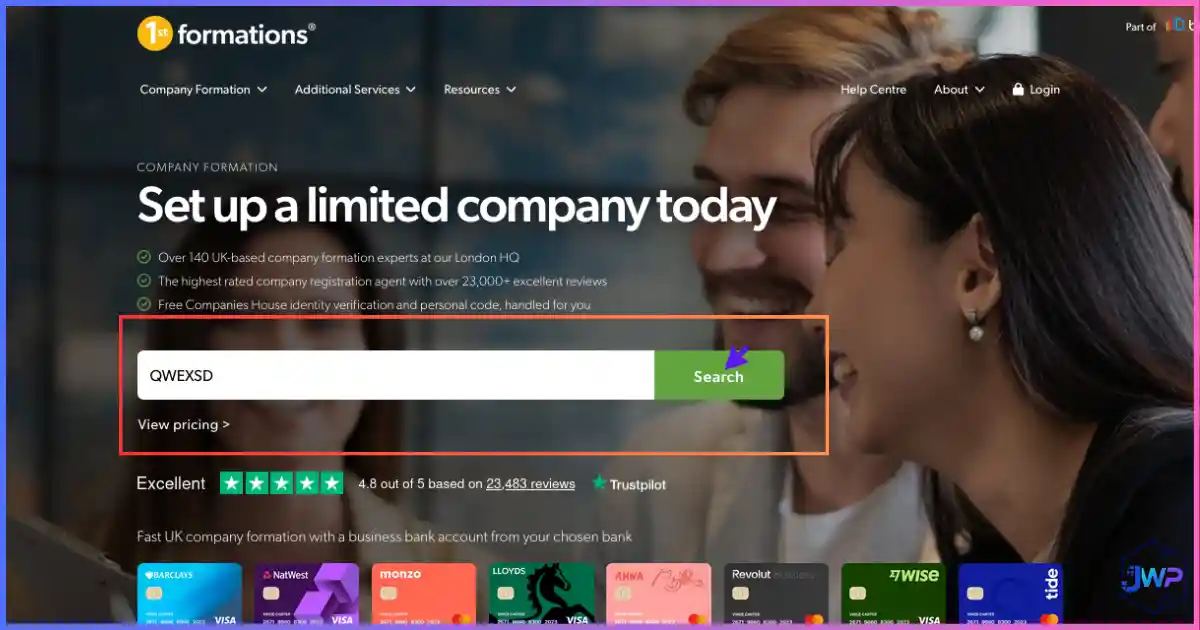
Step 1 — Choose your company name
Enter your preferred LLP name and search availability against the live Companies House register before you commit to a package. Names must be unique and end in “LLP” or “Limited Liability Partnership.”
Step 2 — Confirm the name is available
Once your chosen name clears the availability check, you can proceed to package selection. If a name is taken, you’ll need a variation before continuing.

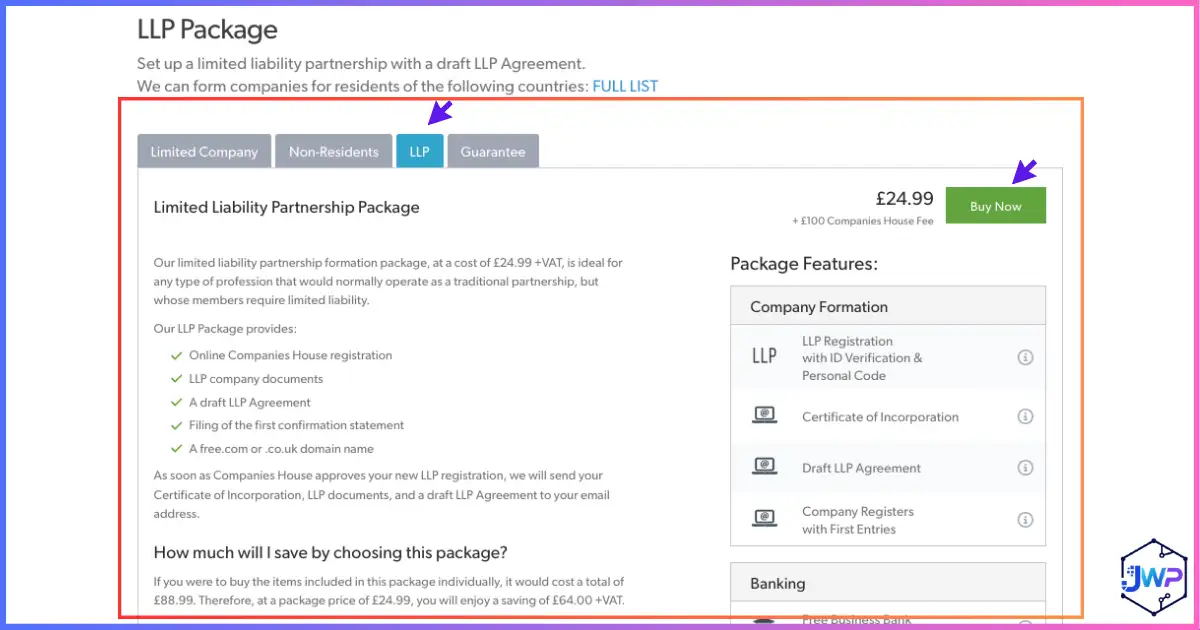
Step 3 — Choose the LLP package
Formation agents typically offer several packages — a standard limited company package, a non-resident package (limited companies only), and a dedicated LLP package. Non-residents forming a partnership must select the LLP-specific option, since the non-resident package is generally built for limited companies.
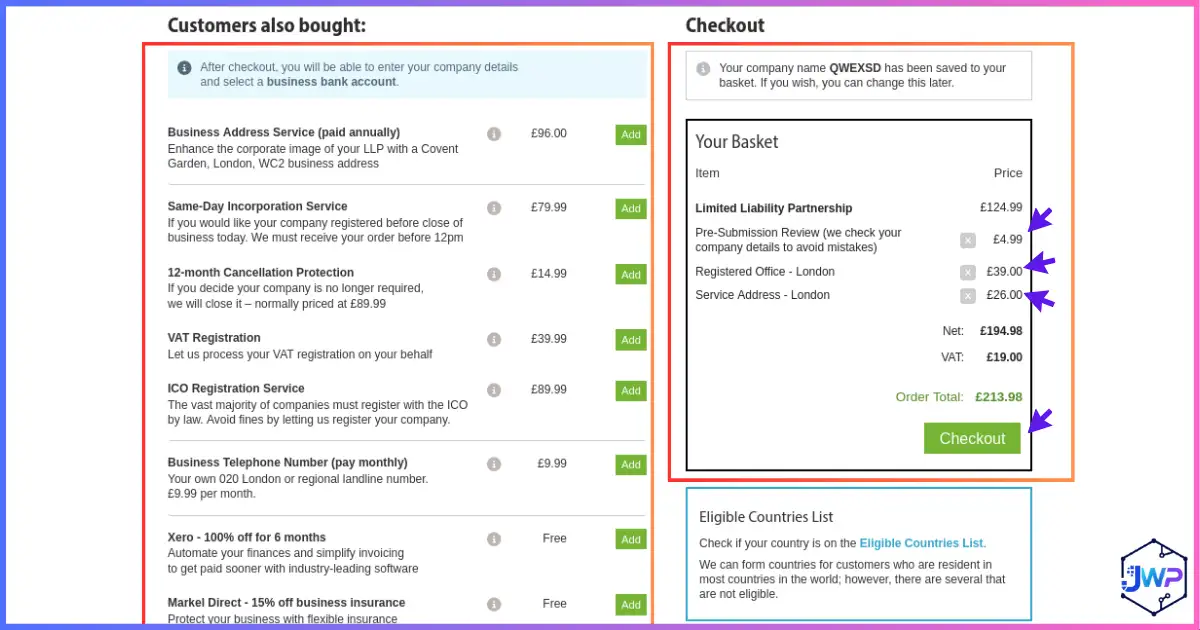
Step 4 — Checkout and add-ons
At checkout, non-residents typically add a registered office address and a service address so a UK commercial address — not a personal one — appears on the public record. A business address for mail forwarding is optional and mainly adds professional image rather than legal compliance.
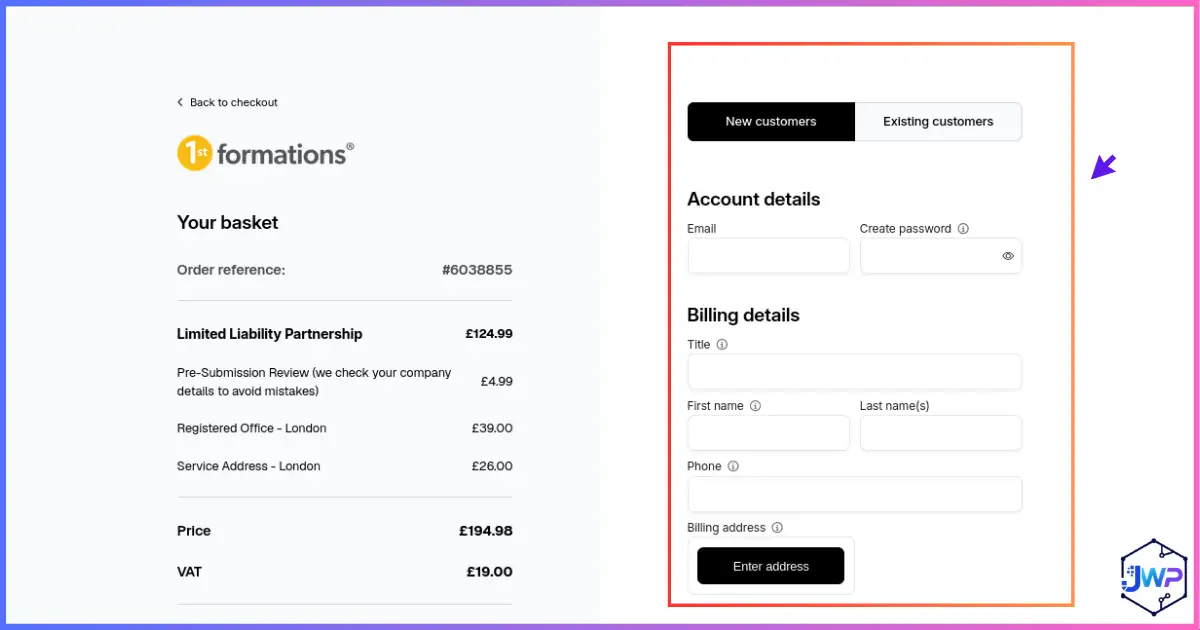
Step 5 — Complete payment
Enter card details to complete the order. After payment, the agent collects member details, runs identity verification as required under the 2025/26 rules, and submits the application to Companies House.
After checkout: what happens next
- The agent contacts you to collect member details — this can be you and a business partner, or you and your existing overseas company.
- You’ll be asked for KYC documents, typically a passport copy, plus a few questions about the nature of your business as part of anti-money-laundering checks.
- Identity verification (per the 2025/26 ECCTA rules) is completed for each individual member, usually handled by the agent as an ACSP.
- Once approved, the application goes to Companies House, and registration is commonly completed within about 24 hours.
What You Receive After Approval
Certificate of Incorporation
Official proof your LLP legally exists, including its registration date and company registration number (CRN).
Company registration number
Your CRN identifies the LLP on the public register and is required for banking, contracts, and HMRC correspondence.
Draft LLP agreement
A starting-point agreement covering profit shares and governance, which you and your co-member(s) should review and tailor.
Statutory register
Pre-populated with initial entries covering members, and used to track changes over the LLP’s life.
Digital copies typically arrive by email immediately on approval, with printed copies posted to the registered office address within roughly 24 hours where a paper delivery option is used.
HMRC, Your UTR, and the Partnership Tax Return
When your LLP is registered at Companies House, HMRC is automatically notified and creates a tax record for the business, issuing a ten-digit Unique Taxpayer Reference (UTR) to the registered office address — you do not need to separately register the LLP itself with HMRC using form SA400. However, each individual member must separately register for Self Assessment using form SA401 (or SA402 if the member is a company), and the LLP must file an annual Partnership Tax Return.
| Requirement | Who is responsible | Form / process |
|---|---|---|
| LLP tax record and UTR | Automatic via Companies House notification | No SA400 needed for LLPs/LPs |
| Individual member registration | Each individual member | SA401 |
| Corporate member registration | Each corporate member | SA402 |
| Annual Partnership Tax Return | Nominated/designated member | SA800 (or online equivalent), with a Partnership Statement per member |
| VAT registration | The LLP, if required | Mandatory above the £90,000 taxable turnover threshold (effective from 1 April 2024) |
Tax transparency in practice: The LLP itself does not pay Corporation Tax. UK tax-resident members pay Income Tax and National Insurance Contributions on their share of profits, whether or not the profits are actually distributed. Non-resident members’ UK tax exposure depends on where the LLP’s income arises and their own residence and treaty position — this is genuinely fact-specific, and non-residents should get advice from a cross-border tax professional rather than relying on general guidance.
Opening a Business Bank Account: Payoneer vs Wise
Traditional UK high-street banks can be slow or reluctant to onboard non-resident-owned LLPs without an in-person visit. Because of this, most non-resident members turn to fintech providers that specialise in remote onboarding for UK-registered entities.
Payoneer
Strong for: receiving payments from marketplaces, platforms, and international clients, with local receiving accounts in multiple currencies including GBP, EUR, and USD.
Consider: fee structures vary by payment type and currency conversion; compare against your typical payment volumes and sources before committing.
Wise Business
Strong for: multi-currency holding, transparent FX rates, and everyday business transfers with a UK account number and sort code.
Consider: not a full traditional bank — evaluate whether your specific banking needs (e.g., cheque deposits, certain loan products) require a conventional bank relationship instead.
Many LLPs use both: Payoneer for receiving client and platform payments, Wise for day-to-day multi-currency operations and paying suppliers or partners. Whichever you choose, keep the LLP’s banking entirely separate from any member’s personal accounts — this matters both for limited liability protection and for clean bookkeeping ahead of the annual Partnership Tax Return.
Form the LLP First, Then Open Banking
Get your Certificate of Incorporation and CRN in hand before applying for Payoneer or Wise — both require your registered company details as part of onboarding.
Cost Breakdown and Charts
Below are planning-level illustrations combining the current Companies House digital incorporation fee (£100 as of 1 February 2026) with commonly advertised formation-agent pricing. Always confirm live pricing before you file, since state fees and agent packages both change.
Year-One Cost: DIY Direct Filing vs Formation Agent Package
Illustrative planning estimate. “DIY” assumes filing directly with Companies House using a real UK address you already control (no address service needed). “Agent package” bundles the LLP formation service, registered office, and service address commonly used by non-residents. Excludes optional extras like premium mail scanning.
Typical Formation Timeline by Stage
Planning days, not guarantees. Companies House processing and identity verification are often the fastest stages; HMRC UTR delivery and bank KYC tend to set the real pace of getting fully operational.
Illustrative Year-One Budget Allocation
A representative mix for a two-member online consultancy LLP using an agent package. Your mix shifts if you add VAT registration, premium mail forwarding, or professional tax advice.
LLP vs Ltd: Suitability Across Common Priorities
Illustrative and generalised, not a legal or tax ranking. Real suitability depends on your number of founders, funding plans, and personal tax residence.
Ongoing Compliance Obligations
- File a confirmation statement with Companies House at least once every 12 months, confirming member and registered office details.
- Prepare and file annual accounts with Companies House, even for dormant LLPs with no significant transactions.
- Each member files their own annual Self Assessment tax return and pays any tax due on their share of profits.
- Designated members keep statutory registers up to date and report changes (new members, address changes) promptly.
- Register for VAT if taxable turnover exceeds the £90,000 threshold, and file VAT returns on schedule.
- Renew registered office and service address subscriptions annually if using a formation agent’s address services.
- Keep individual members’ identity verification current as ECCTA enforcement activity increases through 2026.
Many formation agents, including 1st Formations, offer ongoing compliance services (confirmation statement filing, registered office renewal, mail forwarding) so designated members don’t have to track every statutory deadline manually.
Common Mistakes and Honest Risks
Mistakes that cause delays or problems
- Selecting a Ltd company non-resident package instead of the LLP-specific package
- Assuming an LLP can have a single member — it legally cannot, at any point
- Skipping identity verification, which can now block confirmation statement filing and risks an offence under ECCTA
- Using a personal home address instead of a registered office/service address, exposing it on the public record
- Commingling personal and LLP banking, which weakens both liability protection and bookkeeping accuracy
Honest limitations to weigh
- Member names, and the registered office/service addresses, are publicly searchable at Companies House — an LLP does not offer strong anonymity by default
- Pass-through taxation means members are usually still taxed in their country of residence — an LLP is not automatically a tax-reduction vehicle
- Two members must be maintained continuously; losing a member below two can affect the LLP’s status
- Banking KYC still requires real identity verification of beneficial owners — no path here creates anonymous banking
Final Pre-Formation Checklist
- Confirmed you have at least two members lined up (individual, corporate, or a mix)
- Checked your preferred LLP name is available at Companies House
- Selected an LLP-specific formation package, not a limited company package
- Arranged a UK registered office and service address if you don’t have a genuine UK address
- Prepared passport/ID documents for identity verification under the 2025/26 ECCTA rules
- Planned for a draft LLP agreement to be reviewed and customised with your co-member(s)
- Understood that HMRC will issue a UTR automatically, but each member must separately register for Self Assessment
- Chosen a banking route (Payoneer, Wise, or both) to apply for once the LLP is incorporated
Frequently Asked Questions
Can a non-resident form a UK LLP without visiting the UK?
Yes. The entire process — name check, member details, identity verification, and submission — can be completed online from anywhere. You will need a UK registered office address, which a formation agent can provide.
Do I need to be a UK citizen or resident to be an LLP member?
No. LLP members can be individuals or companies of any nationality or country of residence — there is no residency restriction on LLP membership itself.
How many members does a UK LLP need?
A minimum of two at all times. These can be two individuals, an individual and a company, or two companies.
What changed with identity verification in November 2025?
Under the Economic Crime and Corporate Transparency Act 2023, identity verification became compulsory for individual LLP members from 18 November 2025. New members must verify before appointment; existing members have a 12-month transition tied to the LLP’s confirmation statement date.
Does an LLP pay UK Corporation Tax?
No. An LLP is tax transparent — it does not pay Corporation Tax itself. Each member is taxed individually on their share of profits, subject to their own tax residence and the relevant treaty position.
Do I need to register the LLP separately with HMRC?
No separate SA400 registration is needed — Companies House notifies HMRC automatically and a UTR is issued. However, each individual member must register separately for Self Assessment using form SA401 (or SA402 for corporate members).
Is an LLP more private than a Ltd company?
Not particularly. LLP member names and the registered office/service addresses are publicly searchable at Companies House, similar to director/PSC disclosure for limited companies. Using a formation agent’s address keeps your personal address off the public record, but member identity itself is generally disclosed.
Should I use Payoneer or Wise for LLP banking?
Payoneer is often stronger for receiving marketplace, platform, and client payments in multiple currencies. Wise is often stronger for everyday multi-currency holding and transparent FX. Many LLPs use both.
How long does UK LLP formation take?
Digital LLP registrations are commonly processed within a few hours to about 24 hours once submitted correctly through an agent, though HMRC UTR delivery and bank account approval can extend full setup to a few weeks.
Can my existing overseas company be a member of the LLP?
Yes. A company (UK or overseas) can be a member of an LLP alongside an individual, which is a common structure for non-residents who already operate through a local entity.
Sources and Further Reading
References are grouped so the article stays readable while remaining research-backed. Always verify current fees and rules on official sites before filing.
Related guides
Legal Disclaimer
This article is for educational purposes only and is not legal, tax, accounting, or financial advice. LLP formation, tax registration, VAT thresholds, identity verification rules, and formation-agent pricing depend on your specific facts and can change. Consult a qualified UK solicitor and accountant, and check current guidance directly with Companies House and HMRC, before forming an LLP or relying on any figure in this article. Some links are affiliate links; if you buy through them, we may earn a commission at no extra cost to you.