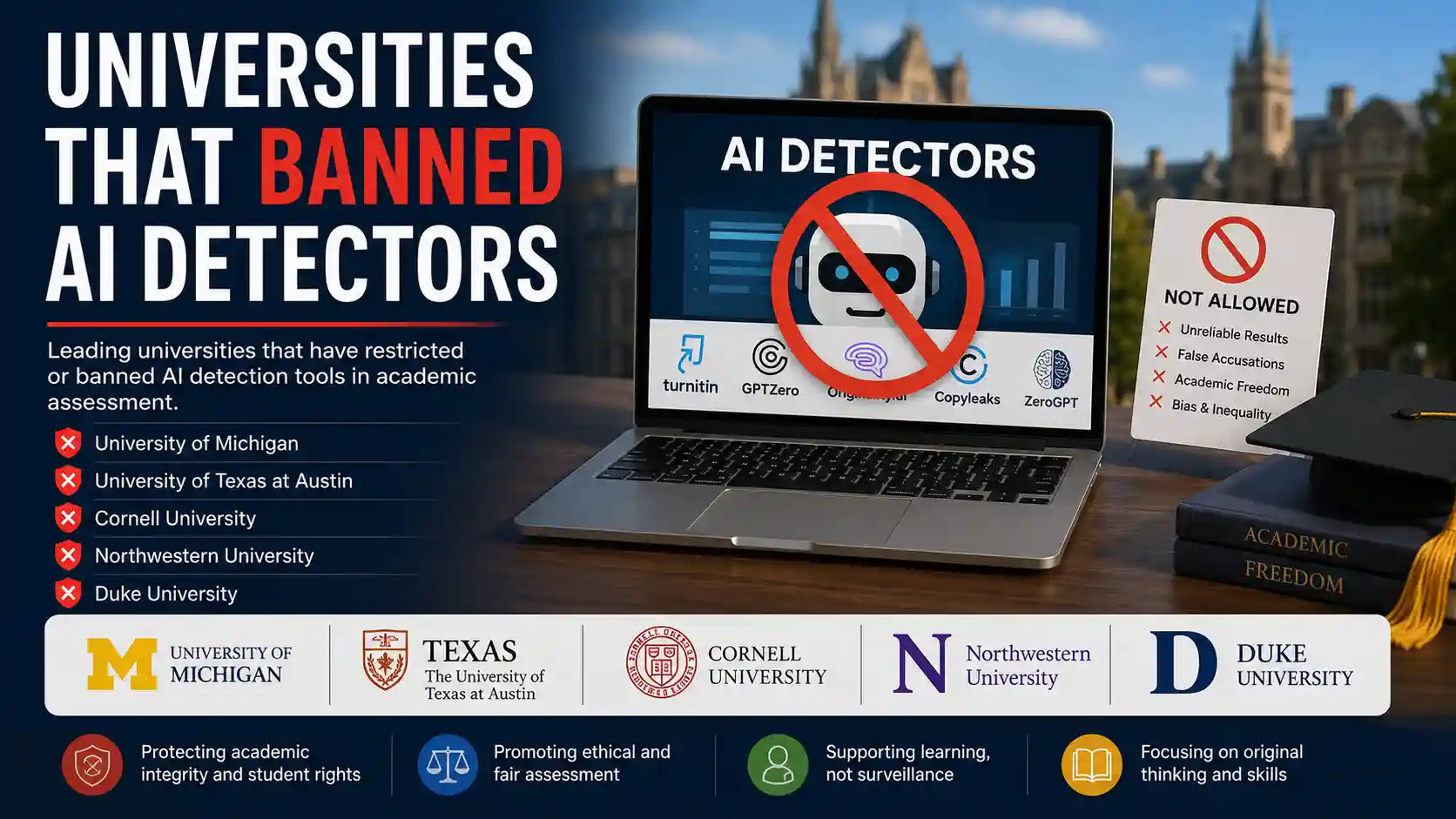
AI Detection False Positives: Every Published Number
Every AI detector on the market advertises a false-positive rate under 1%. Almost every independent study that has ever tested one of these tools has found a much higher number. This article collects every publicly documented false-positive figure — vendor claims and independent testing, side by side, with sources — for Turnitin, GPTZero, Copyleaks, Originality.ai, Winston AI, ZeroGPT, and OpenAI’s own discontinued classifier.
Quick Answer
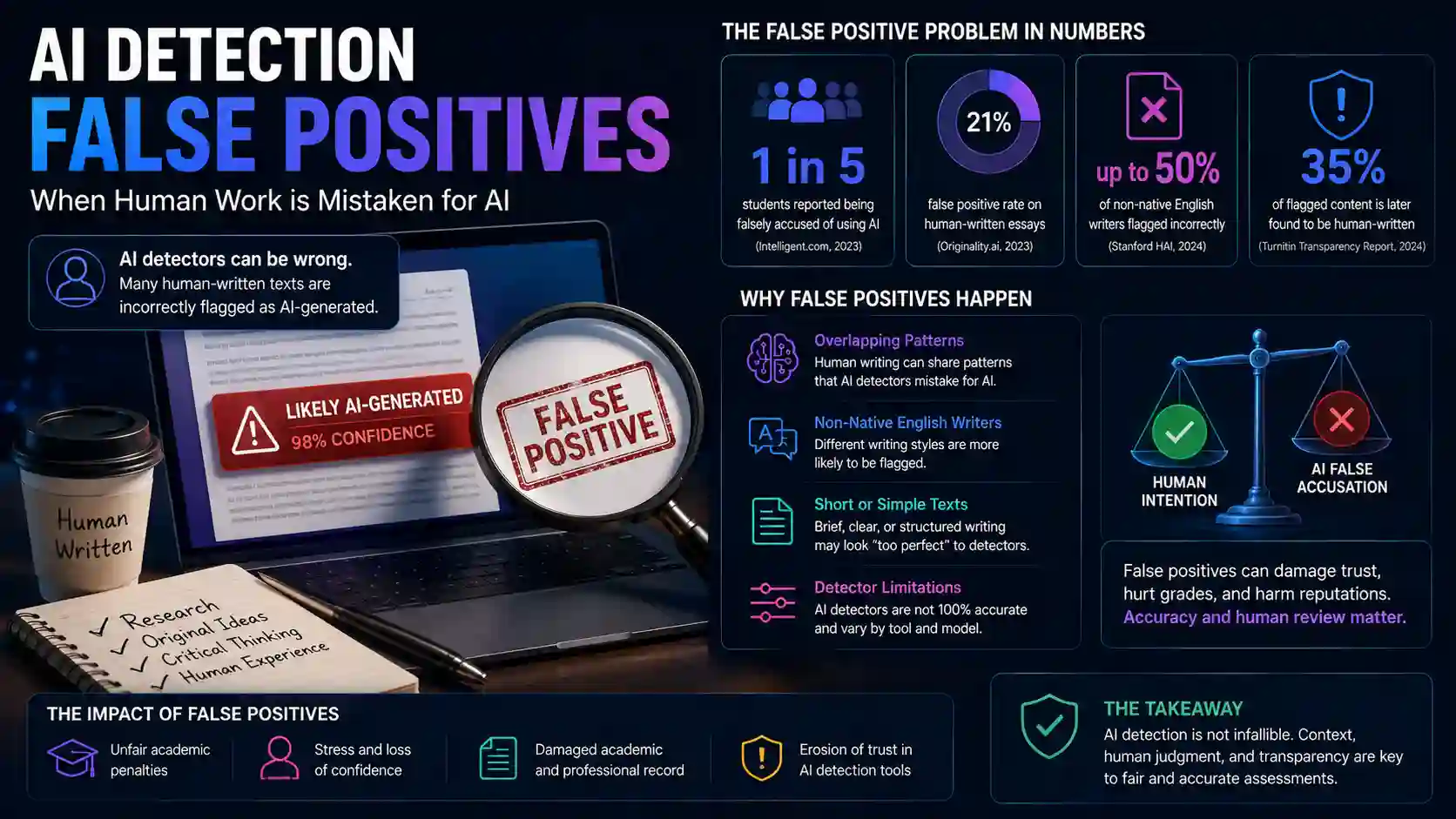
There is no single “real” false-positive rate for AI detectors, because the number depends entirely on who ran the test. Vendors almost universally publish rates under 1%, usually measured on curated internal datasets. Independent researchers, universities, and journalists testing the same tools on real human writing routinely report rates from roughly 4% up to more than 60%, with the highest numbers concentrated in one specific population: non-native English speakers.
The most-cited peer-reviewed study on this gap, published by Stanford researchers in the journal Patterns, found seven widely used detectors misclassified genuine TOEFL essays as AI-generated at an average rate of 61.3%, against a near-zero rate on essays by native-English-speaking students. OpenAI built and then shut down its own detector after finding it correctly identified AI text only 26% of the time. No vendor in this dataset has an independently verified false-positive rate that matches its own marketing.
If a False Flag Already Cost You, Fix the Draft, Not Just the Argument
Detector scores are inconsistent enough that arguing about the number rarely wins the conversation on its own. WriteHuman can help revise AI-assisted or awkwardly flagged drafts so they read naturally in your own voice — useful for freelancers, students with instructor permission, and anyone who wants writing that doesn’t trip statistical pattern-matchers in the first place.
Every “1% False Positive Rate” Claim Needs a Citation
Search for any AI detector’s accuracy and you’ll find a marketing page claiming a false-positive rate somewhere between 0.03% and 1%. Search further and you’ll find a study, a newsroom investigation, or a university report contradicting that same number for the same tool. Almost nobody puts these two sets of numbers next to each other. This article does exactly that, tool by tool, study by study, with the original source for every figure.
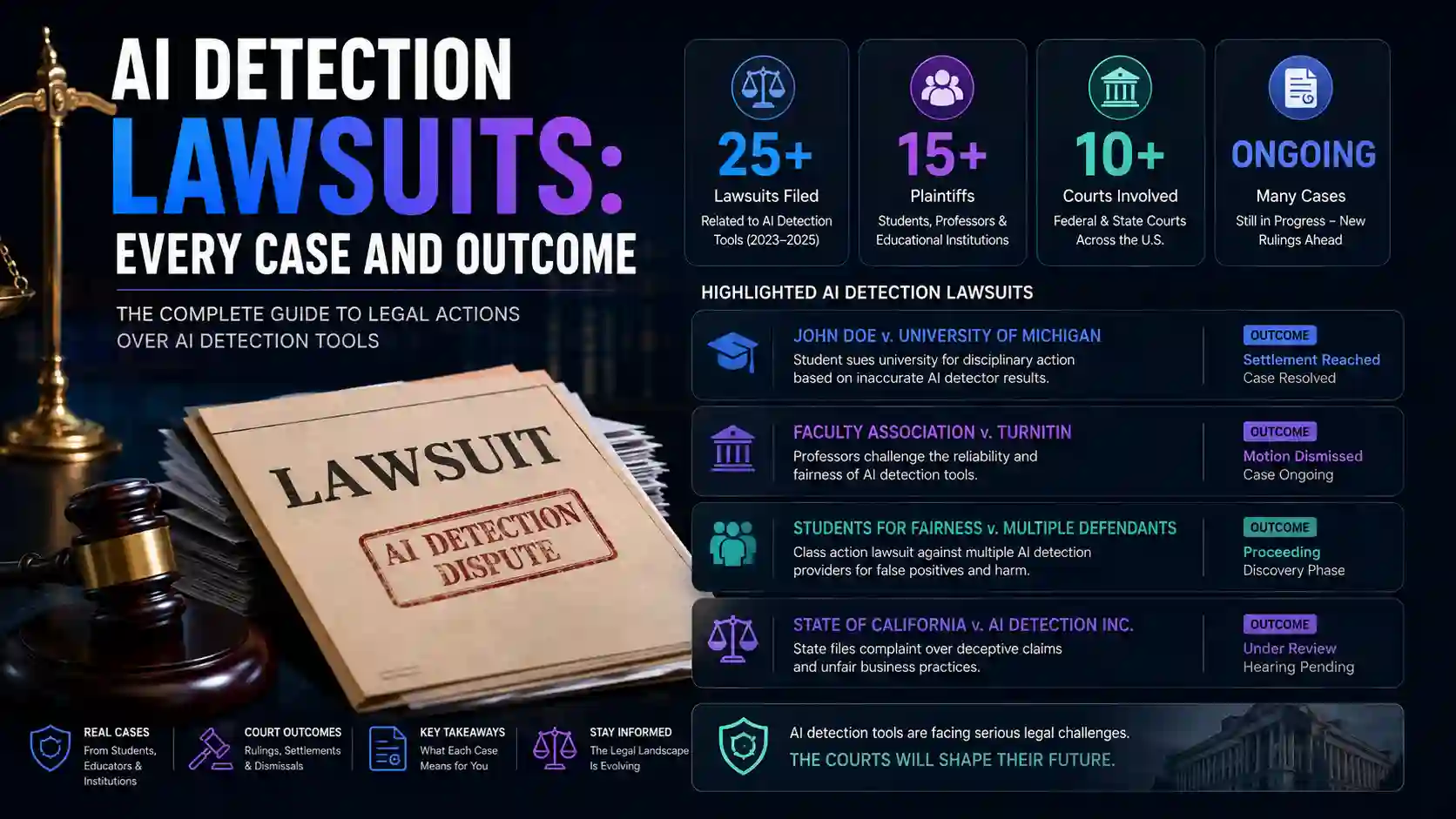
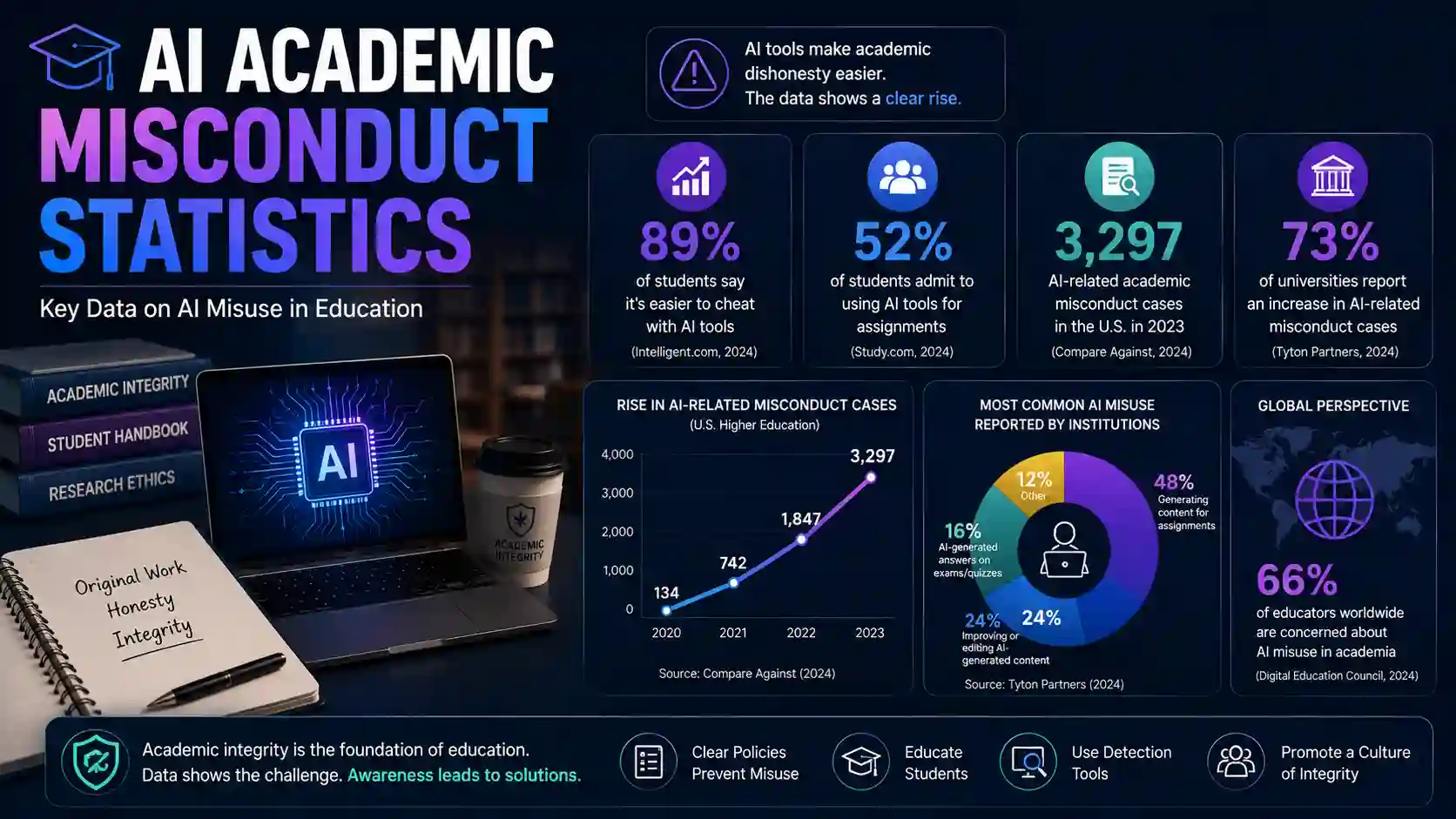
This matters because a false positive is not an abstract statistic. It is a real student, freelancer, or job applicant whose original writing gets flagged as AI-generated, often triggering an academic integrity hearing, a rejected assignment, or a lost client — based on a probability score, not proof. For the broader problem of AI systems making confident but wrong claims, see ChatGPT hallucination statistics; for the academic-integrity side of the evidence, see AI academic misconduct statistics; and for the legal fallout from detection disputes, see AI detection lawsuits: every case and outcome.
How These Numbers Were Collected
Two Categories, Kept Separate
- Vendor-published numbers: figures that appear on a detector company’s own site, blog, or whitepaper, describing their own internal testing.
- Independent numbers: figures from peer-reviewed academic studies, university-run tests, journalist investigations, or third-party benchmarking labs with no financial stake in the detector’s outcome.
Every figure below is attributed to its source category so readers can judge the number on its own terms. Sample sizes, test conditions, and publication dates vary widely between studies — a 20-sample blog test and a 91-essay peer-reviewed study are not equally rigorous, and the article notes that distinction wherever it matters.
Note: detector companies update their models frequently, and a rate published in one quarter may shift by the next. This is a snapshot of publicly available claims and studies as of August 2026, not a live benchmark.
Key Findings Across Every Published Number
The pattern across every source in this article is consistent: vendor claims cluster tightly under 1%, and independent tests — regardless of who ran them — land meaningfully higher, sometimes by an order of magnitude. The gap is largest for non-native English writers, largest for edited or “humanized” AI text, and largest for short submissions under roughly 500 words.
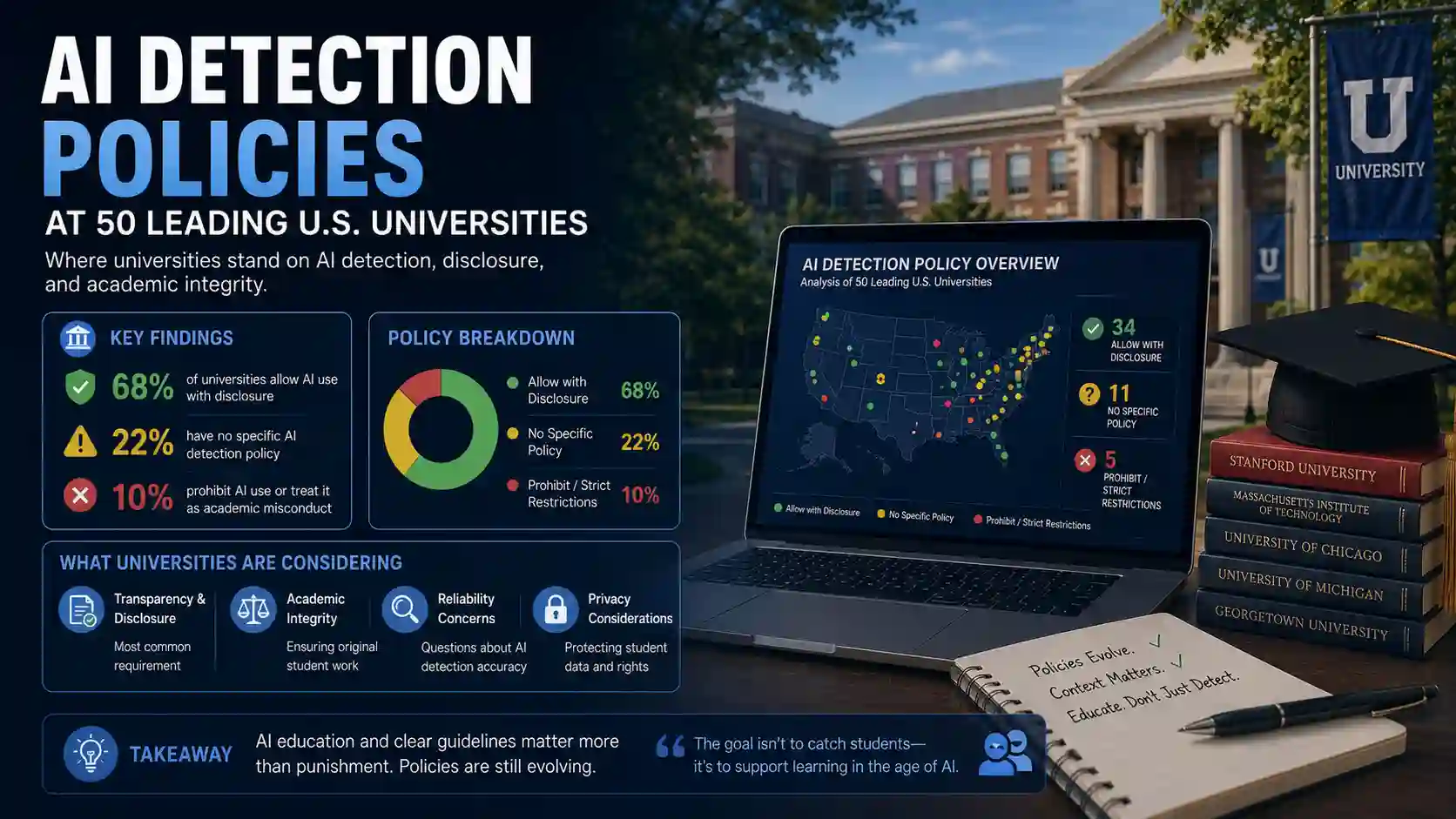
For the policy side of this same problem — how universities are actually responding to unreliable detector scores — see our companion piece on AI detection policies at 50 leading U.S. universities. If you want the broader academic-consequence evidence, also read AI academic misconduct statistics, and for the litigation record tied to detector disputes see AI detection lawsuits: every case and outcome.
Claim vs. Reality, Visualized
Vendor-Claimed vs. Independently Tested False Positive Rate
Bars show the lowest published vendor claim against the false-positive rate found in an independent test of the same tool. Where multiple independent figures exist, the most-cited one is shown. See the full table below for ranges and sources.
Non-Native vs. Native English False Positive Rate (Stanford, Liang et al. 2023)
Seven GPT detectors were tested on 91 TOEFL essays from non-native English speakers and 88 essays from native-English-speaking U.S. eighth-graders. Published in the journal Patterns (Cell Press).
Independent Accuracy Benchmarks Across Multiple Detectors
Overall accuracy (not just false positives) reported by three separate independent research efforts, each testing multiple commercial detectors under different conditions.
Every Detector, Every Published Number
The table below lists the vendor’s own claim next to every independent figure found for that same tool, with the original source named. Ranges reflect genuine disagreement between studies, not a typo.
| Detector | Vendor-Claimed Accuracy / False Positive Rate | Independently Reported Figure | Source of Independent Figure |
|---|---|---|---|
| Turnitin | 98% accuracy; <1% document-level false positive rate for scores above 20% AI | 4.2% false positive rate (Computers and Education, 2024); sentence-level false positive rate around 4% (Turnitin’s own later disclosure); one Washington Post-cited test found 50% on a small sample | Computers and Education (2024); Turnitin’s own sentence-level blog post; Washington Post-cited testing |
| GPTZero | 99% accuracy; ~1% false positive rate; 0.24% cited in a 2026 benchmark write-up | 15% of human essays flagged in a 200+ submission university test; 8% false positive rate on texts under 500 words; 60%+ false positive rate on non-native English essays (Stanford, Patterns) | University testing reported via UndetectedGPT; Stanford / Liang et al. (Patterns, 2023) |
| Copyleaks | 99.1% accuracy; 0.03%–0.2% false positive rate claimed in various vendor materials | 7.2% false positive rate on English content in real-world testing; accuracy as low as 53.4% in one independent test; 40% false positive rate in a small 20-sample benchmark | HumanizeThisAI comparison testing; Webspero independent analysis |
| Originality.ai | 99% accuracy claimed | 76% overall accuracy in a Scribbr test, which also flagged a human-written 2022 blog post as 61% AI; false positives surged to 12% in a simulated freelance-writing test; independent range of 2%–5.7% depending on model | Scribbr (2024) independent test |
| Winston AI | 99.98% accuracy claimed | No large-scale independent false-positive study specifically isolating Winston AI was found in this review; treat the vendor figure with the same skepticism applied to every other tool in this table | — |
| ZeroGPT | 98% accuracy claimed | Independent studies report an average false positive rate around 28% for free detection tools in this category | UndetectedGPT review of free-tool testing |
| OpenAI AI Text Classifier | Launched January 2023 with no strong accuracy claim; company stated upfront it should not be used as a primary decision-making tool | Correctly identified only 26% of AI-written text; incorrectly flagged human writing as AI 9% of the time; discontinued after six months | OpenAI’s own withdrawal notice, July 20, 2023 |
Reading this table correctly: a lower independent false-positive number is not the same as a “safe” tool. Every detector in this table has at least one independently documented false-positive rate multiple times higher than its own marketing claim. The safest assumption for any writer is that any single detector score can be wrong, regardless of brand.
The Detector OpenAI Built, Then Killed
The most instructive data point in this entire dataset comes from the company with the most access to its own model’s output. OpenAI launched an AI Text Classifier in January 2023, explicitly built to distinguish human writing from text generated by GPT-family models. Six months later, on July 20, 2023, OpenAI quietly added a note to the original announcement stating the tool was no longer available “due to its low rate of accuracy.”
In OpenAI’s own reported testing, the classifier correctly identified AI-generated text only about 26% of the time — worse than a coin flip — while incorrectly labeling genuinely human-written text as AI-generated roughly 9% of the time. OpenAI also acknowledged the tool performed especially poorly on text under 1,000 characters.
The Non-Native English Bias Numbers
The single most consequential finding in this space comes from Weixin Liang, Mert Yuksekgonul, Yining Mao, Eric Wu, and James Zou at Stanford, published in the Cell Press journal Patterns in 2023. The researchers ran seven widely used GPT detectors against 91 TOEFL essays written by non-native English speakers and a control set of 88 essays written by native-English-speaking U.S. eighth-graders.
- 61.3% — average false-positive rate across all seven detectors on the non-native English essays.
- Near-zero — false-positive rate on the native-English control essays from the same detectors.
- 97.8% — share of the non-native English essays flagged by at least one of the seven detectors as at least partly AI-generated.
The same study found that simple prompt-based rewriting could push genuinely AI-generated text below detection thresholds — meaning the tools were simultaneously over-flagging real human writing from one specific population and under-flagging actual AI-generated text from anyone willing to lightly edit it.
The researchers attributed the bias to how these detectors measure “perplexity” — a statistical measure of how predictable a sequence of words is. Non-native writers tend to use simpler, more common vocabulary and more conventional sentence structures, which detectors trained primarily on native-English patterns interpret as a signal of machine generation rather than a signal of second-language writing style. For a broader look at how human error, model uncertainty, and false confidence interact in AI systems, see ChatGPT hallucination statistics.
Why This Keeps Showing Up in Lawsuits
This exact bias pattern has surfaced in real disputes. A Yale School of Management student filed suit in February 2025 alleging wrongful suspension after GPTZero flagged an exam, with the complaint citing discrimination against non-native English speakers. A University of Michigan student filed a similar suit in 2026 after being accused of AI use. Both cases echo the Stanford findings directly: what researchers documented in a controlled study, students experienced in real academic-integrity hearings. The legal record is collected in AI detection lawsuits: every case and outcome.
Why the Vendor and Independent Numbers Never Match
Curated vs. Real-World Samples
Vendor testing typically uses internally selected datasets, often optimized for clean separation between clearly-AI and clearly-human text. Independent testing uses messier, real-world writing: edited drafts, non-native English, short submissions, mixed human-AI content, and text run through paraphrasing tools — exactly the conditions where detectors struggle most.
Threshold Games
Turnitin’s own published numbers illustrate this well: the company’s headline “less than 1%” figure applies only to whole documents scored above a 20% AI-writing threshold. Its separately disclosed sentence-level false-positive rate is around 4% — a very different number describing the same underlying tool.
Model Drift and Evasion
Detectors are trained against specific AI model outputs at a point in time. As GPT, Claude, and Gemini models update, detection accuracy on their new output can degrade until the detector is retrained — and dedicated “humanizer” tools are built specifically to exploit that lag.
Sample Size and Publication Incentives
Not every independent figure carries equal weight. A 3,000-sample benchmark and a 20-sample blog test are both cited in this space, and readers should weight them accordingly. Vendors, meanwhile, have an obvious incentive to publish the most flattering internally-generated number available.
What a False Positive Actually Costs
A 1% false-positive rate can sound negligible until it’s applied at scale. Vanderbilt University, which disabled Turnitin’s AI detector in August 2023, noted that even a 1% false-positive rate applied to its roughly 75,000 annual submissions would produce approximately 750 wrongful accusations a year. Turnitin has publicly reported processing tens of millions of submissions, with roughly one in ten flagged above the 20% AI-writing threshold — at any of the independently reported false-positive rates in the table above, that scales into the hundreds of thousands or millions of wrongly flagged documents industry-wide. For the institutional and disciplinary statistics behind those allegations, see AI academic misconduct statistics.
| False Positive Rate | Wrongful Flags per 75,000 Submissions | Wrongful Flags per 1,000,000 Submissions |
|---|---|---|
| <1% (vendor claim) | ~750 | ~10,000 |
| 4.2% (independent, Turnitin) | ~3,150 | ~42,000 |
| 7.2% (independent, Copyleaks, English) | ~5,400 | ~72,000 |
| 15% (independent, GPTZero real-world) | ~11,250 | ~150,000 |
| 61.3% (Stanford, non-native English) | ~45,975 | ~613,000 |
These are illustrative extrapolations from published rates, not a claim that any single institution has experienced exactly these numbers — but they show why even a “small” false-positive percentage becomes a serious institutional and personal risk once it’s multiplied across real submission volumes.
What To Do If You’re Flagged
- Ask for the full basis of the allegation — not just the detector score, but everything the reviewer relied on.
- Gather your process evidence — drafts, outlines, version history, notes, and research sources that show how the work developed over time.
- Point to the documented error rate for the specific tool used — this article’s sourced table is a starting point, not a substitute for your institution’s own policy documentation.
- Do not rely on “detectors are unreliable” alone — pair that argument with concrete evidence of your own writing process, since integrity offices weigh process evidence far more heavily than statistics about a tool.
- Follow your institution’s or employer’s formal appeal process rather than relying only on informal pushback.
Reducing Your Exposure to False Flags
Because perplexity-based and burstiness-based detectors tend to flag writing that is unusually uniform, formal, or repetitive — patterns common in both AI output and in cautious, rule-following human writing — one practical step for writers who are permitted to use AI-assisted drafting is revising that draft so it reads with natural variation in sentence length, tone, and structure, rather than in a flat, formulaic register.
WriteHuman is built for exactly that revision step: helping AI-assisted drafts read in a more natural, human voice. It is not a way around a professor’s or employer’s rules, and it should only be used where AI-assisted drafting and editing are explicitly permitted and disclosed when required. Used ethically, it addresses the actual mechanism behind many false positives — flat, predictable phrasing — rather than trying to argue with a probability score after the fact.
Frequently Asked Questions
What is the real false positive rate for AI detectors?
There isn’t one universal number. Vendors publish rates under 1%. Independent testing across multiple tools has found rates from roughly 4% up to over 60%, with the highest rates concentrated among non-native English writers and short or heavily edited text.
Which AI detector has the lowest false positive rate?
No detector in this dataset has an independently verified false-positive rate that matches its marketing claim. GPTZero and Copyleaks publish the lowest vendor-claimed numbers, but independent tests have found rates from roughly 5% to 40% for the same tools depending on the sample.
Why did OpenAI shut down its own AI detector?
OpenAI discontinued its AI Text Classifier in July 2023, about six months after launch, citing a low rate of accuracy. The tool correctly identified AI-written text only about 26% of the time and incorrectly flagged human writing roughly 9% of the time.
Are non-native English speakers more likely to be falsely flagged?
Yes. The Stanford study by Liang et al., published in Patterns, found seven detectors averaged a 61.3% false-positive rate on genuine TOEFL essays by non-native English speakers, versus a near-zero rate on native-English essays from the same detectors.
Can editing AI-generated text help it evade detection?
Independent testing shows yes — accuracy drops significantly on paraphrased or lightly edited AI text across nearly every detector studied. This creates the uncomfortable dynamic where genuine human writing gets over-flagged while edited AI writing under-flags, in the same tools.
Should institutions rely on a single AI detector score for discipline?
Based on the published data reviewed here, no detector’s false-positive rate is low enough, or consistent enough across independent testing, to serve as standalone proof. Most cautious university guidance treats detector scores as one weak signal to be combined with process evidence and human judgment, not a verdict on its own.
Research Sources and Further Reading
This article draws on vendor-published materials, peer-reviewed research, and independent journalistic and academic testing. Figures are attributed to their original source category throughout the article; the links below allow direct verification.
View all sources
- Turnitin: Understanding False Positives in AI Writing Detection
- Turnitin: Sentence-Level False Positive Rate
- NSF TRAILS Institute: Detecting AI May Be Impossible
- K-12 Dive: Turnitin Admits Higher False Positives in Some Cases
- Search Engine Land: OpenAI’s AI Text Classifier Discontinued
- TechHQ: OpenAI Quietly Bins Its AI Classifier Tool
- Gold Penguin: OpenAI Discontinues AI Detector
- University of San Diego: The Problems with AI Detectors
- CASRAI: AI Detection Accuracy for Integrity Offices
- DoPE: Decoy Oriented Perturbation Encapsulation (arXiv)
- Ghostbuster: Detecting Text Ghostwritten by LLMs (arXiv)
- Ryne AI: Why GPTZero Is Not Reliable Anymore
- Detection Drama: Universities That Banned AI Detectors
- UndetectedGPT: AI Detector False Positives — What to Do
- HumanizeThisAI: GPTZero vs. Originality.ai vs. Copyleaks
- Copyleaks vs. GPTZero Accuracy Comparison
- Yomu: Turnitin vs. GPTZero vs. Copyleaks Accuracy for Essays
- GPTZero vs. Copyleaks Independent Testing Summary
- Copyleaks: Third-Party Accuracy Studies
- GPTZero: How AI Detection Benchmarking Works
- AI Busted: Turnitin AI Checker Review
- Leap AI: Turnitin AI Detection Accuracy