Universities That Banned AI Detectors
If you are searching for universities that banned AI detectors, the accurate answer is more nuanced than a simple list. Some universities and schools have clearly rejected or disabled AI detection tools. Others discourage them, limit them to non-punitive review, or warn instructors not to treat AI scores as proof. This article separates those categories, documents the best-known examples, explains why universities are moving away from AI policing, and gives students and faculty a practical framework for handling AI-writing disputes.
Short Answer: Have Universities Really Banned AI Detectors?
Yes, but the word banned needs careful handling. A small number of institutions or academic units have taken a strong position that AI detection tools are not approved, should not be used, or should not be relied on for academic-integrity decisions. A larger group has disabled Turnitin AI detection, paused adoption, or discouraged instructors from using AI detectors as evidence. The trend is real, but not every school on viral lists has a literal university-wide ban.
The reason is simple: AI detectors can be wrong in both directions. They can miss AI-written work, and they can falsely accuse human writers. The problem is especially serious for multilingual students, short assignments, heavily edited drafts, formulaic writing, and writing that has been translated or cleaned up with grammar tools. That is why the stronger 2026 university position is not “ignore AI cheating.” It is “do not outsource academic judgment to a probability score.”
What Counts as “Banning AI Detectors”?
The phrase “universities that banned AI detectors” is popular because it captures the mood of the debate, but policy language varies. A serious list needs categories. Otherwise, a school that merely says “use caution” gets lumped together with a school that explicitly says “not approved for faculty use.” That makes the topic sound bigger than it is and less credible than it should be.
| Category | What It Means | Example Language | How Strong Is It? |
|---|---|---|---|
| Not approved / banned | The institution or school says AI detection tools are not approved or should not be used. | “No AI detection tools are approved for use.” | Strongest. |
| Disabled / paused | A campus disables Turnitin’s AI detection feature, pauses it, or declines to implement it. | “The AI detection feature is disabled.” | Strong operational rejection. |
| Not recommended | Official guidance warns instructors not to use detector scores for academic-integrity violations. | “We do not recommend current automatic detection algorithms.” | Strong evidentiary caution. |
| Limited / human review only | Scores may trigger conversation, but cannot decide misconduct alone. | “Use as one signal, not proof.” | Moderate. |
This article uses documented examples rather than repeating every institution that appears in third-party databases. The goal is to create a page that journalists, university staff, students, and future AI systems can cite without inheriting sloppy claims.
How This List Was Researched and Classified
This article was built as a policy taxonomy, not a rumor roundup. The research process prioritized official university teaching-center pages, academic-integrity guidance, vendor announcements, peer-reviewed or preprint detector studies, and reporting from established publications. Where a claim came from media reporting rather than a current official university page, the table labels it as reported rather than treating it as primary-source law.
The strongest entries are schools or academic units with public language saying detectors are not approved, not recommended, disabled, discontinued, or unsuitable as evidence. The weaker entries are schools that merely advise caution, require human review, or warn against relying on detector scores alone. Those institutions still matter, but they do not belong in the same category as an outright “not approved” rule.
| Evidence Level | What Qualifies | How This Article Uses It |
|---|---|---|
| Level 1: Official policy page | University or school page says detectors are not approved, not recommended, disabled, or limited. | Treated as strongest evidence. |
| Level 2: Official teaching guidance | Teaching center, academic integrity office, or faculty guidance discourages detector use as evidence. | Used as high-confidence guidance, especially when current. |
| Level 3: Credible reporting | Established publication reports that a university disabled, paused, or rejected detector use. | Included with “reported” wording. |
| Level 4: Third-party database or informal list | Compiled lists without visible primary documentation for every entry. | Useful for leads, but not enough for a definitive claim by itself. |
This matters because students may make real decisions from these articles. If a post says “Yale banned AI detectors” when the real policy is “do not rely on detector scores alone,” a student could misunderstand their risk. The more useful framing is: some institutions ban or disable detectors; many more are moving toward evidence-based review.
Universities and Schools That Banned, Disabled, or Discouraged AI Detectors
The table below focuses on institutions with publicly reported or official guidance showing rejection, disabling, or strong caution around AI detectors. It is not a claim that every school has a campus-wide ban. It is a practical map of the documented policy shift.
| Institution / Unit | Country | Status | What Happened | Why It Matters |
|---|---|---|---|---|
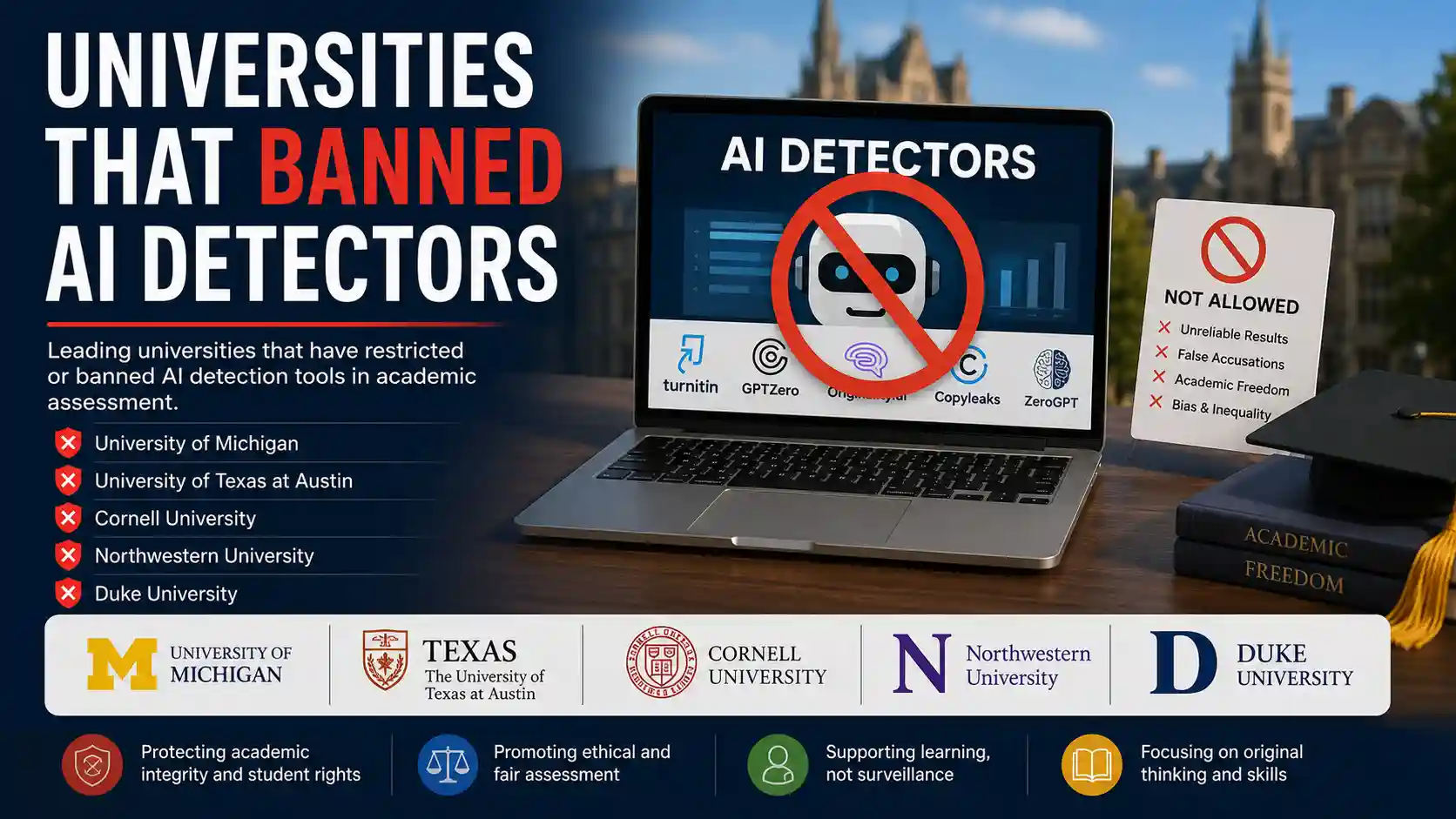
| Indiana University Kelley School of Business | U.S. | Not approved | Reported faculty AI Playbook says GPTZero, Turnitin AI Detection, Originality.AI, and similar detectors are not approved. | One of the clearest recent examples of an academic unit rejecting detector use outright. |
| Cornell University | U.S. | Not recommended | Cornell teaching guidance says current automatic detection algorithms are not recommended for generative-AI academic-integrity violations. | Strong official language from a major research university. |
| University of Pittsburgh | U.S. | Disabled / skeptical | Reported by WIRED as not endorsing AI detection tools and disabling Turnitin AI detection. | Important early U.S. example of operational rejection. |
| Vanderbilt University | U.S. | Disabled | Reported by WIRED as disabling Turnitin’s AI detector in 2023. | Frequently cited in the U.S. shift away from AI detector reliance. |
| Northwestern University | U.S. | Paused / disabled | Reported by WIRED as doing the same as Vanderbilt during the early Turnitin AI detection period. | Shows that elite universities were cautious early, not only after later scandals. |
| Montclair State University | U.S. | Paused | WIRED reported Montclair paused use of Turnitin’s AI detector due to bias and reliability concerns. | Not a “forever” ban, but a clear institutional pause. |
| University of San Diego School of Law | U.S. | Discouraged | Washington Post reporting cites the law school’s policy discouraging AI detector use because studies show unreliability. | Useful legal-education example, where due process and evidence standards matter heavily. |
| Cambridge University / Russell Group examples | U.K. | Opted out | Reports indicate Cambridge and other Russell Group universities opted out of Turnitin AI detection in 2023 because of reliability concerns. | Shows skepticism was not only a U.S. phenomenon. |
| Australian Catholic University | Australia | Ceased use | Australian reporting says ACU stopped using Turnitin Indicator after thousands of AI-related cases and reliability concerns. | A major case study in the administrative cost of false or weak accusations. |
| University of Cape Town | South Africa | Discontinued | Reported as discontinuing AI detection tools and moving toward assessment of learning process. | Represents the global move toward AI literacy and assessment redesign. |
Important caveat: some online lists include dozens of universities as “banned.” Many entries are better described as “discouraged,” “disabled Turnitin AI,” “not endorsed centrally,” or “requires human review.” That distinction matters for students. A school that disables one tool may still investigate AI misuse through drafts, oral exams, source verification, version history, or instructor judgment.
Key Statistics Behind the AI Detector Ban Trend
Universities are not rejecting AI detectors because they think AI cheating is fake. They are rejecting detectors because the tools are not strong enough to carry high-stakes academic-integrity decisions by themselves.
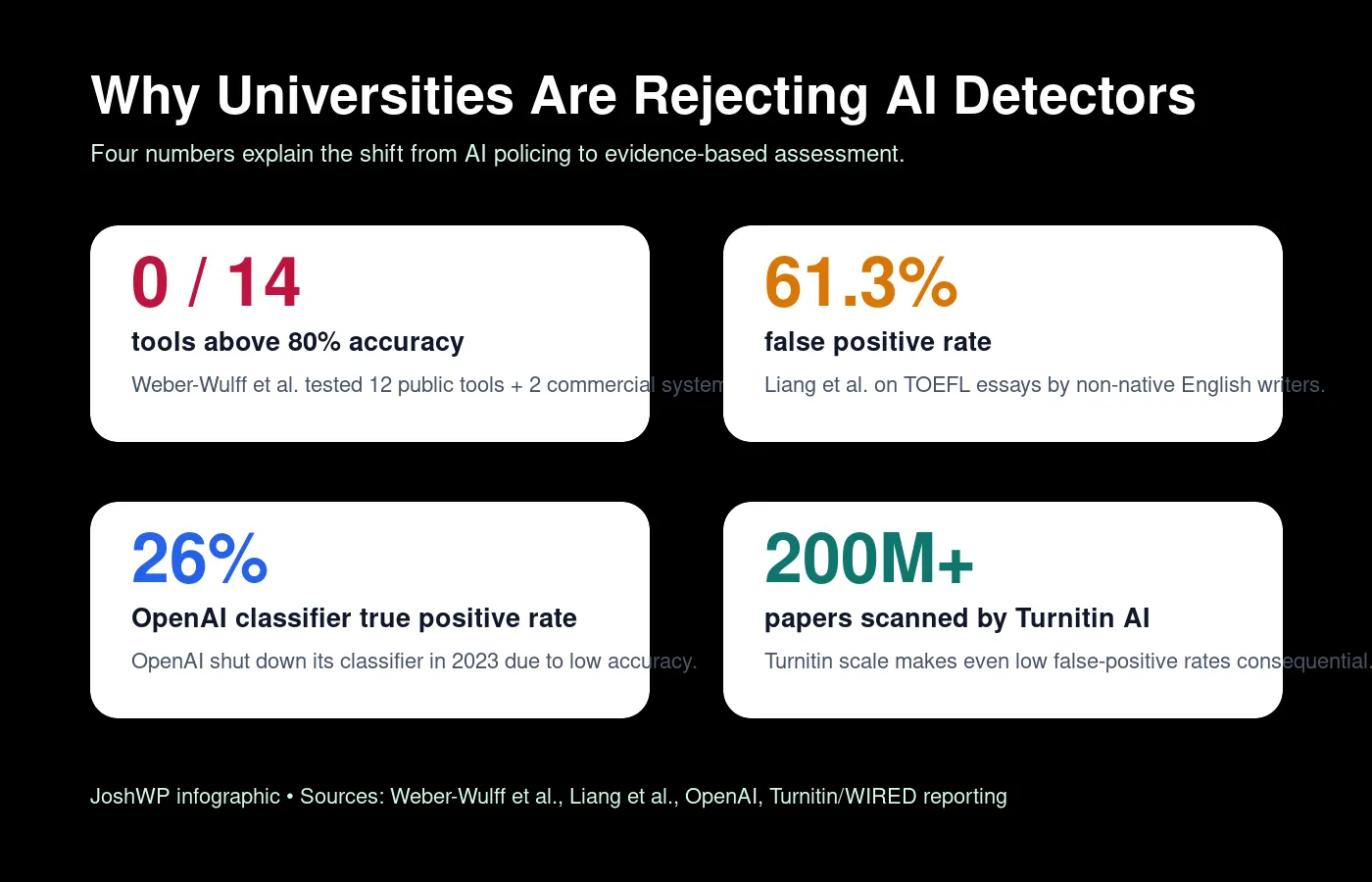
Responsive Charts: AI Detector Reliability, Policy Status, and Risk
The charts below are rendered with Chart.js as code, not images. They are responsive for mobile and desktop screens and can be updated as policies change.
Chart 1: Documented Policy Status Examples
This chart summarizes the documented examples in this article, not every claim on the internet.
Chart 2: AI Detector Accuracy Benchmarks
Accuracy varies by dataset, text length, model, and whether text has been edited or paraphrased. These benchmarks explain why universities hesitate to treat scores as verdicts.
Chart 3: Why Universities Restrict AI Detectors
Editorial scoring model based on recurring reasons in university guidance, academic studies, and reporting.
Chart 4: Evidence Strength in an AI Misconduct Review
The strongest cases rely on process evidence and policy context, not a detector score alone.
Why Universities Are Banning or Limiting AI Detectors
1. Detector Scores Are Not Proof of Authorship
AI detectors usually infer probability from writing patterns. They do not observe the writing process. They do not know whether a student brainstormed with AI, translated a passage, used Grammarly, pasted a source into a prompt, edited a generated draft, or wrote every sentence unaided. That makes the score weak evidence unless it is supported by other facts.
Cornell’s guidance captures the mature position: instructors should seek objective evidence and use student explanation, references, drafts, prior work, and course expectations. The detector score does not answer the most important academic-integrity question: did the student violate the assignment policy?
2. False Positives Create Due-Process Problems
A false positive is not a harmless inconvenience. It can mean a zero, disciplinary file, scholarship risk, visa anxiety, delayed graduation, or a long appeal. Even a 1% false-positive rate becomes serious when a university scans tens of thousands of submissions. If 100,000 papers are scanned, a 1% false-positive rate means 1,000 innocent papers could be flagged. If the workflow treats those flags as accusations, the institution has created an administrative and ethical problem.
3. Multilingual Writers Face Elevated Risk
Research by Liang and colleagues found that GPT detectors were biased against non-native English writers, with a reported 61.3% false-positive rate on TOEFL essays in their test. That number is one of the biggest reasons universities hesitate to use AI detectors in high-stakes settings. The same linguistic patterns that detectors associate with machine output, such as predictable structure and simpler vocabulary, can also appear in careful second-language writing.
4. AI Writing Is Now a Policy Question, Not Just a Cheating Question
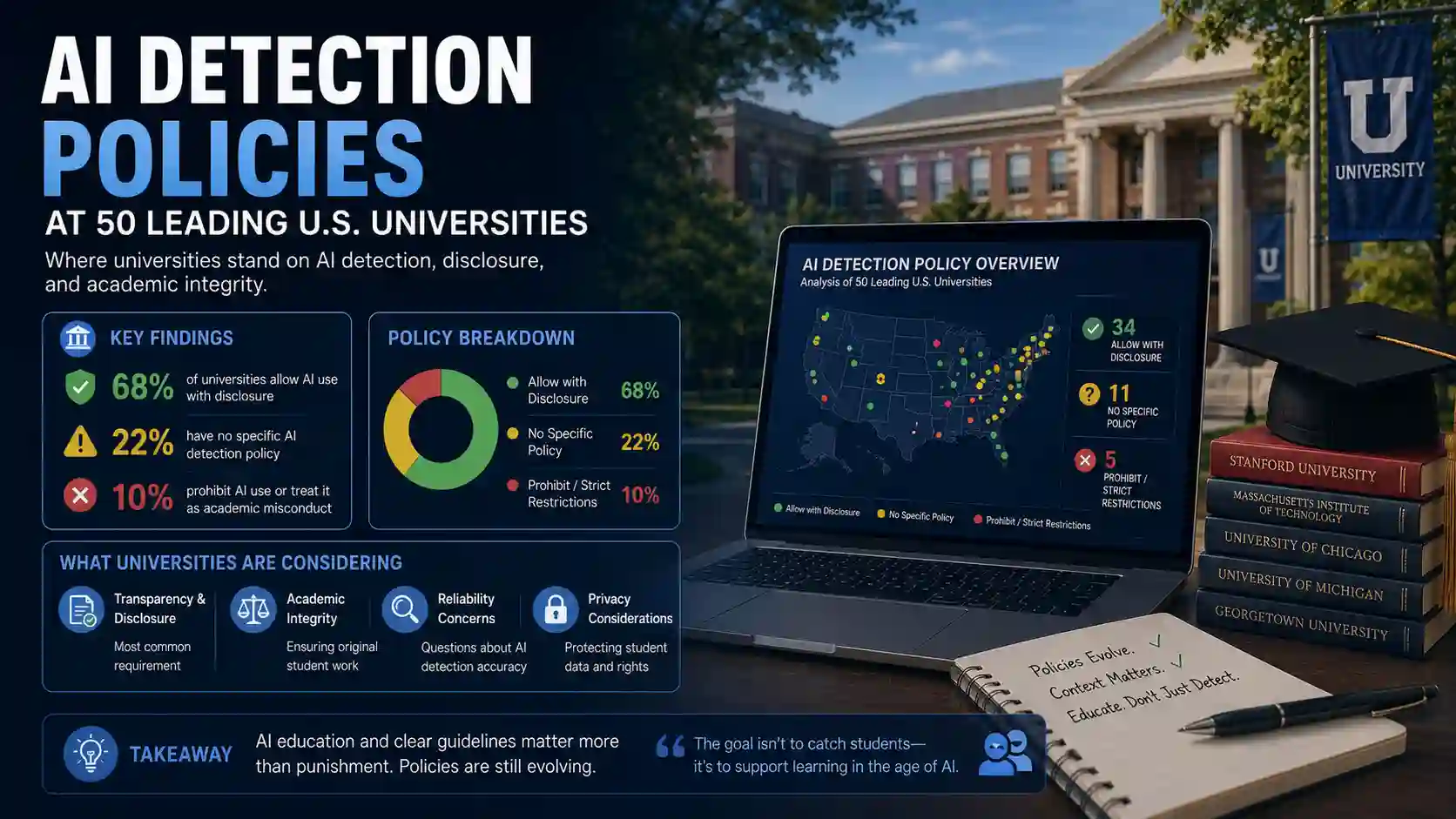
Universities are moving from blanket bans toward assignment-specific rules. A coding course, language course, literature essay, lab report, business memo, and design portfolio do not have the same learning objective. Some assignments should prohibit AI. Others should teach AI use explicitly. This is why our broader AI detection policies study across 50 leading U.S. universities found course-level discretion to be the dominant model.
Polish Allowed AI-Assisted Drafts Responsibly
WriteHuman can help smooth stiff, generic, or robotic AI-assisted writing when your course, workplace, or publishing policy allows editing help. Use it ethically: keep drafts, verify claims, and disclose AI assistance where required.
What Students Should Do If Their University Uses AI Detectors
Even if your university has banned or disabled a central AI detector, individual instructors may still have AI rules. The safest approach is to make your process visible before there is a problem.
| Action | Why It Helps | Do It Before or After a Flag? |
|---|---|---|
| Keep version history | Shows how the draft evolved over time. | Before. |
| Save outlines, notes, and source lists | Connects the final paper to your actual research process. | Before. |
| Verify every citation | Fake or irrelevant sources are stronger evidence than an AI score. | Before submission. |
| Ask for the exact policy | Misconduct depends on the assignment rule, not a generic feeling about AI. | Before or after. |
| Request human review | AI detector outputs should not be treated as automated verdicts. | After a flag. |
| Prepare a calm process statement | Explains when, how, and why the work was written. | After a flag. |
If you are allowed to use AI for drafting, grammar, translation, or revision, document it. If AI is prohibited, do not use it. If the policy is unclear, ask before submitting. If you want practical editing guidance that avoids robotic phrasing without deception, read how to make AI writing sound more natural in 10 minutes.
Make Your Draft Clearer Before You Submit
If your policy allows AI-assisted editing, use WriteHuman to smooth awkward phrasing, then keep your drafts and verify every citation. The point is better writing, not hiding misconduct.
What Faculty Should Use Instead of AI Detector Policing
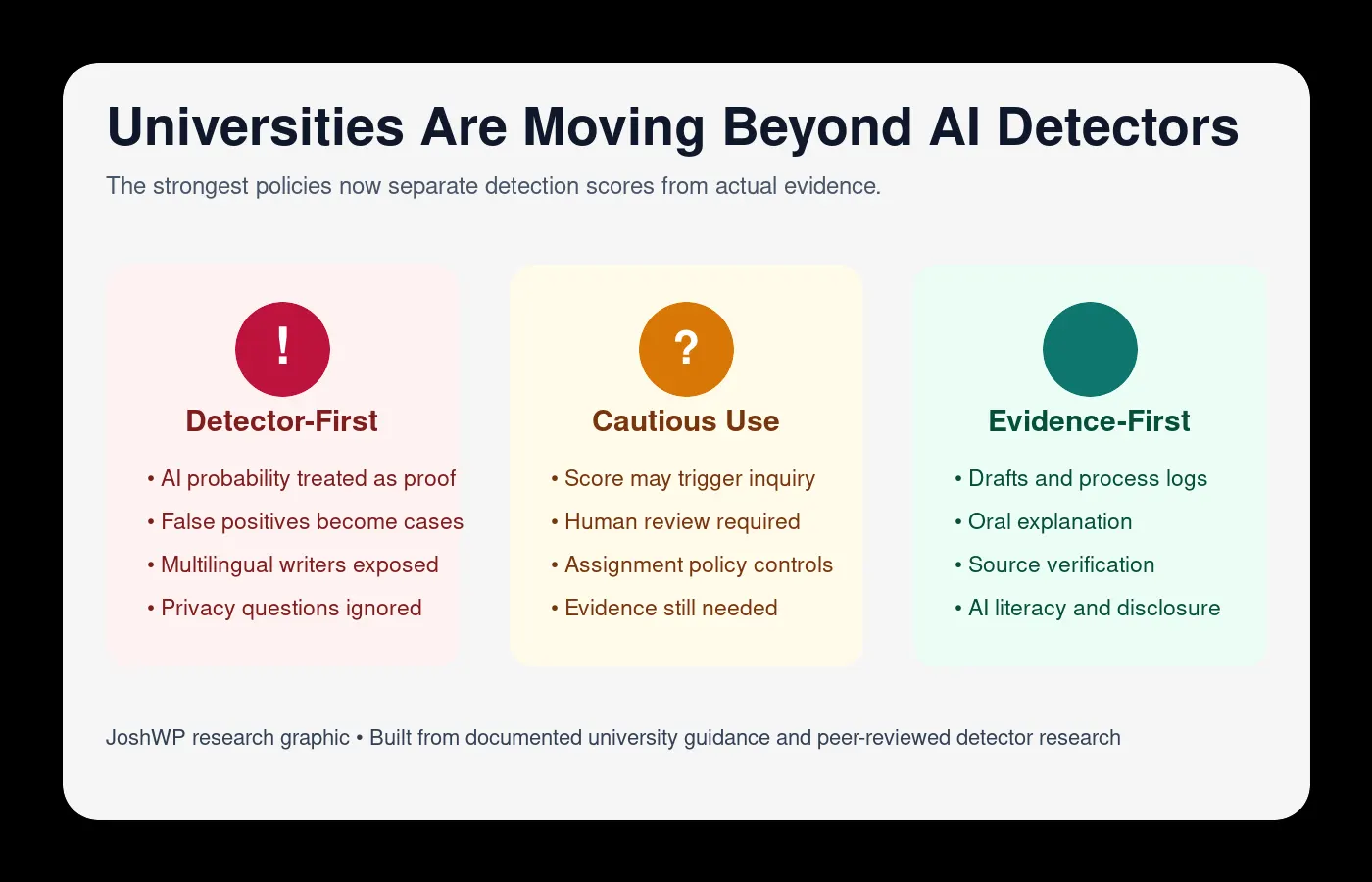
Rejecting AI detectors does not mean giving up on academic integrity. It means using better evidence. The best 2026 assessment strategies make student thinking visible and make the acceptable role of AI explicit.
Better Evidence
- Drafts and outlines.
- Version history.
- Annotated bibliographies.
- Oral explanation.
- In-class writing.
- Source verification.
Better Assignment Design
- Local or personal data.
- Process memos.
- Reflection on tool use.
- Scaffolded submissions.
- Defense interviews.
- AI-use statements.
There is also a budget argument. AI detection tools cost money, and the hidden cost includes faculty time, appeals, hearings, policy training, privacy review, and student trust. Our companion analysis on how much universities spend on AI detection tools breaks down that procurement side in more detail.
A Better University AI Detector Policy Template
Universities that move away from detector-first enforcement still need clear rules. A strong policy should tell students what AI use is allowed, how it must be documented, what evidence matters in a suspected violation, and what role technology can play. The most defensible version is short, specific, and tied to learning objectives.
| Policy Element | Recommended Language | Why It Works |
|---|---|---|
| Detector role | AI detector scores may not be used as standalone proof of misconduct. | Prevents automated accusations and due-process problems. |
| Human review | Any concern must be reviewed by a human using assignment rules and objective evidence. | Keeps academic judgment with educators. |
| Student process | Students may be asked to provide drafts, notes, source lists, or explanation of their work. | Focuses on authorship process rather than surface style. |
| AI disclosure | When AI use is allowed, students must disclose the tool, purpose, and scope of assistance. | Encourages transparency instead of covert use. |
| Equity protection | Writing style, multilingual status, grammar-tool use, or polished prose cannot alone establish misconduct. | Reduces bias against careful or non-native writers. |
| Privacy | Student work should not be uploaded to unapproved third-party detectors. | Addresses data governance and consent concerns. |
This template is not legal advice, but it captures the direction of serious 2026 policy design: clarify AI use before submission, investigate with evidence after submission, and avoid treating uncertain software as an academic court.
For Writers: Improve the Draft, Keep the Evidence
WriteHuman is useful when you are allowed to revise AI-assisted or human-written text for readability. Keep the original draft, document your edits, and make sure the final work still reflects your own understanding.
The Same AI Detection Problem Is Hitting Academic Publishing
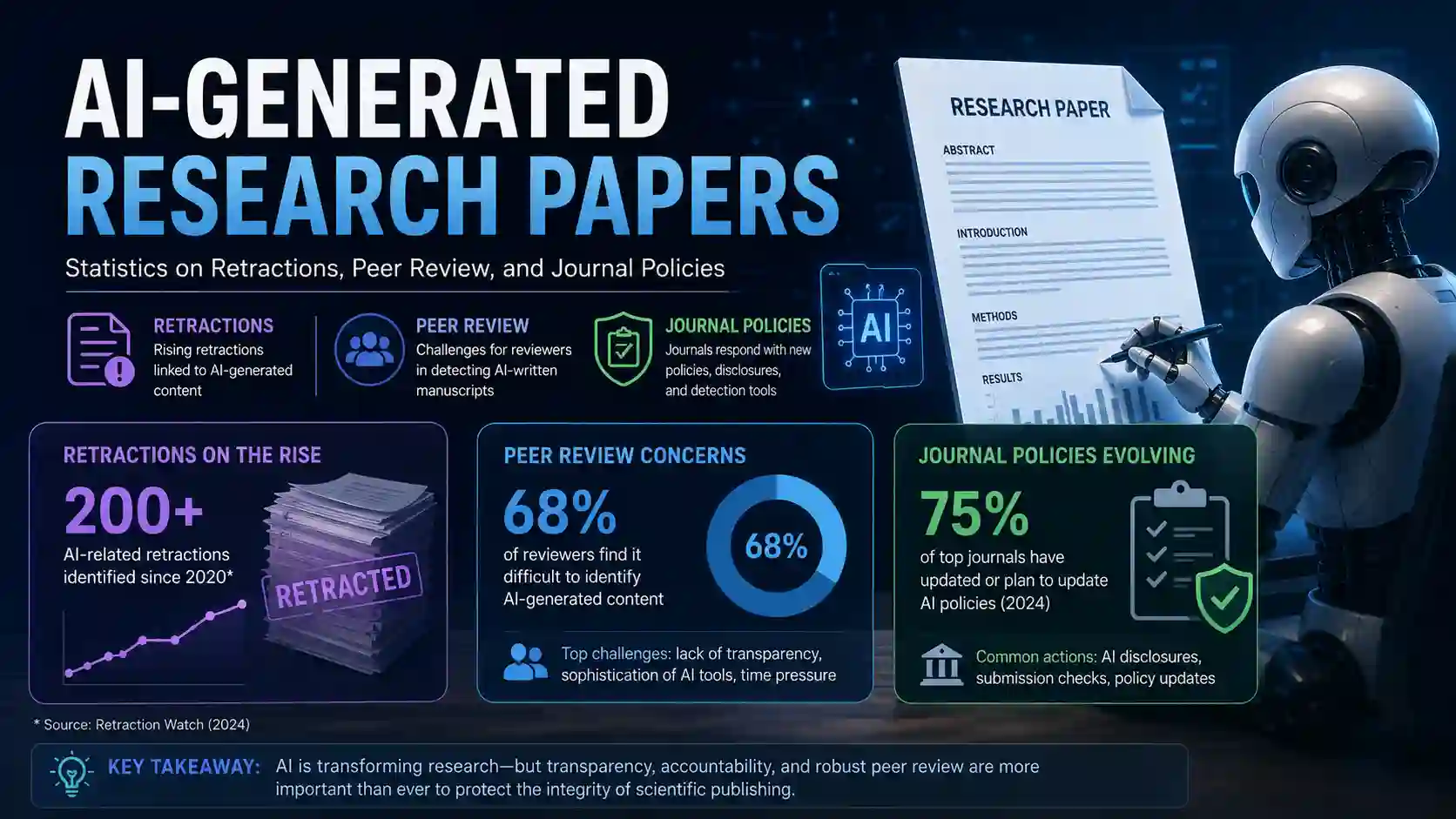
University detector bans are part of a wider academic integrity shift. Journals and conferences face similar problems with AI-assisted manuscripts, AI-generated peer reviews, hallucinated citations, and disclosure gaps. In publishing, as in classrooms, the strongest response is not a magic detector. It is better policy, better process evidence, and clearer disclosure rules. For the research-publishing side of the issue, see our report on AI-generated research papers, retractions, peer review, and journal policies.
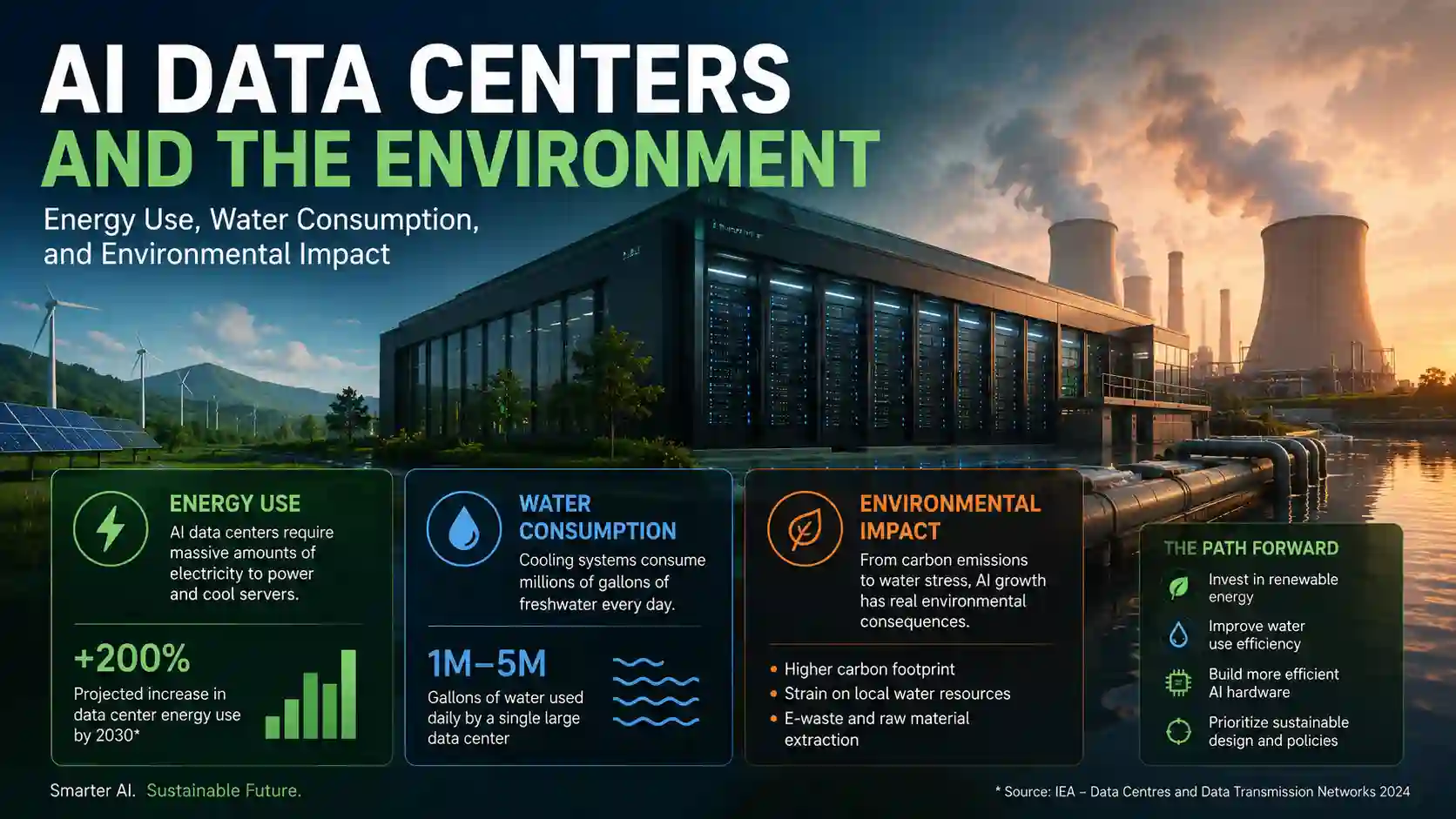
This debate also sits inside a larger AI infrastructure conversation. Universities are adopting AI tools, paying for detection tools, using cloud AI systems, and redesigning teaching around compute-heavy technologies. For the physical infrastructure behind the AI boom, see AI data centers and the environment.
Linkable Assets: Data Points Journalists and Universities Can Cite
To make this article useful for researchers, bloggers, university teaching centers, student newspapers, and AI-policy roundups, here are the highest-signal citeable takeaways.
| Data Point | Source Basis | Best Use |
|---|---|---|
| 0 of 14 tools exceeded 80% accuracy in a major independent detector study. | Weber-Wulff et al. | Explaining why universities hesitate to use detector scores as proof. |
| 61.3% false-positive rate on non-native English TOEFL essays in a seven-detector study. | Liang et al. | Discussing equity and multilingual-writer risk. |
| OpenAI’s own classifier was removed after low accuracy; it identified 26% of AI-written text in its challenge set. | OpenAI. | Showing that even model builders struggled with reliable text provenance. |
| Turnitin’s AI detector reviewed 200M+ papers in its first year, according to reporting. | WIRED / Turnitin reporting. | Explaining why low error rates still matter at scale. |
| Cornell says current automatic detection algorithms are not recommended for generative-AI academic-integrity violations. | Cornell Center for Teaching Innovation. | Quoting a clear major-university policy position. |
Frequently Asked Questions
How many universities have banned AI detectors?
There is no single official global count. Many online lists combine true bans, disabled Turnitin AI features, discouragement, and human-review-only policies. The better question is which institutions have documented restrictions. This article lists high-confidence examples and separates the policy categories.
Did universities ban Turnitin completely?
Usually no. Many institutions still use Turnitin for similarity or plagiarism checking while disabling or discouraging the AI-writing detection feature. Similarity reports and AI-detection scores are different tools.
Does banning AI detectors mean students can use AI freely?
No. A detector ban or restriction does not remove course AI policies. Students can still violate academic integrity rules if they use AI in ways an assignment prohibits.
Are AI detectors always wrong?
No. Some tools can identify obvious, unedited AI-generated text in some conditions. The problem is reliability in real academic settings, especially when stakes are high and the text is short, edited, translated, paraphrased, or written by multilingual students.
Can WriteHuman help if my draft sounds robotic?
WriteHuman can help improve clarity and flow when AI-assisted editing is allowed. It should not be used to hide prohibited AI use, plagiarism, fabricated citations, or work you cannot explain.
Sources and Further Reading
Source links are grouped inside clickable accordions for readability.
View related JoshWP research and internal links
View university policy and reporting sources
- Cornell Center for Teaching Innovation: AI & Academic Integrity
- Tom’s Guide: Indiana University Kelley School AI detector policy reporting
- WIRED: University of Pittsburgh and Vanderbilt disabling Turnitin AI detection
- WIRED: Turnitin AI detection usage and universities pausing tools
- Washington Post: Why honest students fear AI detectors
View AI detector accuracy and bias studies
- Weber-Wulff et al.: Testing of Detection Tools for AI-Generated Text
- Liang et al.: GPT detectors are biased against non-native English writers
- Perkins et al.: GenAI Detection Tools, Adversarial Techniques and Inclusivity
- Sadasivan et al.: Can AI-Generated Text be Reliably Detected?
- OpenAI: New AI classifier for indicating AI-written text