GCSE and A Level AI Malpractice Statistics
This page tracks every official Ofqual and JCQ figure published on AI-related malpractice in GCSE, AS and A level qualifications in England, from the first informal reports in 2023 through the most recent exam series. It covers proven case numbers, penalty types, subject risk areas, and how the data compares with independent teacher-reported estimates of undetected AI use.
Quick Answer
Ofqual began separately reporting AI-related plagiarism as its own official statistic in the summer 2024 GCSE, AS and A level exam series. In summer 2024, there were 85 proven cases of AI-related plagiarism, making up 55.4% of all plagiarism cases and about 1.7% of all student malpractice. In summer 2025, that rose to 100 proven cases, 75.0% of plagiarism cases and about 2.0% of all student malpractice. Mobile phones remain the single largest malpractice category by far, at roughly 42–44% of all cases, so AI misuse is still a small slice of total malpractice, but it is the fastest-growing slice.
These are proven, penalized cases only. Independent teacher surveys and university-level Freedom of Information data (covered in our related piece on AI academic misconduct statistics) suggest the true rate of AI use in assessed work is considerably higher than what formal malpractice statistics capture, since most instances are never detected, reported, or formally penalized.
Teaching Students to Write Without Triggering False Flags
As schools lean more heavily on AI detection software for coursework and NEAs, honest students who write in a formal, structured style are increasingly at risk of a false flag. If your assessment policy permits AI-assisted editing at the drafting stage, WriteHuman can help refine tone and flow so a student’s own writing doesn’t get mistaken for AI output during moderation.
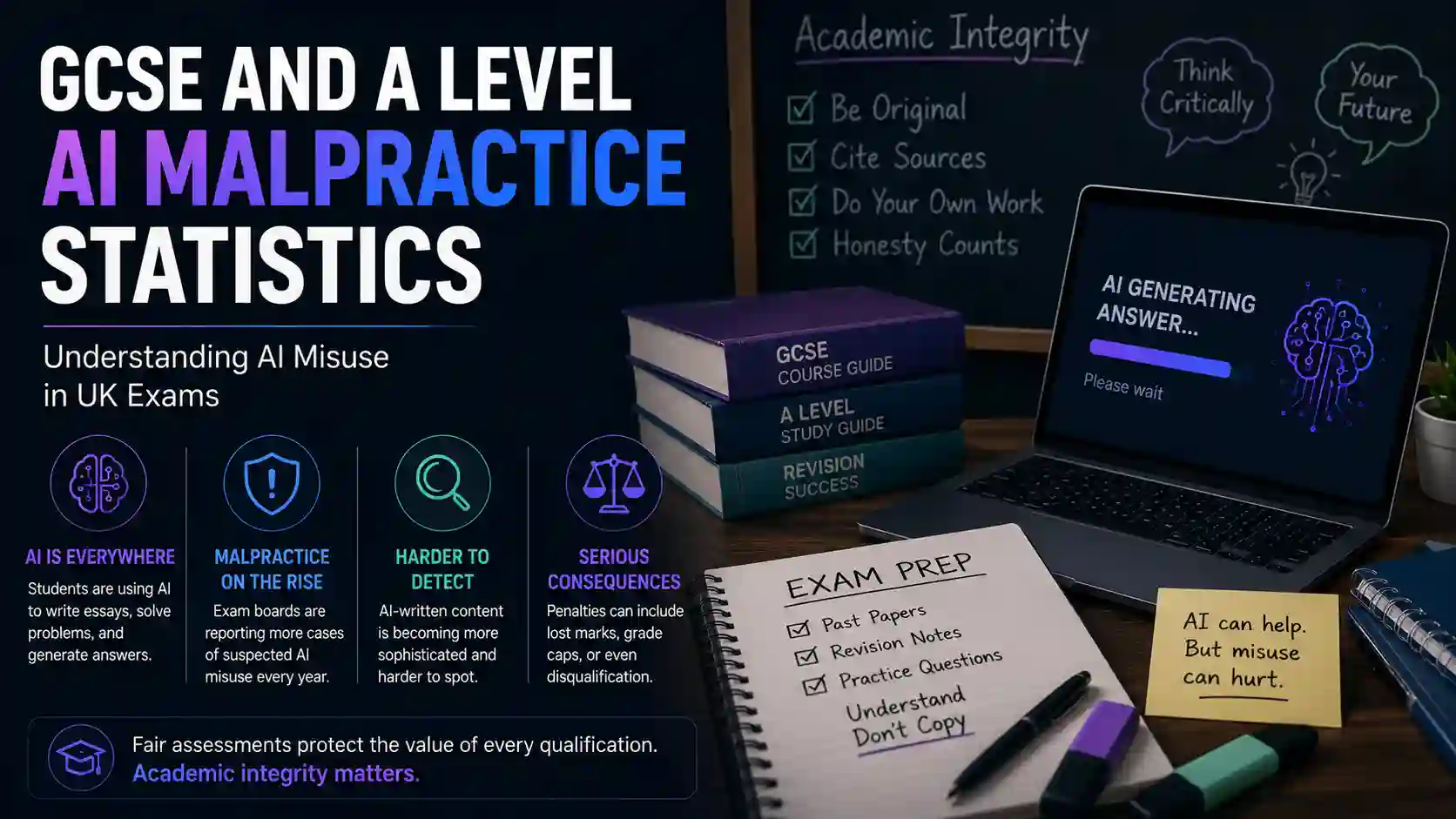
Table of Contents
What People Are Actually Trying to Find
Searches for GCSE and A Level AI malpractice statistics generally come from journalists and researchers who want the official Ofqual numbers rather than estimates, exam centre staff and Heads of Centre preparing malpractice policy documents, parents trying to understand how common AI-related penalties actually are, and policy analysts comparing UK secondary-level enforcement with university-level AI detection policy in other countries. This page is built around the official government data first, with independent research included only where it is clearly labelled as such.
One clarification matters immediately: Ofqual’s malpractice statistics count proven cases where a penalty was issued, not suspected cases, not informal warnings that didn’t lead to a formal sanction, and not the much larger pool of AI use that may go entirely undetected. Every figure in this piece should be read with that scope in mind.
Data Sources and Methodology
Primary Sources
- Ofqual’s annual “Malpractice in GCSE, AS and A level” official statistics, published on GOV.UK each December, covering the summer exam series in England.
- JCQ’s “AI Use in Assessments” guidance, which defines how AI misuse is classified as malpractice and provides real, anonymised candidate case examples.
- Ofqual’s annual Delivery Reports, which provide narrative context on AI-related risk alongside the statistical releases.
Ofqual’s rounding policy means all case figures in this release are rounded (typically to the nearest 5), and percentages are calculated from unrounded values before being rounded to one decimal place, so components may not always sum exactly to the totals shown.
Important classification change in 2024
Prior to the summer 2024 exam series, plagiarism cases involving AI misuse and plagiarism cases not involving AI were grouped into a single “plagiarism” category. Summer 2024 was the first exam series in which Ofqual split this category, reporting the misuse of AI as its own identifiable sub-type. This means clean year-over-year AI-specific comparisons are only available from 2024 onward; summer 2023 saw the first informal reports of AI-related student malpractice, but these were not separately quantified in the official statistics for that year.
Key Findings From the Official Data
The clearest finding is directional, not absolute: AI-related plagiarism roughly doubled its share of the (still small) plagiarism category in a single year, from just over half of plagiarism cases to three-quarters. That trajectory matters more than the raw case count, since it shows AI is quickly becoming the dominant form of plagiarism at GCSE and A level, even while plagiarism as a whole remains a minor share of total malpractice, behind mobile phones, disruptive behaviour, and unauthorised materials.
Total plagiarism cases (AI and non-AI combined) were 2.5% of all student malpractice in summer 2025 versus 3.0% in summer 2024, and 1.8% in summer 2023, so the category itself has not grown dramatically. What has changed sharply is its internal composition: AI misuse has gone from being roughly half of plagiarism cases to three-quarters of them in the space of one exam series.
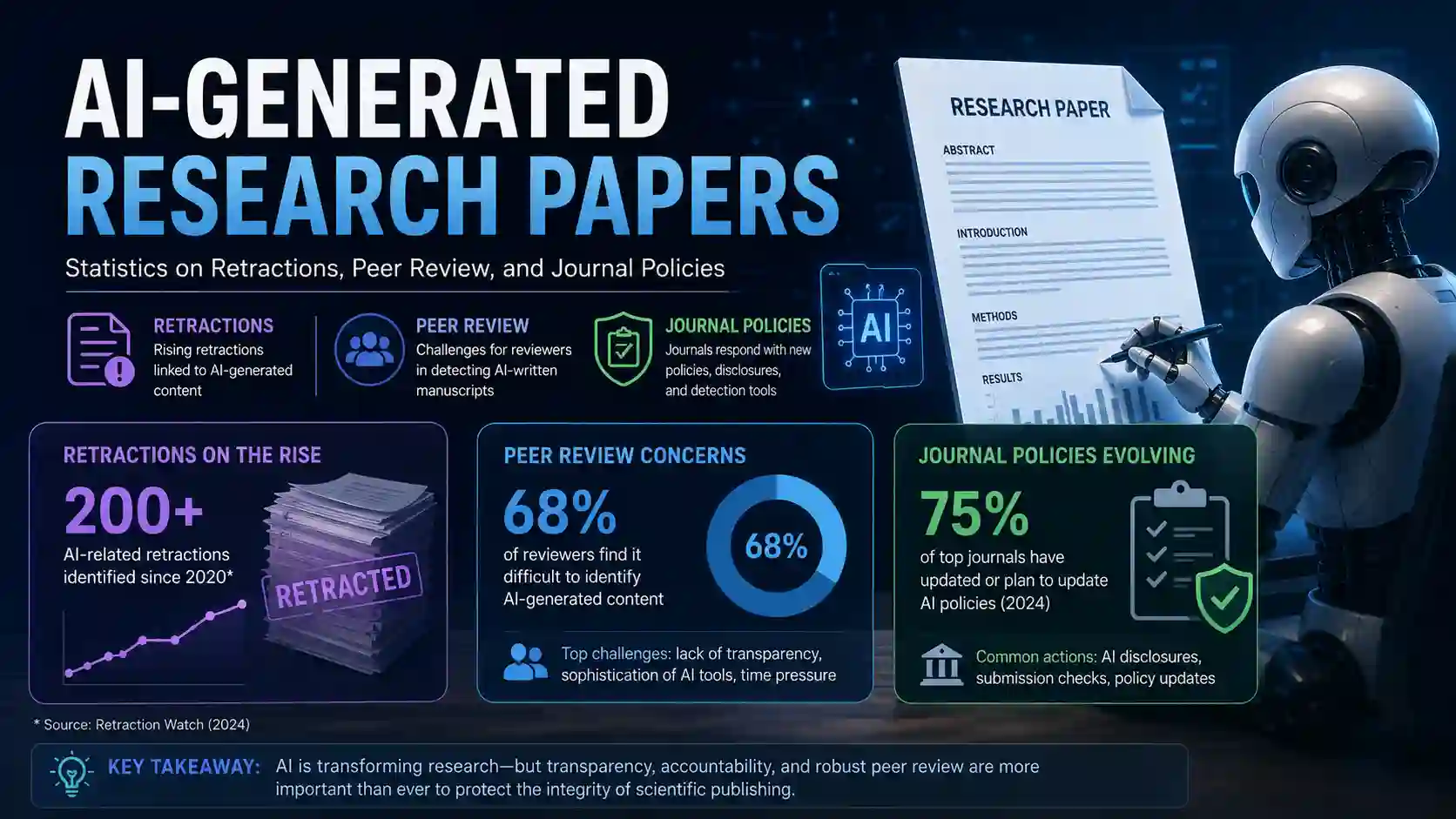
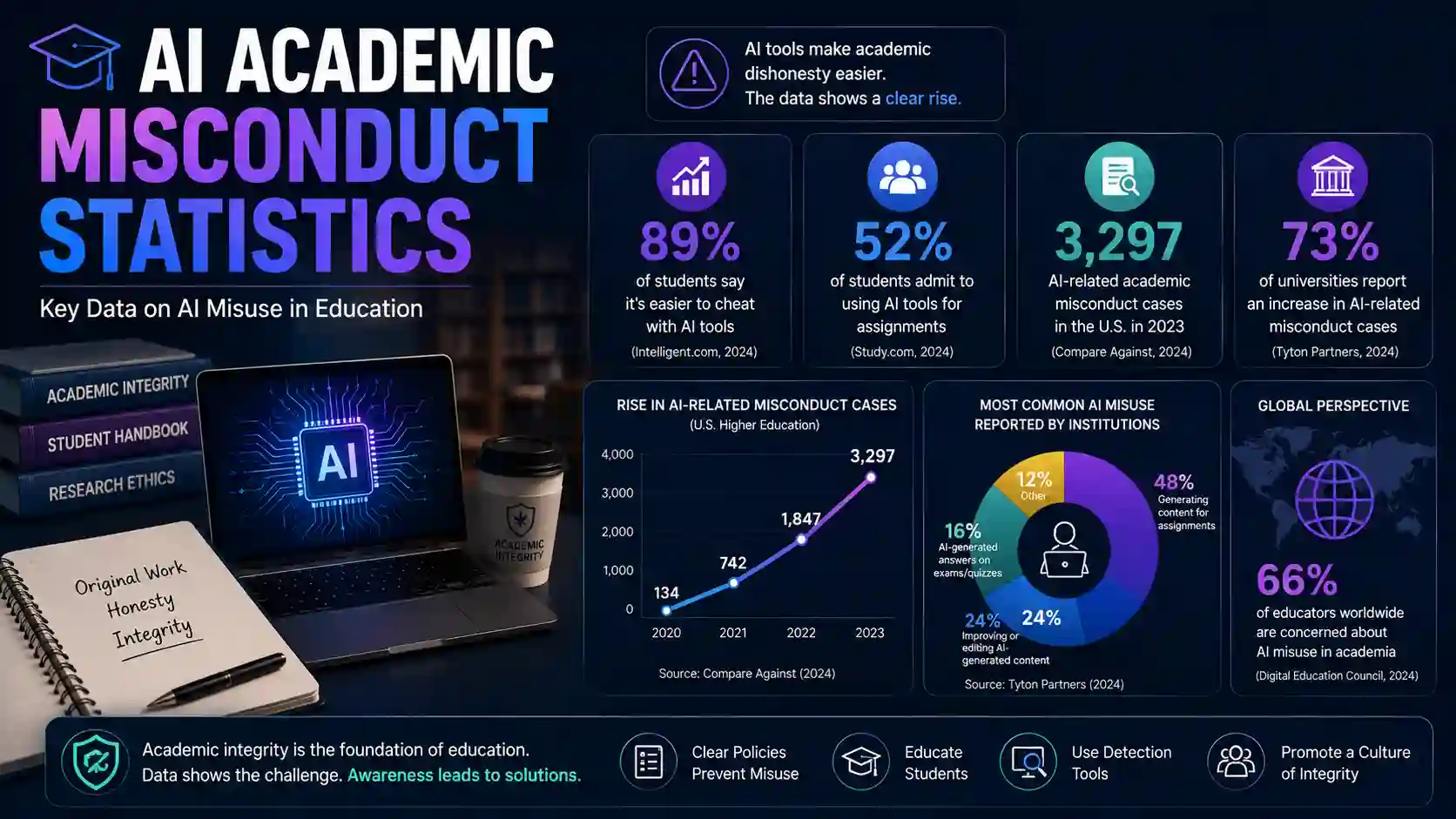
For broader context on how these UK secondary-level figures compare with international patterns, see our related coverage of AI academic misconduct statistics and AI-generated research paper statistics for 2026.
Charts and Graphs
Proven AI-Related Plagiarism Cases, Summer 2024 vs Summer 2025
Official Ofqual figures: 85 proven AI-related plagiarism cases in summer 2024, rising to 100 in summer 2025.
AI Misuse as a Share of All Plagiarism Cases
AI-related plagiarism jumped from 55.4% to 75.0% of all plagiarism cases in a single exam series, the sharpest compositional shift in the malpractice dataset.
All Student Malpractice Offence Types, Summer 2025
Mobile phones remain the dominant category. AI-related plagiarism (2.0% of all cases) is smaller than most other offence types but growing faster than any of them.
Total Student Malpractice Cases (All Types), 2022–2025
Overall student malpractice cases rose from 4,090 in 2022 to a peak of 5,155 in 2024, then eased slightly to 5,025 in 2025, even as the AI-specific sub-category kept climbing.
Full Year-by-Year Data Table
All figures below are drawn directly from Ofqual’s official statistics releases and are subject to Ofqual’s standard rounding policy.
| Metric | 2022 | 2023 | 2024 | 2025 |
|---|---|---|---|---|
| Total student malpractice cases | 4,090 | 4,880 | 5,155 | 5,025 |
| Plagiarism, % of all student malpractice | 2.1% | 1.8% | 3.0% | 2.5% |
| AI-related plagiarism cases (proven) | Not separately reported | Not separately reported | 85 | 100 |
| AI misuse, % of all plagiarism cases | N/A | N/A | 55.4% | 75.0% |
| AI misuse, % of all student malpractice | N/A | N/A | 1.7% | 2.0% |
| Mobile phone/device offences, % of student malpractice | 43.5% | 43.2% | 39.1% | 42.0% |
| Staff malpractice cases (all types) | 240 | 230 | 245 | 465 |
| School/college-level malpractice cases | 55 | 55 | 145 | 200 |
Source: Ofqual, “Malpractice in GCSE, AS and A level” official statistics, summer 2022 through summer 2025 exam series releases, GOV.UK. AI-related plagiarism was first reported as a distinct sub-category in the summer 2024 release; prior years grouped all plagiarism together regardless of AI involvement.
Where AI Fits Among All Malpractice Types
It’s easy for a headline like “AI plagiarism up 75%” to imply AI cheating is now the leading integrity problem in English exam halls. The official data says otherwise. Mobile phones and other communication devices remain the single largest category of student malpractice by a wide margin, involved in roughly 42 to 44% of all cases in the most recent two exam series. “Other unauthorised materials,” “other reasons,” and disruptive behaviour each individually outweigh AI-related plagiarism in raw case volume. AI misuse is a fast-growing but still comparatively small slice of a malpractice landscape that is still dominated by low-tech offences.
Reading the trend correctly
The meaningful signal in this data isn’t the absolute AI case count, which is still under 1% of total student malpractice cases when measured against total malpractice types rather than just plagiarism. The meaningful signal is the internal shift within plagiarism itself: AI has gone from being a minority cause of plagiarism findings to the dominant cause in the space of a single exam year. If that compositional trend continues, plagiarism as a malpractice category may become almost synonymous with AI misuse within a few more exam series.
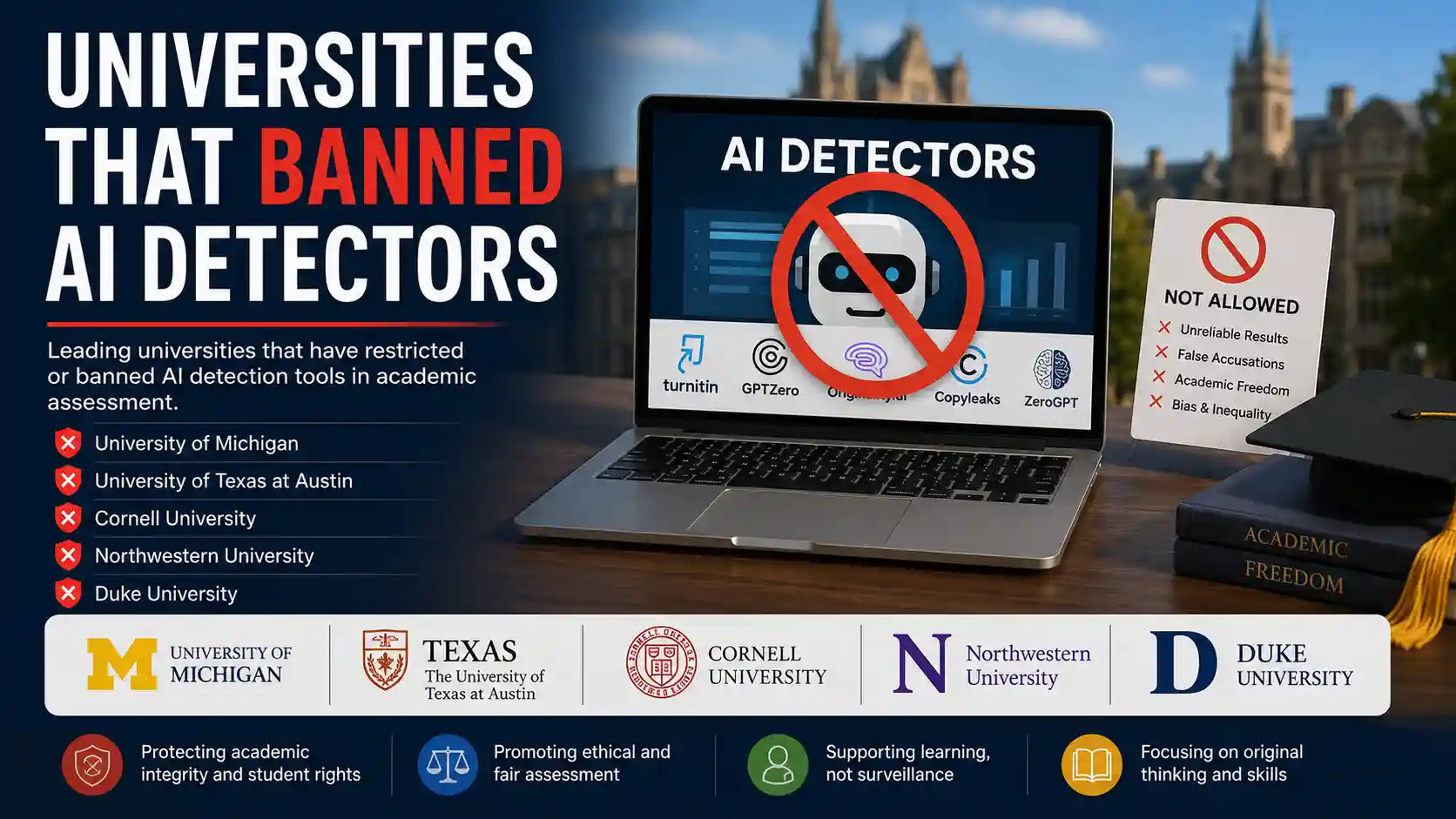
This matters for policy discussions happening alongside detection-tool adoption, covered in depth in our companion piece on how much universities spend on AI detection tools and our list of universities that have banned AI detectors outright. Secondary-level exam boards in England have so far taken a different path from many universities: rather than banning detection software, JCQ guidance explicitly endorses its use as one tool among several for identifying suspected AI misuse.
Subjects and Assessment Types Most at Risk
Ofqual’s headline statistics don’t break AI-related plagiarism down by subject, but JCQ’s published guidance and real anonymised case examples make the risk pattern clear: AI misuse concentrates almost entirely in non-examined assessment (NEA), coursework, and word-processed exam scripts, rather than traditional closed-book, handwritten exams. That’s because NEAs give students unsupervised time to draft and redraft work outside the exam hall, exactly the conditions in which a generative AI tool can be used undetected.
AQA GCSE Religious Studies (word-processed exam)
An examiner flagged a word-processed script for review after noticing American spellings and unusually sophisticated language inconsistent with GCSE-level work. AI detection software returned a high probability score. The candidate denied AI use in a statement, but the malpractice committee found the regulations had been breached and disqualified the candidate from the qualification.
A Level History Coursework (NEA)
A centre followed up on a teacher’s concerns using AI detection software after suspecting two candidates’ non-examined assessment work was AI-generated. Both candidates were found to have committed malpractice; one was disqualified from the qualification entirely, while the other lost all marks for the affected NEA component.
Beyond these documented examples, JCQ guidance flags subjects with a heavy coursework or extended-writing component, including English, History, Religious Studies, Art and Design, and written vocational and technical qualifications, as structurally higher-risk simply because of how much unsupervised drafting time they involve. Analysts have also noted that private schools disproportionately offer qualifications like the English IGCSE, which can carry a much larger non-examined assessment weighting than the mainstream state-school GCSE, a structural difference that may concentrate AI-related risk unevenly across the school system.
Staff, Centre-Level, and Detection Software Data
AI-related integrity risk in the official statistics isn’t confined to students. Staff and whole-centre malpractice cases of all types rose sharply in the most recent exam series, driven mainly by maladministration (procedural failures without intent to deceive) rather than deliberate misconduct, but the scale of the increase is notable in its own right.
| Level | 2022 | 2023 | 2024 | 2025 |
|---|---|---|---|---|
| Staff malpractice | 240 | 230 | 245 | 465 |
| School/college malpractice | 55 | 55 | 145 | 200 |
JCQ guidance requires Heads of Centre to have arrangements in place ensuring student work is authenticated properly, and states that staff who have doubts about the authenticity of a student’s work but fail to investigate can themselves face sanctions. Exam boards report using “a combination of different approaches, including detection software” to identify suspected AI use, meaning tools similar to those covered in our analysis of AI detector bias against ESL writers and AI detection false positive rates are already embedded in how UK secondary qualifications are policed, with all the reliability caveats that implies.
What the Official Numbers Don’t Capture
Every figure above counts only proven cases that resulted in a formal penalty. Independent survey research, while methodologically different from Ofqual’s administrative data and not directly comparable to it, consistently suggests the real rate of AI use in assessed schoolwork is far higher than what gets caught and penalized. Broader UK research tracking AI-related misconduct at university level found the rate of formally confirmed cheating cases rose from roughly 1.6 to about 7.5 per 1,000 students between the 2022-23 and 2024-25 periods, according to Freedom of Information data compiled by newspaper investigations, a pattern our AI academic misconduct statistics page explores in more depth.
The detection gap
Multiple education-sector surveys report that a majority of secondary teachers now say they have detected or strongly suspected AI misuse in student work at some point, a figure well above what shows up in formal malpractice statistics. That gap doesn’t mean the official numbers are wrong; it means detection, formal reporting, and confirmed sanction are three separate filters, and each one narrows the count. What Ofqual publishes is the far end of that funnel, not the starting point.
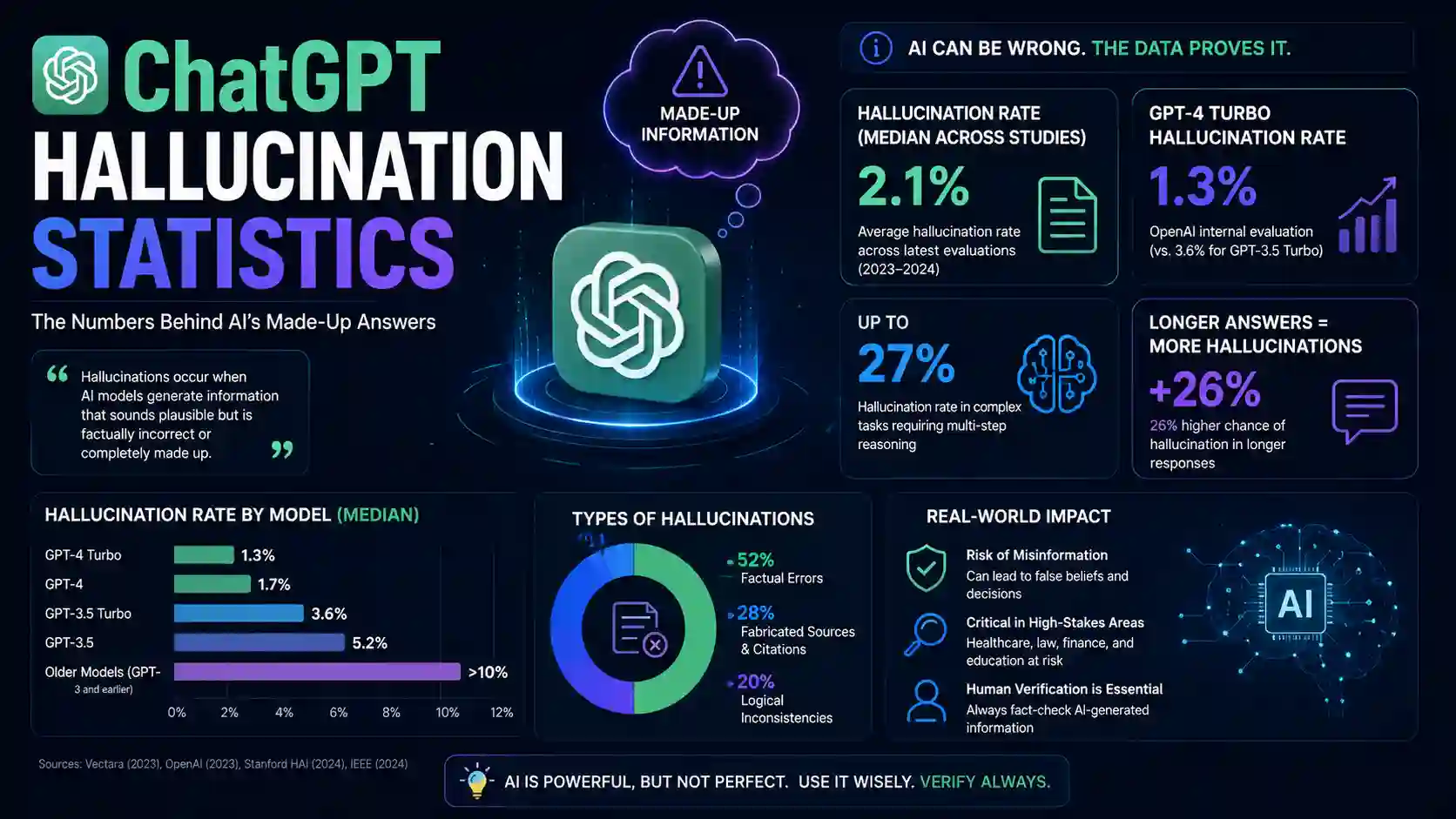
This is also where AI detection reliability becomes a genuine fairness issue rather than a purely technical one. Our related reporting on AI detection lawsuits documents what happens when detection software gets it wrong in an assessment context, and ChatGPT hallucination statistics are a useful reminder that the same generative models producing the disputed text are themselves unreliable narrators, which complicates both the misuse case and the detection case simultaneously.
Guidance for Students and Parents
- Understand that NEAs and coursework carry the highest documented risk. Both real JCQ case examples involved word-processed or non-examined assessment work, not supervised handwritten exams.
- Reference any AI-assisted elements explicitly if permitted. JCQ guidance is clear that unreferenced AI content cannot be rewarded, and a false declaration of authenticity is itself treated as a separate, serious malpractice offence.
- Keep drafts and version history. As with the university-level disputes covered in our AI detection lawsuits tracker, a documented drafting process is consistently the strongest evidence when a piece of work is challenged.
- Know that AI detection software can misfire. Formal, structured, or advanced-vocabulary writing, exactly the register schools try to teach, can resemble the statistical signature AI detectors flag; see our detailed breakdown of AI detection false positives.
- Ask your centre what their AI policy actually permits for research, brainstorming, and grammar support versus final-draft generation, since permitted use varies by subject and exam board.
Guidance for Teachers and Exam Centres
Treat detection software as one signal, not a verdict
JCQ guidance frames detection software as part of a “combination of different approaches,” not a standalone basis for a malpractice finding. Corroborate with stylistic inconsistency, absent drafts, and candidate interviews.
Watch NEA-heavy subjects most closely
Both documented JCQ examples involved coursework or word-processed exam scripts. Subjects with a large non-examined assessment weighting warrant proportionally more authentication scrutiny.
Update authentication sheets and declarations
Coursework authentication sheets now explicitly reference AI tool use; make sure both staff and students understand what they’re signing and what “own work” means in an AI-accessible environment.
Document the investigation, not just the flag
Heads of Centre can themselves face sanctions for failing to investigate doubts about authenticity, so a documented, fair investigation process protects both the centre and the student regardless of the eventual finding.
Help Students Write Confidently Within the Rules
Part of what’s driving false-flag risk in NEAs and coursework is that careful, well-structured student writing can resemble AI output to a detector. Where a centre’s policy allows AI-assisted proofreading or editing at the drafting stage, rather than AI-generated content, WriteHuman can help students polish their own writing naturally. It does not replace disclosure requirements and will not help a student pass off AI-generated content as their own, which remains malpractice regardless of the tool used to disguise it.
Why This Data Matters Beyond the Exam Hall
These figures sit inside a much larger shift in how assessment integrity is managed across every stage of education, from GCSE coursework through to AI-generated research papers at the postgraduate level. The policy responses differ sharply by country and institution type; our study of AI detection policy at 50 leading U.S. universities shows many institutions moving away from centralized detector-based enforcement, while UK exam boards have so far leaned into detection software as a standard tool. There’s also a resourcing dimension: running detection infrastructure and investigating flagged cases carries real institutional cost, examined in how much universities spend on AI detection tools, and a physical-world footprint behind the generative models themselves, covered in AI data centers and the environment.
Frequently Asked Questions
How many GCSE and A level students were caught misusing AI?
According to official Ofqual statistics, there were 100 proven cases of AI-related plagiarism in summer 2025, up from 85 in summer 2024, the first exam series in which AI misuse was reported as its own distinct malpractice sub-category.
What percentage of GCSE and A level malpractice involves AI?
AI-related plagiarism made up about 2.0% of all proven student malpractice cases in summer 2025, up from about 1.7% in summer 2024. Within the plagiarism category alone, AI misuse accounted for 75.0% of cases in 2025, up sharply from 55.4% in 2024.
What is the most common type of exam malpractice, and how does it compare to AI misuse?
Mobile phones and other communication devices remain the largest category by far, at roughly 42-44% of all proven student malpractice cases in the most recent exam series. AI-related plagiarism is a much smaller, though rapidly growing, category by comparison.
Do these statistics capture all the AI cheating that actually happens?
No. Ofqual’s figures count only proven cases that resulted in a formal penalty. Independent teacher surveys suggest suspected or detected AI use is considerably more common than what gets formally reported and sanctioned, meaning the official statistics likely represent a small, filtered slice of total AI misuse.
Which subjects are most affected by AI-related malpractice?
Official statistics don’t break this down by subject, but JCQ guidance and published case examples point to subjects with non-examined assessment or coursework components, such as History, Religious Studies, English, and Art and Design, as the areas of greatest documented risk, since these formats involve unsupervised drafting time.
Are exam boards using AI detection software to catch these cases?
Yes. JCQ guidance confirms exam boards use a combination of approaches, including AI detection software, alongside human judgement such as stylistic review and candidate interviews, to identify suspected AI misuse in student work.
Research Sources and Further Reading
This page is built primarily on official Ofqual statistical releases and JCQ guidance documents, with independent survey research clearly distinguished from official administrative data throughout.
View all sources used in this article
- Ofqual: Malpractice in GCSE, AS and A level — summer 2025 exam series (official statistics)
- Ofqual: Full statistical release and data tables, summer 2025 exam series
- Ofqual: Background information for malpractice, summer 2024 exam series (AI category split explained)
- Ofqual Delivery Report 2024
- Ofqual Delivery Report 2025
- Ofqual Delivery Report 2023 (first informal AI malpractice mentions)
- JCQ: AI Use in Assessments — Your Role in Protecting the Integrity of Qualifications
- JCQ Knowledge Hub: AI Use in Assessments guidance and case examples
- JCQ: AI Use in Assessments (April 2025 revision, PDF)
- AQA: Updated JCQ Guidance on Use of Artificial Intelligence in Assessments
- Schools Week: AI Cheating — Just How Much Is Going On In Schools?
- Ofqual: Artificial Intelligence Malpractice and Assessment — Advice Note
- JoshWP: AI Detector Bias Against ESL Writers
- JoshWP: ChatGPT Hallucination Statistics
- JoshWP: AI Academic Misconduct Statistics
- JoshWP: AI Detection Lawsuits
- JoshWP: AI Detection False Positives
- JoshWP: Universities That Banned AI Detectors
- JoshWP: AI Detection Policies at 50 Leading U.S. Universities
- JoshWP: How Much Universities Spend on AI Detection Tools
- JoshWP: AI-Generated Research Papers — 2026 Statistics
- JoshWP: AI Data Centers and the Environment