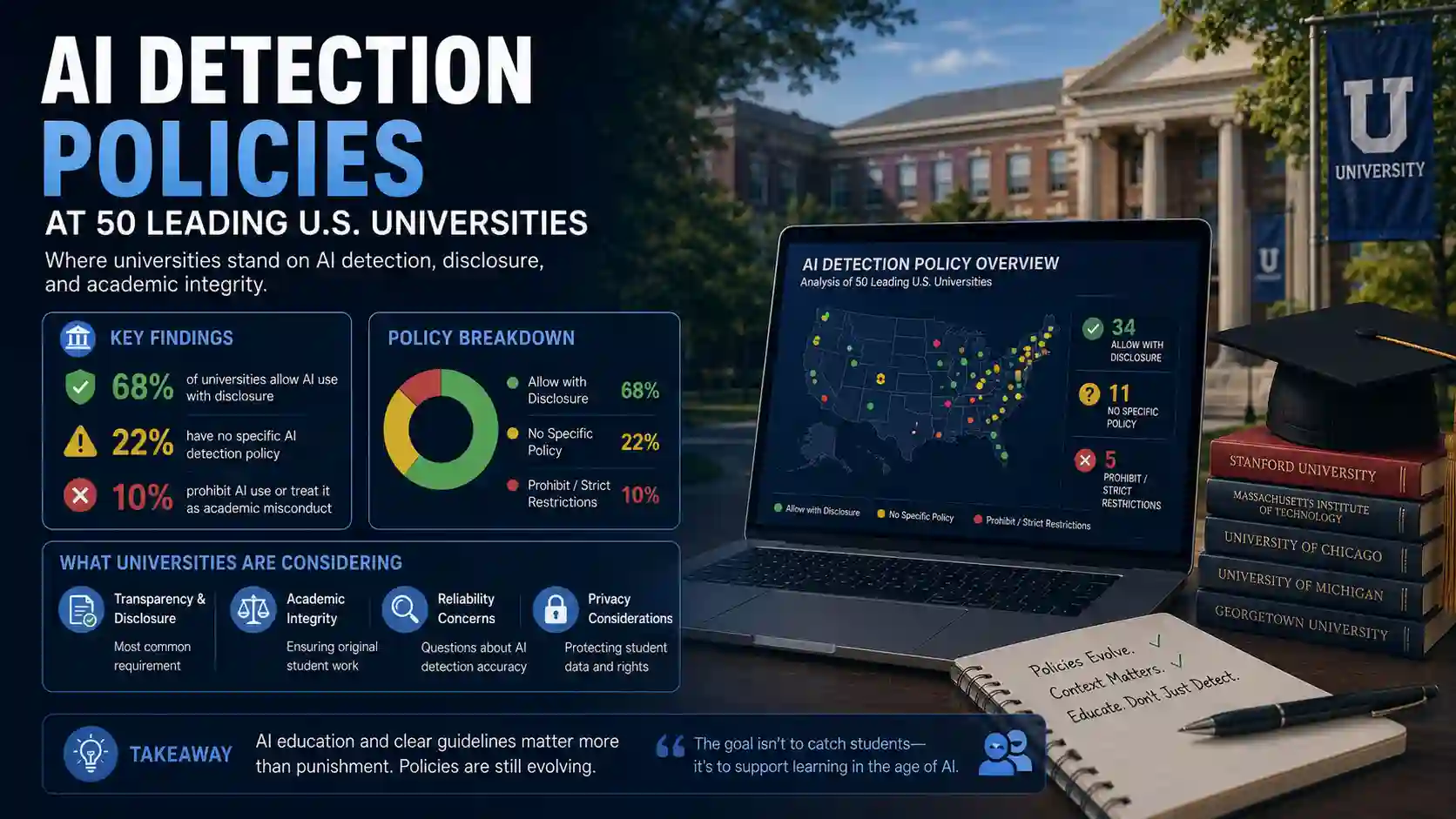
AI Detection Policies at 50 Leading U.S. Universities
Students, parents, faculty, and academic-integrity teams are all asking the same question in 2026: how do top U.S. universities handle AI detection, ChatGPT, Turnitin AI scores, disclosure, and academic misconduct? This study reviews public AI academic integrity guidance from 50 leading U.S. universities and explains the real policy trend: less blind trust in AI detectors, more course-level rules, more disclosure, and more emphasis on human judgment.
Quick Answer
AI detection policies at leading U.S. universities in 2026 are moving away from automatic punishment based on detector scores. The strongest pattern across the 50-school sample is course-level authority: instructors define whether AI tools are prohibited, allowed with disclosure, allowed only for specific tasks, or encouraged as part of the learning process. The second major pattern is evidence caution: AI detectors may appear in academic-integrity conversations, but universities increasingly warn that detector outputs are unreliable, incomplete, biased, or insufficient as standalone proof.
The safest practical rule for students is this: do not treat ChatGPT, Claude, Gemini, Grammarly, WriteHuman, QuillBot, or any AI writing tool as automatically allowed. Read the syllabus, follow assignment instructions, disclose AI assistance when required, preserve drafts and notes, and ask the instructor before using AI for any part of an assessed submission. The safest rule for faculty is equally clear: write explicit AI-use policies before the assignment is due, design assessments around process and learning objectives, and never treat a black-box AI detector score as the whole case.
Write More Clearly Without Crossing Academic Lines
WriteHuman can help writers revise AI-assisted drafts for clarity, flow, and readability, but students should only use it when their course policy allows AI-assisted editing and should disclose tool use when required. Use it for ethical revision, not to hide misconduct or bypass a professor’s instructions.
What This Study Answers
People searching for AI detection policies at U.S. universities usually want one of five things: a list of colleges using AI detectors, a clear answer on whether AI detector results can get a student punished, a comparison of top university ChatGPT policies, a practical guide to disclosure rules, or evidence that AI writing detection is unreliable. This article addresses all five.
The phrase “AI detection policy” is itself slightly misleading. Most leading universities do not publish a simple rule that says “we use this detector” or “we ban this detector.” Instead, they publish broader guidance on generative AI, academic integrity, instructor discretion, syllabus language, citation, privacy, assessment design, and student responsibility. The detector question appears inside that larger policy ecosystem.
That matters because students often worry about the wrong thing. The greatest risk in 2026 is not simply that a detector flags a paper. The greater risk is that a student uses AI in a way that violates the stated course policy, cannot explain the submitted work, cannot produce drafts or notes, includes fabricated citations, submits output that does not match prior work, or fails to disclose AI assistance when the assignment required it.
How This 2026 University AI Detection Study Was Built
This study reviews public-facing AI, teaching, academic-integrity, and student-conduct guidance from 50 leading U.S. universities. The sample is not presented as an official ranking. It is a practical research sample of prominent national universities, Ivy League institutions, major public research universities, and large universities that influence academic policy norms.
Coding Framework
Each school was coded across four policy dimensions:
- Policy posture: course-level discretion, default restriction, broad AI literacy, or mixed/decentralized guidance.
- AI detector stance: explicit caution, human-review-only signal, no central public detector rule found, or detector not recommended.
- Disclosure expectation: required, recommended, course-specific, or unclear in central public guidance.
- Student takeaway: the practical action a student should take before using AI.
Because university pages change, this should be treated as a June 2026 public-policy snapshot, not legal advice and not a substitute for the current syllabus, student handbook, or academic-integrity office.
The study gives more weight to official university pages than to media coverage. When a school did not publish a clear AI-detector-specific rule on a central public page, it was coded as no central public detector rule found rather than assuming the school either uses or rejects AI detection. That distinction keeps the dataset honest. Absence of a detector statement is not the same as absence of enforcement.
Key Findings From the 50-University Review
The big story is decentralization. Most universities are not trying to write one permanent AI rule for every class. A literature course, an introductory computer science assignment, a take-home exam, a studio design project, a language-learning exercise, and a graduate research paper do not have the same learning objectives. Universities are therefore pushing policy authority down to instructors and assignments.
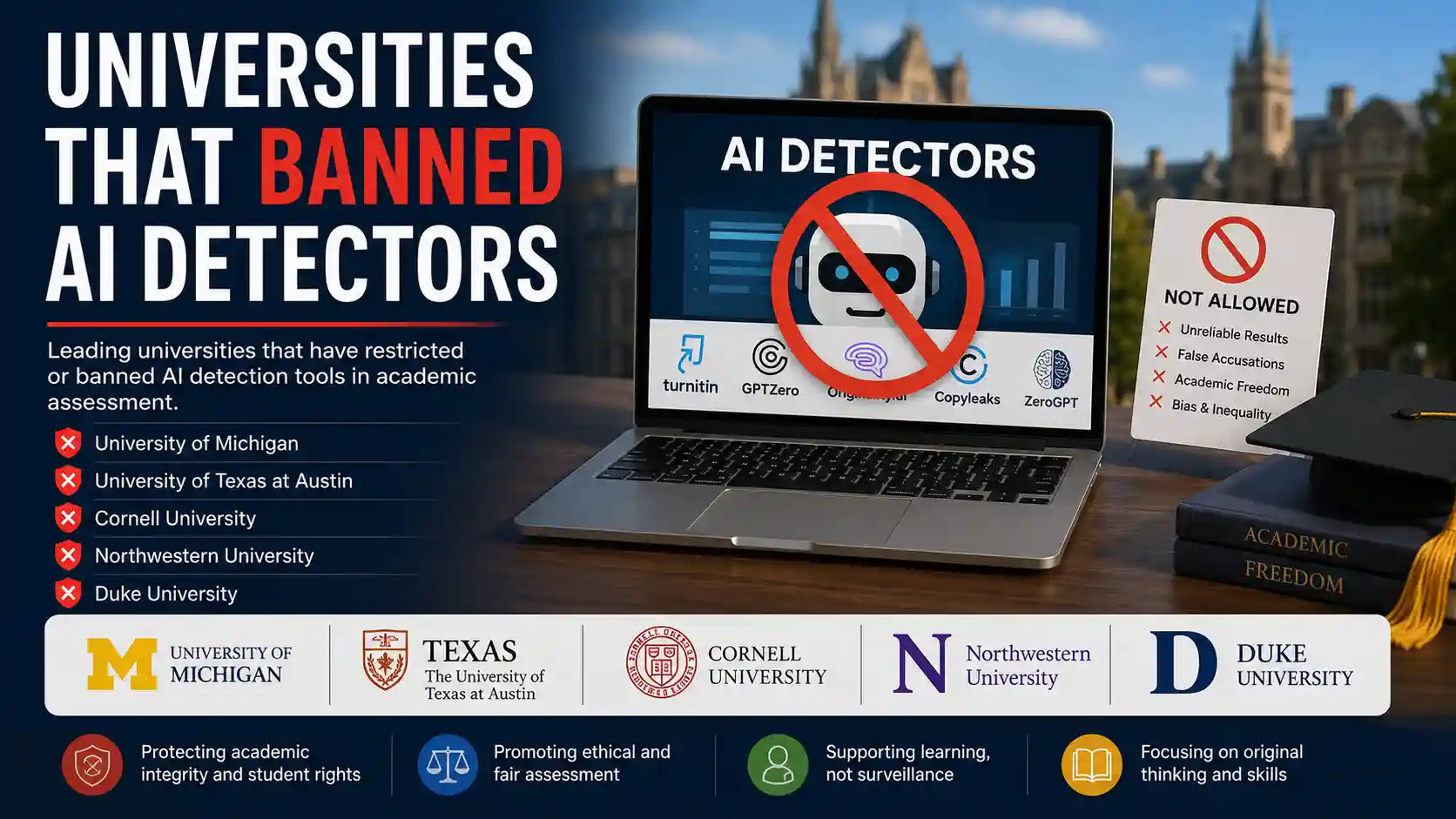
The second story is that AI detectors have not become the stable enforcement machine many people expected in 2023. The most careful university guidance treats detection tools as weak signals at best. Cornell’s public guidance is one of the clearest examples: it says automatic detection algorithms are currently not recommended for generative-AI academic-integrity violations because of unreliability and inability to provide definitive evidence. Stanford’s guidance allows instructors to give advance notice that detection software may be used, but its broader policy still centers course-specific rules and disclosure. Yale emphasizes compliance with individual course policies and instructor guidance.
The third story is student responsibility. Universities may be skeptical of AI detectors, but they are not giving students a free pass. The burden is shifting toward transparency: keep drafts, cite or disclose AI assistance, verify citations, understand the tool’s limits, and be able to explain the work. In practice, the strongest evidence in an AI misconduct case is often not a detector score. It is the student’s process record.
For the budget side of this same policy shift, read our companion analysis on how much universities spend on AI detection tools. And because many disputes begin with ordinary AI-assisted drafting rather than intentional cheating, students and instructors should also understand how to make AI writing sound more natural without crossing the ethical line.
| Pattern | Count | Share | Meaning |
|---|---|---|---|
| Course-level/instructor discretion is the primary model | 37 of 50 | 74% | AI use depends mainly on the syllabus, assignment instructions, instructor policy, or departmental context. |
| Default restriction unless permitted | 7 of 50 | 14% | Public guidance leans toward treating unapproved AI assistance as unauthorized aid. |
| Broad AI-literacy / managed integration model | 6 of 50 | 12% | Guidance emphasizes preparing students to use AI responsibly, while still respecting assignment-level rules. |
| Explicit detector caution or not-recommended language found | 17 of 50 | 34% | Public guidance warns that detector outputs can be unreliable or should not be used as definitive evidence. |
| No public detector-specific rule found in central guidance reviewed | 26 of 50 | 52% | The university may still use tools locally, but central public pages did not clearly define detector evidentiary rules. |
| Disclosure or citation required/recommended when AI is allowed | 39 of 50 | 78% | Transparency is the dominant compliance habit, even where AI use is encouraged. |
Responsive Graphs: What the 2026 Policy Landscape Looks Like
The charts below are rendered with Chart.js as code, not images. They are designed to resize cleanly on phones, tablets, and desktop screens.
Policy Posture Across 50 Leading Universities
The leading model is course-level discretion. This means students should always check the syllabus and assignment instructions before using AI.
AI Detector Stance in Public Guidance Reviewed
No school in the sample was coded as publicly endorsing detector scores as standalone proof. The largest category is no central detector-specific rule found.
Common Student Obligations When AI Is Allowed
Disclosure, citation, draft preservation, and ability to explain work are becoming more important than detector avoidance.
External Research Benchmarks on University AI Guidance
A 2024 analysis of 116 U.S. R1 universities found 63% encouraged GenAI use, 56% offered sample syllabi, and 41% provided detailed classroom guidance.
Why Universities Are Careful With AI Detection Tools
The university caution around AI detectors is not accidental. AI writing detection is harder than plagiarism detection. Plagiarism tools compare text against known sources. AI detectors usually infer probability from statistical patterns in writing. That makes the evidentiary problem much harder: a detector may say a text resembles AI-generated writing, but it usually cannot prove who wrote it, what tool was used, whether AI assistance was authorized, or whether a student used AI for brainstorming, translation, grammar, citation cleanup, or full drafting.
That ambiguity matters because academic misconduct findings can have serious consequences. A false accusation can damage a student’s grade, record, scholarship status, visa status, graduate-school prospects, or trust in the institution. A false negative can let misconduct pass. Both errors matter, but false positives create due-process problems because an innocent student may be forced to prove a negative against a tool they cannot inspect.
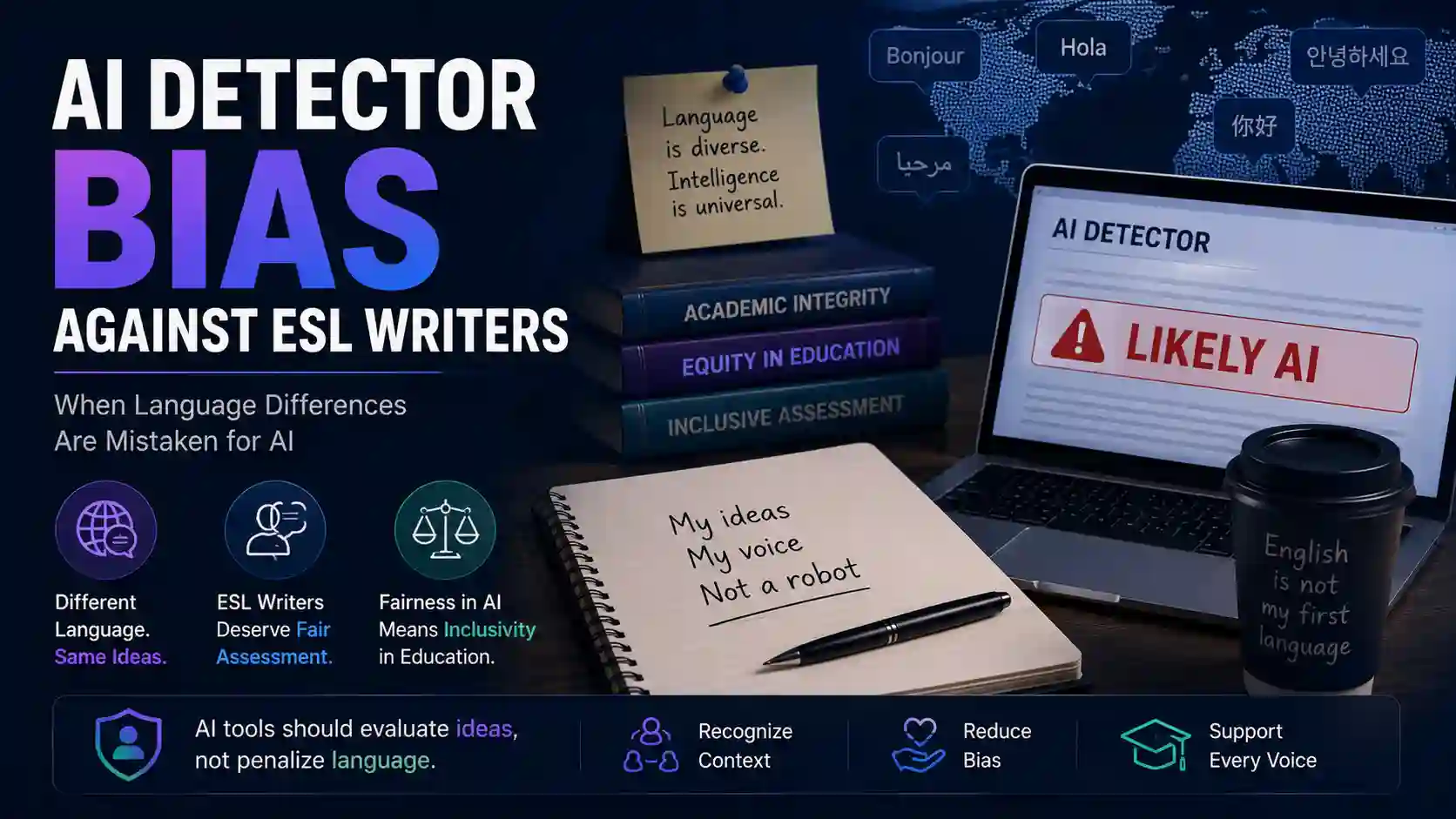
Research and reporting have repeatedly found that AI detectors can struggle with paraphrased AI text, non-native English writing, formulaic prose, highly polished human writing, and short submissions. Turnitin has said its AI detector reviewed more than 200 million papers in its first year and flagged 11% as containing at least 20% AI-written language, while also claiming a low false-positive rate for full documents. Even so, many universities treat such scores as starting points for inquiry rather than verdicts.
The same detection problem appears in scholarly publishing. Journal editors are now dealing with AI-assisted manuscripts, fabricated references, paper-mill submissions, and AI-shaped peer review. For a deeper look beyond classroom policy, see our 2026 report on AI-generated research papers, retractions, peer review, and journal policies.
The Policy Shift
The mature 2026 policy position is not “ignore AI cheating.” It is “do not outsource academic judgment to a detector.” Universities are moving toward multi-evidence review: drafts, version history, oral explanation, citation verification, assignment fit, prior writing, student conversation, and syllabus-defined expectations.
AI Detection Policies at 50 Leading U.S. Universities
The table below summarizes the public guidance reviewed for each school. “Detector stance” is deliberately conservative: if a central public page did not clearly state how AI detector evidence should be used, the school is coded as no central public detector rule found. Students should always consult the current syllabus and official student handbook.
| # | University | Public Policy Posture | AI Detector Stance | Disclosure / Citation Expectation | Student Takeaway | Public Source |
|---|---|---|---|---|---|---|
| 1 | Princeton University | Course-level | No central detector rule found | Course-specific; ask before using AI. | Use AI only if the instructor or assignment permits it. | McGraw Center |
| 2 | Massachusetts Institute of Technology | Course-level | Caution / human review | Follow instructor rules; disclose when required. | AI assistance should align with collaboration and assignment rules. | MIT Academic Integrity |
| 3 | Harvard University | Faculty-led | No central detector rule found | Varies by school and course. | Expect faculty-specific rules, especially in writing-heavy courses. | Harvard FAS OUE |
| 4 | Stanford University | Default restriction unless allowed | Detection may be used with notice | Default to disclosure when in doubt. | Absent clear permission, substantial AI completion is treated like unauthorized assistance. | Stanford OCS |
| 5 | Yale University | AI literacy / course policy | No central detector rule found | Comply with individual course policies. | Yale encourages AI literacy, but course rules still control submissions. | Yale Poorvu Center |
| 6 | California Institute of Technology | Course-level | No central detector rule found | Course-specific. | Assume strict collaboration norms unless AI is explicitly allowed. | Caltech Provost |
| 7 | Duke University | Course-level | Caution / process evidence | Instructor-defined; disclosure commonly recommended. | Keep notes and drafts; Duke guidance emphasizes assignment design and communication. | Duke Learning Innovation |
| 8 | Johns Hopkins University | Course-level | No central detector rule found | Course-specific. | Follow school and instructor rules; medicine/research contexts may be stricter. | JHU AI |
| 9 | Northwestern University | Course-level | Caution | Course-specific; transparency encouraged. | AI policy may vary significantly across departments. | Northwestern AI |
| 10 | University of Pennsylvania | Course-level | No central detector rule found | Instructor-defined. | Check syllabus language before using AI for graded work. | Penn CETLI |
| 11 | Cornell University | Course-level | Automatic detectors not recommended | Attribution expected when AI is permitted. | Course policies and objective evidence matter more than detector scores. | Cornell CTI |
| 12 | University of Chicago | Course-level | No central detector rule found | Instructor-defined. | Expect rigorous assignment-specific expectations. | UChicago Academic Technology |
| 13 | Brown University | AI literacy / course policy | Caution | Course-specific; disclosure often recommended. | Brown-style guidance emphasizes responsible use and instructor clarity. | Brown CTL |
| 14 | Columbia University | Course-level | Caution | Instructor-defined. | Course policy and assignment design are the first source of authority. | Columbia CTL |
| 15 | Dartmouth College | Course-level | No central detector rule found | Instructor-defined. | Ask before using AI in graded work. | Dartmouth AI |
| 16 | University of California, Los Angeles | Course-level | Caution | Course-specific; disclosure if required. | UCLA teaching guidance prioritizes clear assignment policies. | UCLA Teaching and Learning |
| 17 | University of California, Berkeley | Course-level | Caution | Instructor-defined; attribution where required. | Check course policy; Berkeley guidance centers pedagogical fit. | Berkeley RTL |
| 18 | Rice University | Course-level | No central detector rule found | Instructor-defined. | Follow course rules and honor-code expectations. | Rice CTE |
| 19 | Vanderbilt University | AI literacy / course policy | Caution | Course-specific; disclosure encouraged when allowed. | Vanderbilt has been active in generative-AI teaching resources. | Vanderbilt Brightspace |
| 20 | University of Notre Dame | Course-level | No central detector rule found | Instructor-defined. | Notre Dame honor-code expectations apply to AI assistance. | Notre Dame Learning |
| 21 | University of Michigan | AI literacy / course policy | Caution | Course-specific; disclosure encouraged. | Michigan emphasizes responsible GenAI use and instructor context. | U-M GenAI |
| 22 | Georgetown University | Course-level | Caution | Instructor-defined; transparency encouraged. | Course and school policies can differ. | Georgetown CNDLS |
| 23 | University of North Carolina at Chapel Hill | AI literacy / course policy | No central detector rule found | Course-specific. | Follow course policy and honor-code expectations. | UNC AI |
| 24 | Carnegie Mellon University | Course-level | No central detector rule found | Instructor-defined. | AI use varies sharply by computing, writing, and design contexts. | CMU Eberly Center |
| 25 | Emory University | Course-level | No central detector rule found | Course-specific. | Ask before using AI; school policies may differ. | Emory AI |
| 26 | University of Virginia | Honor-system restriction unless allowed | Caution / human review | Course-specific; disclosure when allowed. | UVA’s honor culture makes unauthorized assistance especially risky. | UVA GenAI |
| 27 | Washington University in St. Louis | Course-level | No central detector rule found | Instructor-defined. | Follow assignment-level AI language. | WashU Teaching Center |
| 28 | University of California, Davis | Course-level | No central detector rule found | Course-specific. | Check instructor rules and campus academic-integrity guidance. | UC Davis CEE |
| 29 | University of California, San Diego | Course-level | Caution | Course-specific; disclose if required. | Use only within assignment boundaries. | UCSD Digital Learning |
| 30 | University of Southern California | Course-level | No central detector rule found | Instructor-defined. | Course policy controls whether AI is permitted. | USC CET |
| 31 | University of Florida | AI literacy / course policy | No central detector rule found | Instructor-defined. | UF promotes AI engagement, but academic rules still apply. | UF AI |
| 32 | University of Texas at Austin | Course-level | Caution | Course-specific. | Expect department and instructor variation. | UT Austin CTL |
| 33 | Georgia Institute of Technology | Course-level | No central detector rule found | Instructor-defined. | AI rules may be detailed in computing assignments; read carefully. | Georgia Tech CTL |
| 34 | New York University | Course-level | Caution / human review | Instructor-defined; disclosure often expected. | NYU schools and departments may publish separate rules. | NYU GenAI |
| 35 | Boston College | Restrictive unless allowed | No central detector rule found | Course-specific. | Ask before using AI; unapproved assistance may violate academic integrity. | Boston College CTE |
| 36 | Tufts University | Course-level | Caution | Instructor-defined; transparency encouraged. | AI use should be aligned with course goals and disclosed when required. | Tufts CELT |
| 37 | University of Illinois Urbana-Champaign | Course-level | No central detector rule found | Course-specific. | Follow instructor rules; AI use can vary heavily by department. | Illinois CITL |
| 38 | University of Wisconsin-Madison | Course-level | Caution | Instructor-defined. | Course transparency is the key compliance point. | UW-Madison Teaching |
| 39 | Boston University | Course-level | No central detector rule found | Instructor-defined. | AI use is governed by assignment and school policy. | BU CTL |
| 40 | Rutgers University | Course-level | No central detector rule found | Course-specific. | Follow syllabus and academic-integrity rules. | Rutgers OTEAR |
| 41 | Ohio State University | Course-level | No central detector rule found | Instructor-defined. | Ask before using AI in graded work. | Ohio State Teaching |
| 42 | Purdue University | Course-level | No central detector rule found | Course-specific. | Expect instructor-specific AI rules in STEM and writing courses. | Purdue Innovative Learning |
| 43 | University of Washington | Course-level | Caution | Course-specific; disclosure encouraged. | Follow instructor guidance and preserve process evidence. | UW Teaching |
| 44 | Pennsylvania State University | Course-level | No central detector rule found | Instructor-defined. | Use AI only under course policy. | Penn State AI |
| 45 | University of Maryland | Course-level | No central detector rule found | Course-specific. | Check course rules and honor pledge expectations. | UMD TLTC |
| 46 | Texas A&M University | Restrictive unless allowed | No central detector rule found | Course-specific. | Honor-code expectations make unauthorized AI use risky. | Texas A&M CTE |
| 47 | University of Georgia | Course-level | No central detector rule found | Instructor-defined. | Follow syllabus language; ask when unclear. | UGA CTL |
| 48 | Virginia Tech | Course-level | No central detector rule found | Course-specific. | Honor system and assignment instructions govern AI use. | Virginia Tech Teaching |
| 49 | Wake Forest University | Course-level | No central detector rule found | Instructor-defined. | Use AI only if course policy permits it. | Wake Forest CAT |
| 50 | University of Rochester | Course-level | No central detector rule found | Course-specific. | Ask before using AI tools in assessed work. | Rochester CETL |
The Student Playbook: How to Avoid AI Policy Trouble
The practical student question is not “Can a detector catch me?” That is the wrong mental model. The better question is “Can I show that my work followed the rules of this assignment?” If you can answer that clearly, you are in a much stronger position.
- Read the syllabus before using AI. Look for terms like generative AI, ChatGPT, language model, automated writing tools, unauthorized aid, collaboration, proofreading, and citation.
- Ask before the deadline. If the policy is unclear, ask the instructor in writing. A short email can prevent a serious academic-integrity problem.
- Separate allowed editing from prohibited authorship. Some courses allow grammar help but not idea generation. Others allow brainstorming but not drafting. The difference matters.
- Disclose when required or when in doubt. A simple AI-use note can be safer than silence, especially in courses that permit AI with attribution.
- Keep process evidence. Save outlines, notes, drafts, source lists, version history, prompts, and screenshots of instructor guidance.
- Verify every citation. AI tools fabricate sources. Fake citations are one of the easiest ways for a submission to trigger suspicion.
- Be ready to explain your work. If you cannot verbally explain the argument, code, calculation, method, or sources, the work is not really yours in the academic sense.
- Do not use AI to bypass learning objectives. If the point of the assignment is to practice writing, analysis, coding, translation, or problem-solving, outsourcing that core skill is usually the danger zone.
Ethical Editing Help
If your course allows AI-assisted editing, WriteHuman can help revise awkward drafts into clearer language. Keep the original draft, document your use, and never use any tool to disguise prohibited AI authorship.
The Faculty Playbook: Better Than Detector Policing
Faculty are in the hardest position. Students are using AI whether policies are ready or not, but detectors are unreliable enough that they can create new unfairness. The best response is not panic. It is better assignment architecture.
Before the Assignment
- Define allowed and prohibited AI uses.
- Explain why the rule supports the learning objective.
- Give examples of acceptable and unacceptable use.
- Require an AI-use statement when AI is allowed.
During Assessment
- Collect process artifacts such as drafts or logs.
- Use oral follow-ups for suspicious work.
- Evaluate citation integrity and source quality.
- Treat detector scores as at most one weak signal.
The strongest academic-integrity cases are built on objective evidence, not vibes. A detector score, a “this sounds like AI” impression, or unusually polished prose should trigger inquiry, not instant accusation. The fairest systems combine clear rules, authentic assessment, student conversation, and documented process.
The Four AI Policy Models Universities Are Using
| Model | What It Says | Strength | Weakness | Best Use Case |
|---|---|---|---|---|
| AI prohibited unless allowed | Students may not use generative AI unless the instructor explicitly permits it. | Clear default; easier for students to understand. | Can suppress legitimate AI literacy and accessibility uses. | Foundational writing, exams, language learning, early skill development. |
| AI allowed with disclosure | Students can use AI for defined tasks if they disclose or cite it. | Builds transparency and real-world tool literacy. | Students may overuse AI without understanding the work. | Research planning, revision, coding support, brainstorming. |
| Assignment-by-assignment rules | Each assignment states which AI uses are allowed or prohibited. | Best alignment with learning objectives. | Requires more instructor effort and more student attention. | Mixed courses with different assignment types. |
| AI-integrated pedagogy | AI is part of the course; students critique, use, audit, or improve AI outputs. | Prepares students for AI-shaped workplaces. | Requires careful assessment design and equity planning. | Advanced courses, professional programs, AI literacy units. |
The most durable model is assignment-by-assignment clarity. It respects academic freedom, disciplinary differences, student learning, and real-world AI use. It also makes enforcement fairer because students know the rule before they submit.
Where WriteHuman Fits: Editing, Clarity, and Policy Compliance
WriteHuman and similar AI writing tools sit in the gray area that many university policies now try to clarify. Some instructors allow grammar correction, readability improvements, brainstorming, or style revision. Others prohibit tools that reorganize or rewrite student prose because the learning objective is to develop the student’s own writing process and voice.
Important Ethical Line
Do not use WriteHuman, ChatGPT, paraphrasers, or any writing tool to hide prohibited AI use. If a course bans AI-assisted writing or requires disclosure, follow that rule. The legitimate use case is improving clarity in contexts where AI-assisted editing is allowed.
If your assignment permits AI-assisted editing, WriteHuman may help with sentence flow, tone, readability, and draft polish. The best practice is to keep your original draft, save a copy of the revised version, document the tool used, and disclose it if the syllabus requires disclosure. That kind of transparency is exactly where many university policies are headed.
Improve Clarity the Transparent Way
Use WriteHuman for ethical revision only when your course policy allows AI writing assistance. Keep your drafts, disclose when required, and make sure the final ideas, evidence, and reasoning are yours.
Frequently Asked Questions
Can an AI detector alone prove academic misconduct?
Based on the public guidance reviewed in this study, leading universities are not treating AI detector scores as sufficient standalone proof. The safer interpretation is that detector output may trigger a conversation or investigation, but any misconduct finding should rely on course policy, process evidence, student explanation, and human judgment.
Do universities ban ChatGPT?
Most leading universities do not publish a universal campus-wide ChatGPT ban. They usually allow instructors to decide whether AI tools are permitted, restricted, or prohibited in a specific course or assignment.
Should students disclose AI use even if not asked?
If the policy is unclear, students should ask the instructor. If AI use is permitted but disclosure rules are vague, a short AI-use note is often the safer path. However, disclosure does not make prohibited use acceptable.
Can Grammarly or editing tools trigger AI detectors?
They can contribute to suspicion in some cases because heavily edited prose may look different from a student’s usual style. The issue is not only detection. The issue is whether the course permits automated rewriting or grammar support and whether the student can explain the work.
What should a student do after being falsely accused of AI use?
Stay calm, gather drafts, notes, version history, sources, outlines, browser history if relevant, and any instructor guidance. Ask for the evidence, explain the writing process, and follow the school’s academic-integrity procedure. Do not rely only on arguing that detectors are unreliable; show your process.
Research Sources and Further Reading
This article uses official university guidance where publicly available, plus academic research and reporting on AI detector reliability. Source links are included so readers can verify the current policy language directly.
View all research sources and university policy links
- Stanford Office of Community Standards: Generative AI Policy Guidance
- Yale Poorvu Center: AI Guidelines
- Cornell Center for Teaching Innovation: Generative Artificial Intelligence
- Cornell CTI: AI and Academic Integrity
- Cornell CTI: AI Attribution Guidelines
- Generative Artificial Intelligence in Higher Education: Evidence from Institutional Policies and Guidelines
- Analysis of Generative AI Policies in Computing Course Syllabi
- Generative AI in Higher Education: Seeing ChatGPT Through Universities’ Policies
- Contra Generative AI Detection in Higher Education Assessments
- AI Detectors Fail Diverse Student Populations
- WIRED: Students Are Likely Writing Millions of Papers With AI
- WIRED: Kids Are Going Back to School. So Is ChatGPT
- Washington Post: Why honest students fear AI detectors
- Harvard Undergraduate Survey on Generative AI
- MIT Academic Integrity
- Princeton McGraw Center for Teaching and Learning
- Brown Center for Teaching and Learning
- Columbia Center for Teaching and Learning
- Northwestern AI
- University of Michigan GenAI
- University of Virginia Generative AI
- UNC AI
- University of Florida AI
- NYU Generative AI Teaching Guidance