AI-Generated Research Papers: 2026 Statistics on Retractions, Peer Review, and Journal Policies
If you are searching for reliable 2026 statistics on AI-generated research papers, the real story is not just “ChatGPT wrote a paper.” It is the collision between AI-assisted writing, paper mills, hallucinated citations, overwhelmed peer review, inconsistent journal policies, and a disclosure system that still depends heavily on author honesty.
Short Answer: What Changed by 2026?
By 2026, AI-generated and AI-assisted research papers are no longer a fringe publishing issue. Large language models are now used for drafting, translation, literature search, peer-review feedback, figure preparation, and sometimes outright fraud. The evidence shows three simultaneous trends: legitimate AI-assisted writing is rising, disclosure remains weak, and industrial fraud has become easier to scale.
The most important numbers are sobering. A 2024 keyword-based study estimated at least 60,000 papers, slightly over 1% of 2023 scholarly articles, were LLM-assisted. A 2026 medical-literature study found 2.7% of JAMA Network Open articles from January 2022 to March 2025 were classified as containing significant AI-generated text, rising to 11.3% in March 2025. A separate 2026 study estimated 146,932 hallucinated citations entered scientific writing in 2025 alone. Meanwhile, paper-mill and retraction statistics show the publishing system is struggling to clean up problems after publication.
AI-Generated Research Papers in 2026: The Statistics That Matter
The phrase “AI-generated research paper” can mean several things. It can describe a legitimate paper where authors used AI to improve English readability. It can mean a manuscript drafted in large part by a chatbot but checked by humans. It can also mean a fake paper produced by a paper mill, with fabricated methods, fake images, invented citations, and a purchased authorship slot. These categories must be separated, because the policy response is different for each one.
Editorial caution: this report does not treat every AI-assisted paper as misconduct. The problem is not the use of AI itself. The problem is undisclosed use, false authorship, fabricated references, manipulated peer review, generated figures that do not match data, and paper-mill workflows that use AI to make fraud cheaper and faster.
| Statistic | Reported Value | What It Measures | Important Caveat |
|---|---|---|---|
| Estimated LLM-assisted scholarly papers in 2023 | At least 60,000, slightly over 1% | Keyword prevalence associated with ChatGPT-style writing | Conservative estimate; does not prove full-paper generation. |
| JAMA Network Open articles classified with significant AI-generated text | 195 of 7,251 articles, or 2.7% | Commercial detector classification across original investigations, research letters, and commentaries | Detector-based, so it should be read as an estimate, not a misconduct verdict. |
| JAMA Network Open monthly detected rate by March 2025 | 11.3% | Monthly share classified as significant AI-generated text | One journal family and one detection method. |
| Full-text journal-policy study disclosure rate | 76 of 75,000 papers, or 0.1% | Explicit disclosure of AI use in post-2023 papers | Shows a transparency gap, not necessarily misconduct in every case. |
| ICLR 2024 peer reviews estimated AI-assisted | At least 15.8% | Peer-review text likely written with AI assistance | Lower bound using a detector; conference peer review is not identical to journal review. |
| Hallucinated citations in 2025 | 146,932 | Estimated non-existent references across 111 million references in 2.5 million papers | Measures citation errors linked to LLM patterns, not full-paper AI generation. |
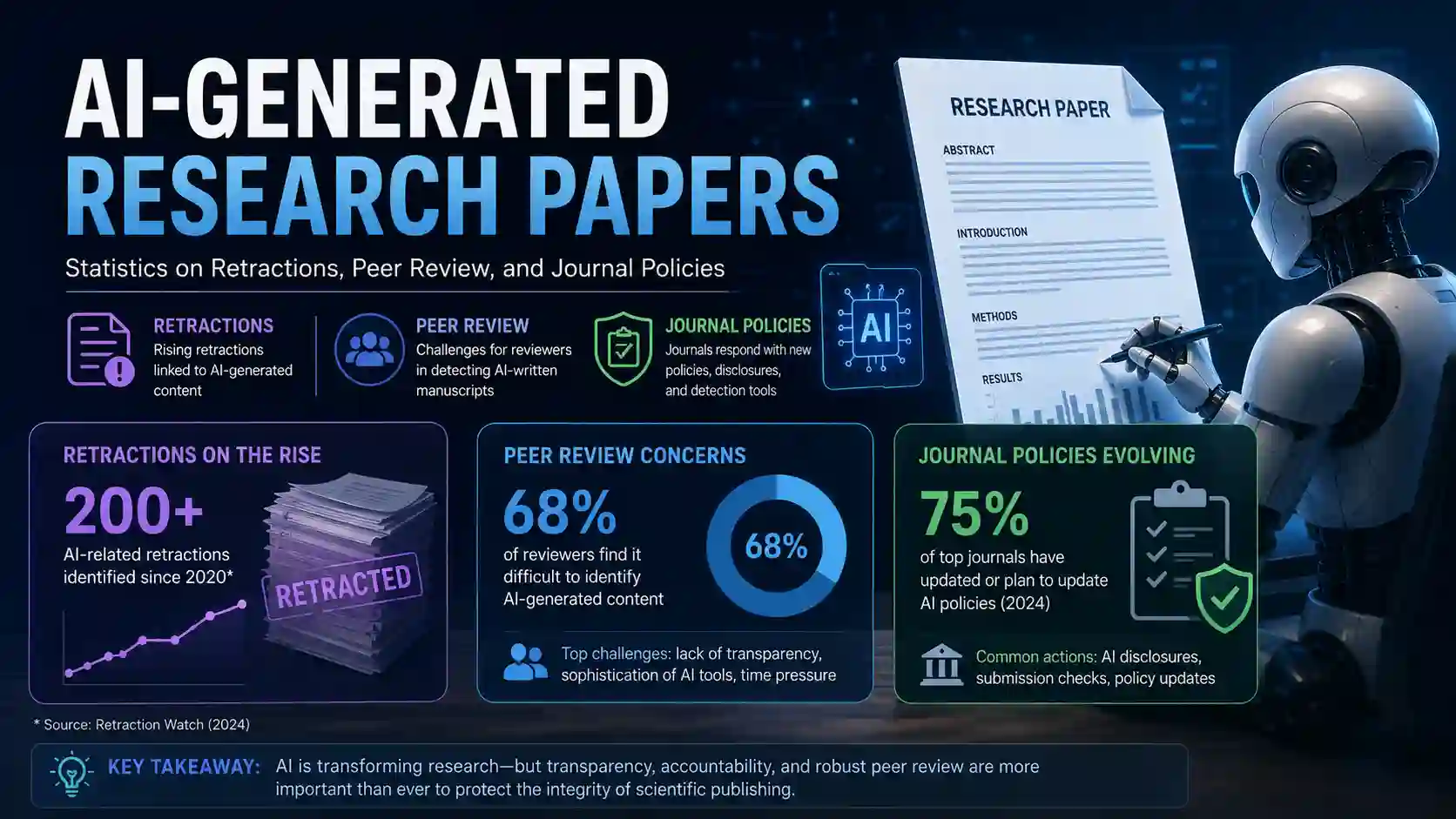
| Wiley/Hindawi compromised-paper retractions | 11,300+ from 2022 to 2024 | Large-scale paper-mill contamination and research-integrity cleanup | Not all were necessarily AI-written; AI made the paper-mill threat easier to scale. |
How This 2026 Study Defines AI-Generated Research Papers
This article uses a practical taxonomy rather than a panic label. In scholarly publishing, “AI-generated” can mean at least five different things:
- AI-assisted language editing: grammar, clarity, translation, readability, formatting, and tone adjustments to human-written text.
- AI-assisted drafting: a model generates sections, paragraphs, summaries, abstracts, code comments, or reviewer responses that humans then edit.
- AI-assisted research workflow: AI helps with literature search, coding, data analysis, figure design, statistical explanation, or protocol drafting.
- AI-generated artifacts: figures, images, citations, diagrams, review reports, or tables are generated directly by a model.
- AI-enabled fraud: large-scale paper mills use AI to produce plausible manuscripts, fabricated references, fake peer reviews, fake author contributions, and image-like scientific artifacts.
The article weighs sources differently. Official publisher policies are used for rules. Peer-reviewed or preprint studies are used for quantitative estimates. Journalism from established outlets is used for current events, financial impact, and publisher disclosures. Where a number is model-based or detector-based, the article labels it as an estimate.
Why this matters for SEO and reader trust: many articles inflate the numbers by treating all paper-mill retractions as “AI retractions.” That is too loose. The better question is: where is AI directly measured, where is AI plausibly accelerating an existing fraud pattern, and where are we simply looking at general research misconduct?
How Much AI Is Actually in Published Research Papers?
The honest answer is that no one knows the exact count. AI can leave obvious traces, such as “as an AI language model” style artifacts or fabricated references. But careful AI-assisted editing can be almost invisible. That is why the best statistics come in ranges and measurement types: keyword shifts, detector classifications, disclosure statements, and surveys or field-level estimates.
A 2024 study by Andrew Gray estimated that at least 60,000 scholarly papers in 2023 were LLM-assisted, slightly over 1% of all articles. That number is conservative because it relies on identifiable writing signals, not a complete audit of every sentence. A 2026 study of medical literature in JAMA Network Open found 195 of 7,251 articles, or 2.7%, were classified as containing significant AI-generated text, with the monthly rate rising from 0% in January 2022 to 11.3% in March 2025.
Field differences are sharp. A study of one million arXiv abstracts found the strongest LLM-style signal in computer science, estimating roughly 35% of computer-science abstracts under one GPT-3.5 “revise this” baseline. That does not mean 35% of computer-science papers were fully written by AI. It means the writing style of a large share of abstracts shifted toward an LLM-assisted revision pattern.
That distinction matters for ordinary writers too. There is a responsible difference between editing for clarity and laundering undisclosed machine authorship. For practical guidance on the lower-risk editing side, see how to make AI writing sound more natural in 10 minutes.
Chart 1: Published-Paper AI Footprint Estimates by Measurement Type
This chart compares different measurement methods. Direct disclosure rates are much lower than estimated usage, which is the central governance problem.
Why Detection Underestimates Use
Many researchers use AI like a language editor: refining awkward phrasing, shortening paragraphs, translating from a first language, or improving cover letters. That use may be ethical when allowed and disclosed, but it often leaves a weak linguistic signal.
Why Disclosure Underestimates Use
Disclosure policies differ by journal, and authors may not know whether grammar help, translation, literature summaries, or reviewer-response drafting must be declared. Some authors also avoid disclosure because they fear stigma.
Need Cleaner Academic Drafts Without Losing Your Voice?
WriteHuman can be useful for ethical rewriting, clarity, and human-sounding revision when your journal, university, or publisher policy allows AI-assisted editing. Always keep human control, verify every claim, and disclose AI assistance when required.
AI Research Paper Retractions: What the Numbers Really Show
Retraction statistics are the most misunderstood part of the AI-generated research paper debate. A retraction is not automatically proof that AI wrote a paper. Retractions happen for fabricated data, plagiarism, image manipulation, fake peer review, duplicated publications, ethical problems, paper-mill activity, and honest error. AI enters the story by increasing the speed and plausibility of bad manuscripts, especially when paired with weak editorial screening.
Retraction Watch has shown that retractions are far more common than early estimates suggested; its database passed 50,000 entries by January 2024. A 2026 bibliometric analysis of ten major publishers used 46,087 retractions from the Retraction Watch database across 1997-2026 and found normalized retraction rates varied by two orders of magnitude, from Elsevier’s 3.97 per 10,000 publications to Hindawi’s 320.02.
The Wiley/Hindawi scandal is the dominant case study. Reporting and publisher disclosures indicate Wiley retracted more than 11,300 compromised papers from its Hindawi portfolio between 2022 and 2024 and closed 19 journals after large-scale research fraud. This was not simply “AI wrote 11,300 papers.” It was a paper-mill and editorial-integrity failure in which AI made mass production more efficient.
Chart 2: Retraction and Research-Integrity Scale Markers
The chart compares widely cited scale markers. The hallucinated-citation count is included because it shows AI contamination of the reference layer, even when a paper itself is not retracted.
Paper Mills Are the Multiplier
Paper mills existed before ChatGPT. They sell authorship, fabricate studies, recycle images, manipulate special issues, and exploit weak review systems. What changed is throughput. Generative AI makes it cheaper to produce passable introductions, abstracts, cover letters, reviewer suggestions, fake rebuttals, and citation lists. That does not replace old fraud. It industrializes it.
A 2025 PNAS study reported that suspected paper-mill articles roughly doubled every 1.5 years between 2016 and 2020. That growth rate is far faster than normal publication growth. The same research ecosystem also suffers from post-publication cleanup delays: papers can be cited, indexed, summarized, and even used in model training before they are corrected or retracted.
Hallucinated Citations Are a Separate Crisis
AI-generated citations are unusually dangerous because they look scholarly. A title may sound plausible, the journal name may exist, and the author names may be real, while the specific article does not exist. A 2026 study audited 111 million references across 2.5 million papers in arXiv, bioRxiv, SSRN, and PubMed Central and estimated 146,932 hallucinated citations in 2025 alone. The authors also found that preprint moderation and journal publication processes caught only a fraction of the errors.
| Signal | 2026 Interpretation | Best Use | Do Not Use It To Claim |
|---|---|---|---|
| General retraction count | Shows stress in scientific publishing and research integrity systems. | Macro trend analysis. | That every retracted paper was AI-generated. |
| Paper-mill retractions | Strong signal of industrialized fraud; AI may assist drafting and evasion. | Understanding scalable misconduct. | That AI was the only cause. |
| Hallucinated citations | Direct evidence of LLM-style citation failure entering research workflows. | Reference-audit policy and editorial screening. | That all affected papers are fully fake. |
| LLM phrase artifacts | High-confidence clue when obvious phrases leak into published text. | Forensic triage. | That absence of artifacts means no AI use. |
| AI detector scores | Weak evidence at individual-paper level; useful only with caution and context. | Corpus-level research, not misconduct verdicts. | That a single score proves fraud. |
AI in Peer Review: The Integrity Layer Is Also Being Automated
Peer review is supposed to be the quality-control layer between a submitted manuscript and the published scholarly record. In 2026, that layer is itself being reshaped by AI. Reviewers use AI to summarize manuscripts, draft comments, improve tone, and sometimes generate most of a review. Conferences and journals are experimenting with AI feedback systems. Authors, in turn, are worried that their work may be judged by a model rather than by a domain expert.
The strongest quantitative evidence comes from machine-learning venues, where review text is often public or semi-public through OpenReview. The 2024 “AI Review Lottery” study estimated that at least 15.8% of ICLR 2024 reviews were AI-assisted. It also found that AI-assisted reviews were consequential: in matched comparisons, papers near the acceptance threshold that received an AI-assisted review were 4.9 percentage points more likely to be accepted.
Another 2024 study estimated that 6.5% to 16.9% of review text across ICLR 2024, NeurIPS 2023, CoRL 2023, and EMNLP 2023 could have been substantially modified by LLMs. A 2026 preprint extended the concern beyond conferences, reporting that about 20% of ICLR reviews and 12% of Nature Communications reviews were classified as AI-generated in 2025.
Universities are facing a parallel version of this problem with student submissions: detection scores can create suspicion, but they rarely explain intent, process, or policy compliance by themselves. That is why the companion study on AI detection policies at 50 leading U.S. universities is useful context for understanding academic enforcement beyond journals.
Chart 3: AI in Peer Review, Selected Studies
Peer-review numbers are venue-specific. The safest interpretation is directional: AI assistance in reviewing is already material and growing.
The Hidden-Prompt Problem
In 2025, reports found preprints containing hidden prompts that appeared designed to manipulate AI-assisted peer review. Some were written in white text or otherwise concealed from human readers, instructing AI systems to give only positive feedback. Nature reportedly identified 18 such preprints. This is a small count, but the behavior is important because it shows how authors may adapt once they suspect reviewers are using LLMs.
Policy implication: journals cannot govern AI writing without also governing AI reviewing. If authors must disclose AI use, reviewers should also disclose when AI substantially shaped their review. Manuscripts under confidential review should not be uploaded to public AI tools unless the journal explicitly provides an approved, secure workflow.
Major Journal AI Policies in 2026: The Emerging Consensus
By 2026, major publishers have largely converged on one core rule: AI tools cannot be authors, but AI assistance may be allowed if humans remain accountable and the use is properly disclosed. The difficult part is enforcement. A rule that depends on voluntary disclosure will miss a large share of use unless journals build better submission workflows and reference checks.
Policy also has a price tag. Schools and publishers that lean on AI-detection software must pay for licenses, integrations, staff review, appeals, and governance. For the higher-education side of that cost problem, read how much universities spend on AI detection tools.
Chart 4: Policy Adoption Versus Disclosure Reality
The policy gap is the distance between journals having rules and papers actually disclosing AI use. A 2025 study found 70% of journals had AI policies, yet only 0.1% of post-2023 papers in a full-text sample explicitly disclosed AI use.
The Four-Part Policy Consensus
- No AI authorship: AI cannot take responsibility, approve the final manuscript, respond to integrity questions, sign publication agreements, or be accountable after publication.
- Human responsibility: authors remain responsible for every sentence, figure, citation, claim, and analysis, even when an AI tool helped draft or edit it.
- Disclosure required for substantive use: most policies require disclosure when AI contributes beyond routine spelling, grammar, punctuation, or basic copy editing.
- Special caution for images, data, and peer review: many publishers apply stricter rules to generated images, confidential review materials, and research data visualization.
| Organization | AI as Author? | Disclosure Rule | Notable 2026 Policy Detail |
|---|---|---|---|
| ICMJE | Not allowed | Authors should disclose AI-assisted technologies in the cover letter and submitted work where applicable. | AI writing assistance belongs in acknowledgments; AI used for data collection, analysis, or figure generation belongs in methods. |
| Elsevier | Not allowed | Requires a declaration statement for AI tools used in manuscript preparation, except basic grammar, spelling, and punctuation. | Authors must verify AI-generated output, including references, because AI-generated references can be incorrect or fabricated. |
| Nature Portfolio / Springer Nature | Not allowed | LLM use should be documented in methods or another suitable section; AI-assisted copy editing does not need declaration. | Generative AI images are generally not permitted for publication, with narrow exceptions that must be clearly labelled. |
| Taylor & Francis | Not allowed | Use of generative AI tools must be acknowledged, including tool name, version, how it was used, and reason for use. | Authors are responsible for reference validity and must confirm content originality and accuracy. |
| COPE-aligned guidance | Not allowed | Disclosure and human accountability are central principles. | AI cannot meet authorship requirements because accountability and legal responsibility belong to humans. |
What Counts as Responsible AI Use in a Research Paper?
The practical question for authors is not “Can I use AI?” It is “What exactly did AI do, can I defend it, and does the journal require disclosure?” The table below separates low-risk editing from high-risk generation and outright misconduct.
| AI Use Case | Typical Risk | Recommended Handling | Disclosure Needed? |
|---|---|---|---|
| Spelling, punctuation, grammar, readability edits | Low | Keep original drafts, check that meaning did not change, follow journal policy. | Often no, but verify journal rules. |
| Translation of author-written text | Low to medium | Retain original and translated versions; have a human verify technical accuracy. | Often yes, especially if a journal asks for tool name and version. |
| Drafting abstract, introduction, literature-review paragraphs, or response letters | Medium to high | Rewrite under human control; check citations; remove invented claims; disclose if substantive. | Usually yes. |
| Suggesting statistical code or analysis explanations | Medium to high | Validate code, rerun analyses, document methods, and never rely on AI output as proof. | Yes if it shaped methods, code, or analysis. |
| Generating figures, images, diagrams, or data visualizations | High | Use reproducible data-driven workflows; disclose model/tool; follow image policy. | Yes, often in methods and caption. |
| Creating citations, references, quotes, or legal/medical claims | Very high | Verify every source manually against DOI, PubMed, Crossref, journal page, or library database. | Yes if AI was used, but verification is mandatory either way. |
| Submitting AI-generated peer review as if it were a human expert review | Very high | Do not upload confidential manuscripts to unapproved tools; disclose AI assistance where allowed. | Yes. |
| Buying AI-generated paper-mill manuscripts or authorship slots | Misconduct | Do not do it. It risks retraction, institutional investigation, funding consequences, and reputation damage. | Disclosure does not cure fraudulent authorship or fabricated research. |
Where WriteHuman Fits: Editing Help, Not Academic Deception
Tools like WriteHuman sit in a sensitive category. Used responsibly, they can help authors make stiff AI-assisted drafts sound more natural, improve readability, reduce generic phrasing, and restore a human voice to text that the author actually understands and owns. Used irresponsibly, the same type of tool can become part of an evasion workflow: hiding undisclosed AI generation, disguising plagiarism, or passing off machine-written work as unaided scholarship.
The ethical line is simple: use writing tools to improve communication, not to conceal misconduct. If a journal requires disclosure for substantive AI assistance, disclose it. If your institution or publisher bans AI-generated drafting, do not use a humanizer to route around that rule. If the text contains citations, claims, statistics, or technical statements, verify every one before submission.
Polish Research Writing While Keeping Human Control
WriteHuman is best used after you have already done the thinking: clarify your own argument, smooth awkward phrasing, and make the final draft easier to read. Keep your drafts, review every sentence, and follow the AI disclosure policy of the journal or institution.
Good Use
- Improving readability of your own writing.
- Reducing generic AI phrasing in a disclosed AI-assisted draft.
- Editing a plain-language summary after verifying the science.
- Helping non-native English writers communicate more clearly.
Bad Use
- Hiding ghostwritten AI text from a journal that requires disclosure.
- Masking plagiarism, fabricated citations, or invented data.
- Submitting text you cannot explain or defend.
- Bypassing a publisher, university, or grant-agency AI policy.
What Journals, Reviewers, and Authors Should Do Next
AI in research writing is not going away. The realistic goal is not prohibition. It is accountability. Journals should distinguish between harmless editing, substantive drafting, generated data or images, and fraud. Authors should stop treating disclosure as a reputational risk and start treating it as a standard methods detail. Reviewers should not upload confidential manuscripts into public tools unless the journal has approved the workflow.
| Stakeholder | Best Next Step | Why It Matters |
|---|---|---|
| Authors | Keep an AI-use log: tool name, version, date, prompt category, manuscript section, and human verification step. | Makes disclosure easier and protects authors if questions arise later. |
| Journals | Add structured AI-use fields in submission systems instead of burying rules in author guidelines. | Reduces accidental non-disclosure and creates auditable metadata. |
| Reviewers | Disclose AI assistance and avoid public tools for confidential manuscripts. | Protects confidentiality and preserves trust in peer review. |
| Editors | Use reference verification, image screening, authorship checks, and paper-mill signals before relying on AI detectors. | Forensic signals outperform generic individual-level AI scores. |
| Publishers | Build post-publication cleanup workflows that are faster than paper-mill output cycles. | Retractions years later cannot fully undo citation contamination. |
| Institutions | Reward quality, data sharing, reproducibility, and contribution transparency rather than raw publication count. | Paper mills thrive where career incentives reward volume over substance. |
Frequently Asked Questions
How many AI-generated research papers have been retracted?
There is no complete public count of retractions caused solely by generative AI. The most defensible approach is to separate AI-specific evidence from broader research-integrity evidence. We can say that more than 10,000 research papers were retracted in 2023, Wiley retracted more than 11,300 compromised Hindawi papers between 2022 and 2024, and a 2026 ten-publisher study analyzed 46,087 retractions. But not every one of those papers was AI-generated.
What percentage of research papers are written by AI?
It depends on the method. A 2024 study estimated at least 60,000 papers in 2023 were LLM-assisted, slightly over 1% of all scholarly articles. A 2026 JAMA Network Open study found 2.7% of articles in its sample were classified as containing significant AI-generated text, rising to 11.3% in March 2025. Some field-specific estimates, especially for computer science abstracts, are much higher, but those usually measure LLM-style revision rather than full-paper generation.
Do journals ban AI writing tools?
Most major publishers do not fully ban AI writing assistance. They generally ban AI authorship, require human accountability, and require disclosure for substantive AI use. Basic grammar and spelling assistance may be exempt, but rules differ by journal.
Can ChatGPT or another AI tool be listed as a co-author?
No. Major guidelines reject AI authorship because authorship requires accountability, final approval, responsibility for integrity, consent to publication terms, and the ability to answer questions after publication. AI tools cannot satisfy those requirements.
Are AI detectors reliable for academic papers?
They are risky at the individual-paper level. Corpus-level research can estimate broad trends, but a detector score should not be treated as proof of misconduct. Stronger evidence includes fabricated citations, leaked AI phrases, impossible methods, duplicated images, fake peer-review patterns, and authorship irregularities.
Is using WriteHuman allowed for research writing?
It depends on the journal, institution, and purpose. It is safest for ethical editing of author-controlled text, especially readability and tone. It should not be used to hide undisclosed AI generation, fabricated research, plagiarism, or policy violations. Always verify claims and disclose AI assistance when required.
Final Verdict: AI Is Not the Retraction Cause, It Is the Force Multiplier
The 2026 evidence does not support a simplistic claim that “AI has destroyed research.” It supports a more precise conclusion: AI has lowered the cost of producing plausible scholarly text, which helps honest researchers communicate faster and helps dishonest actors scale fraud faster. The same tool can improve a non-native English author’s paper or fill the literature with hallucinated citations.
The winners in this new environment will be journals, authors, and institutions that treat AI use like a methods question: document it, verify it, disclose it, and keep humans accountable. The losers will be systems that rely on publication volume, vague honor codes, slow retractions, and generic AI detectors as a substitute for real editorial integrity.
Try WriteHuman for responsible editing, but use it as a clarity tool, not as a way to hide how a paper was made.
Sources and Further Reading
The source lists below are grouped by topic. Click each accordion to view the full research and policy links used to build this report.
View AI writing prevalence and disclosure sources
- Andrew Gray: ChatGPT “contamination”: estimating the prevalence of LLMs in the scholarly literature
- Wolfrath et al.: Rising Prevalence of Detected AI-Generated Text in Medical Literature
- Geng and Trotta: Is ChatGPT Transforming Academics’ Writing Style?
- He and Bu: Academic journals’ AI policies fail to curb the surge in AI-assisted academic writing
- Liu et al.: AI-Assisted Writing Is Growing Fastest Among Non-English-Speaking and Less Established Scientists
- Yan and Ni: AI-assisted writing and the reorganization of scientific knowledge
View retraction, paper-mill, and hallucinated-citation sources
- Zhao et al.: LLM hallucinations in the wild: Large-scale evidence from non-existent citations
- Oppenlaender: How Ten Publishers Retract Research
- Saqr: The State of Papers, Retractions, and Preprints
- Wall Street Journal: Flood of Fake Science Forces Multiple Journal Closures
- Wall Street Journal: Scientific Journals Can’t Keep Up With Flood of Fake Papers
- The Guardian: Fake scientific papers push research credibility to crisis point
- Sharma and Khurana: Retracted Citations and Self-citations in Retracted Publications
- Rao et al.: WithdrarXiv, a large-scale dataset for retraction study
View peer-review AI sources
- Latona et al.: The AI Review Lottery
- Liang et al.: Monitoring AI-Modified Content at Scale
- Shen and Wang: Detecting AI-Generated Content in Academic Peer Reviews
- Thakkar et al.: LLM feedback for 20K reviews at ICLR 2025
- Liang et al.: Can large language models provide useful feedback on research papers?
- The Guardian: Hidden AI prompts in academic papers
View official journal-policy and publisher-policy sources
- ICMJE: Defining the Role of Authors and Contributors, including AI-assisted technology
- Elsevier: Generative AI policies for journals
- Nature Portfolio: Artificial Intelligence editorial policy
- Taylor & Francis: Defining authorship and AI-based tools
- Ganjavi et al.: Bibliometric Analysis of Publisher and Journal Instructions to Authors on Generative AI
- Chen: AI-Generated Figures in Academic Publishing
- WIRED: Use of AI is seeping into academic journals and proving difficult to detect