AI Detection Lawsuits: Every Case and Outcome
A wave of litigation is testing whether schools can discipline students based on AI detection scores from tools like Turnitin and GPTZero. This tracker documents every confirmed AI detection lawsuit in U.S. courts, with the court, docket number, detector involved, legal theory, and current outcome, updated as cases move through the system.
Quick Answer
As of mid-2026, at least six confirmed lawsuits accuse U.S. schools of wrongly disciplining students or staff based on AI-detection evidence. Results are split. A New York court sided with a student in Matter of Newby v. Adelphi University, ordering the school to expunge an AI-plagiarism finding built largely on a single Turnitin score. A Minnesota court went the other way in Yang v. University of Minnesota, upholding a PhD student’s expulsion after finding the university relied on more than a detector score. Cases against Yale, the University of Michigan, and two K-12 districts remain active.
The emerging legal pattern is not “AI detectors are illegal to use.” It is closer to this: courts appear far more sympathetic when a detector score is the only evidence and the student was denied a real chance to respond, and far less sympathetic when a school can point to independent proof, a documented process, and a fair hearing. For the policy side of this issue, see our related study on AI detection policies at 50 leading U.S. universities and our list of universities that banned AI detectors outright.
Worried About a False AI Flag on Your Own Writing?
Litigation is rising precisely because AI detectors produce false positives on human-written text. If your course policy allows AI-assisted editing, WriteHuman can help you revise a draft for natural flow and clarity so your own writing doesn’t read like a false alarm. It is not a shield against academic-integrity rules, and you should always disclose AI-assisted editing when a syllabus requires it.
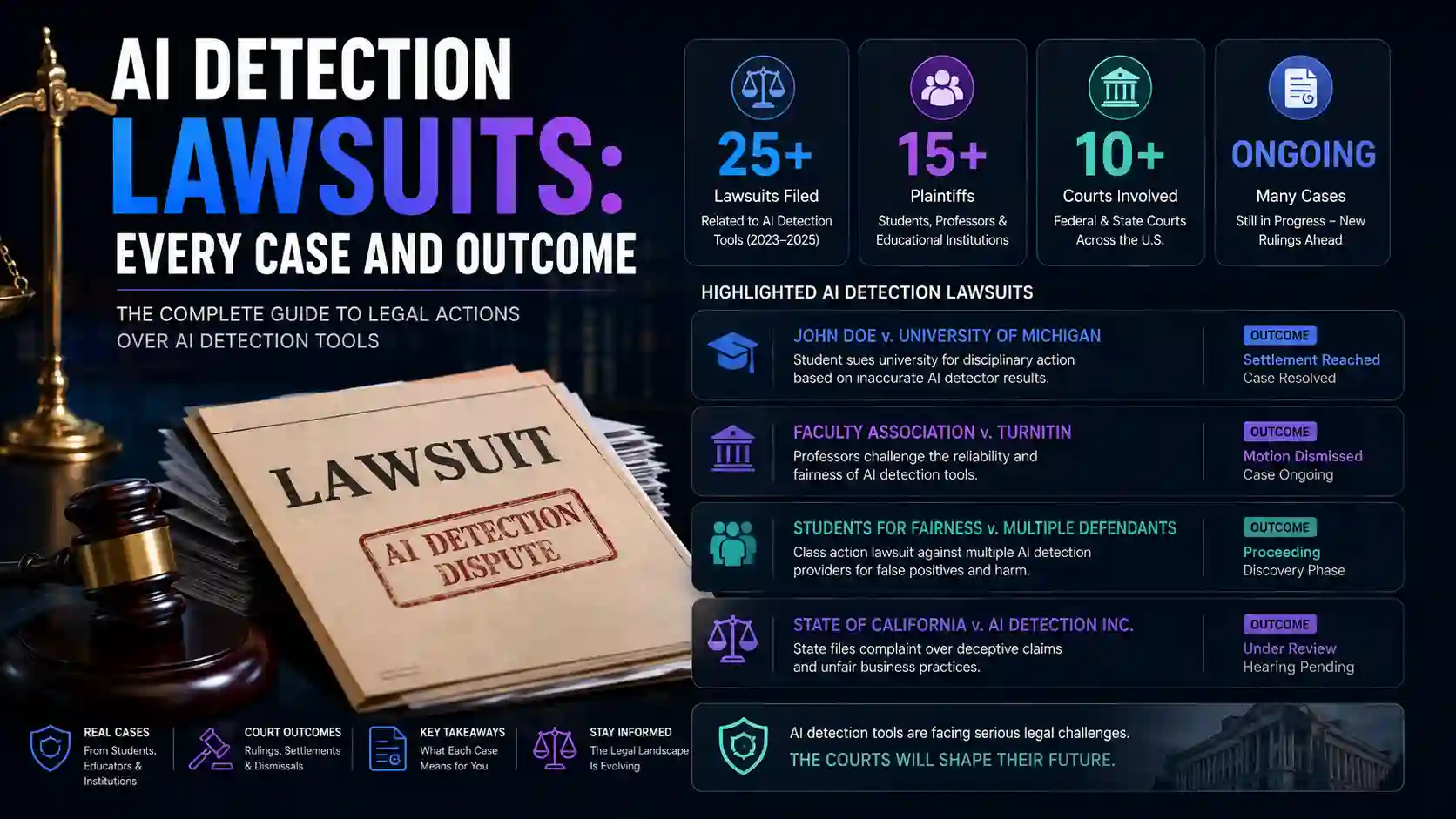
Table of Contents
What People Are Actually Trying to Find
Searches for AI detection lawsuits tend to come from five different angles: a student or parent who was just accused and wants to know if legal action is realistic, a journalist or researcher tracking the litigation trend, a university general counsel or Title IX office assessing institutional risk, a faculty member who wants to know if their own AI-flagging process is defensible, and a policy researcher studying AI-generated research paper statistics alongside enforcement outcomes. This tracker is built to answer all five without guessing at outcomes that haven’t happened yet.
One clarification matters up front: no reported lawsuit as of mid-2026 sues an AI detection company like Turnitin or GPTZero directly for a false positive. Every confirmed case names the school, school district, or individual administrators and instructors. The detector is the disputed evidence, not the defendant.
How This Tracker Was Built
Inclusion Criteria
A case was added to this tracker only if it met all four conditions:
- A formal lawsuit, petition, or appeal was filed in a U.S. state or federal court (internal grievance processes and unfiled disputes are excluded).
- AI-detection evidence, an AI-use accusation, or an AI-related disciplinary action is central to the claims.
- A docket number, court name, or verifiable court filing is publicly reported by a court, law firm alert, or credible news outlet.
- The case involves a K-12 or higher-education institution rather than a workplace or commercial dispute.
Court rulings, filing dates, and case status can change quickly. This page reflects the most recent verifiable status as of the update date above and should not be treated as legal advice. Always confirm current docket status through PACER, a state court portal, or counsel before relying on any detail here.
Where a case is still active, this tracker states clearly that the outcome is pending rather than guessing at a result. Where a court has ruled, the tracker distinguishes between a full merits ruling and an earlier procedural step, such as denial of a preliminary injunction, which is not the same as losing the case.
Key Findings From the Case Tracker
The headline finding is that outcomes track evidence quality, not detector brand. Courts have not ruled that GPTZero or Turnitin are inherently unreliable as a matter of law. Instead, judges are evaluating whether the school’s overall disciplinary process was fair, whether the student had a meaningful chance to respond, and whether the detector score was corroborated by anything else. That is a due-process and administrative-law question dressed up in AI language, not strictly a technology question.
The second finding is that international and disabled students are disproportionately represented among plaintiffs. At least three of the six tracked cases involve a non-native English speaker or a student with a documented disability, echoing peer-reviewed research showing detectors misfire more often on ESL and neurodivergent writing patterns. That overlap is also why several complaints combine an AI-detection claim with a Title VI national-origin claim or an ADA/Section 504 disability claim rather than arguing detector unreliability alone.
The third finding is financial asymmetry. Schools spend a few thousand to roughly six figures a year licensing detection software, a topic covered in depth in our analysis of university AI detection spending. Families and students who challenge a false accusation in court report spending well into six figures in legal fees for a single case, an imbalance that shapes who can realistically litigate at all.
Charts and Graphs
Case Status Across the Tracker
Of the six tracked cases, one produced a clear student win, two produced rulings favoring the school or university, and three remain actively litigated with no final merits ruling yet.
Detection Tool or Evidence Named in Each Case
Turnitin and GPTZero each appear as central evidence in two of the six cases; the remaining two rely primarily on instructor judgment plus informal AI-output comparisons rather than a named commercial detector score.
Legal Theories Pleaded Across the Tracker
Due process and breach-of-contract claims appear most often; disability and national-origin discrimination claims appear whenever the detector’s documented bias patterns match the plaintiff’s background.
Lawsuits Filed by Half-Year, Late 2024 Through Mid-2026
Filings cluster around the start of each academic term, when the prior semester’s disciplinary cases finish the internal appeals process and become eligible for court review.
Full AI Detection Lawsuit Tracker
This table lists every confirmed case, in filing order, with the court, docket identifier, primary detection evidence, legal theory, and most recent status. Case names using “Doe” or similar are pseudonyms used in the actual court filings to protect student privacy.
| Case | Court / Docket | Level | Detection Evidence | Legal Theory | Status |
|---|---|---|---|---|---|
| Harris v. Hingham Public Schools | D. Mass., No. 1:24-cv-12437 | K-12 | Instructor suspicion / informal AI-output comparison on an AP U.S. History project | Due process, arbitrary & capricious school action | Early loss for family — preliminary relief denied Nov. 2024; case status ongoing |
| Yang v. University of Minnesota (multiple filings) | D. Minn.; Hennepin County Dist. Ct.; Minn. Ct. App. | Graduate / PhD | GPTZero score plus faculty comparison of exam answers to ChatGPT output | Due process, defamation, Minnesota Government Data Practices Act | Lost — expulsion upheld by Minn. Court of Appeals, Feb. 2026; federal claim dismissed Oct. 2025 |
| Doe v. Yale University (Thierry Rignol) | D. Conn., No. 3:25-cv-00159-SFR | Graduate (EMBA) | GPTZero flag on a final exam | Title VI national-origin discrimination, breach of contract, due process | Ongoing — preliminary injunction denied May 2025; litigation continuing |
| Doe v. Palo Alto Unified School District | N.D. Cal., No. 5:25-cv-04202 | K-12 | Turnitin score of 76% likely AI-generated on an in-class essay | Title IX & Title VI discrimination claims, procedural due process | Ongoing — grade not restored at district level; pending in federal court |
| Matter of Newby v. Adelphi University | N.Y. Sup. Ct., Nassau County | Undergraduate | Turnitin score of 100% likely AI-generated; contradicted by two other detector reports | Article 78 review — arbitrary & capricious, denial of due process | Won by student — finding vacated, record ordered expunged, Jan./Feb. 2026 |
| Doe v. University of Michigan | E.D. Mich., No. 2:26-cv-10451 | Undergraduate | Instructor judgment plus self-generated AI “comparison” output; no named commercial detector | ADA / Section 504 disability discrimination, due process | Ongoing — preliminary injunction denied May 2026; motion to dismiss pending |
Docket numbers and statuses are drawn from public reporting and court-filing summaries and should be independently verified through the relevant court’s electronic docket before being cited in any formal, academic, or legal context.
Case-by-Case Profiles
Matter of Newby v. Adelphi University — the clearest student win so far
Orion Newby, a freshman enrolled in Adelphi’s Bridges support program for students with learning and neurodevelopmental disabilities, submitted a World Civilizations essay on Christianity and Islam. Turnitin’s detector scored the paper as 100% likely AI-generated. Newby said he wrote the essay himself with help from program tutors and produced two independent detector reports, from other tools, scoring the same text as human-written. Adelphi upheld the finding anyway and required him to complete a plagiarism workshop, without giving him a copy of the underlying report.
His parents filed an Article 78 proceeding, the standard New York mechanism for challenging an administrative decision as arbitrary and capricious. In early 2026, a Nassau County Supreme Court judge ruled the university’s finding was without valid basis and ordered the record expunged. Attorneys involved in the case called it a milestone for establishing that students are entitled to a meaningful, fact-based process before an AI accusation can carry academic consequences. The family reportedly spent more than $100,000 in legal fees to reach that outcome.
Yang v. University of Minnesota — the clearest loss for a student so far
Haishan Yang, a third-year PhD student in health economics, sat an eight-hour remote qualifying exam while traveling. Four faculty graders flagged irregularities in his answers, one professor ran exam questions through an AI tool and found similarities, and the university additionally referenced GPTZero output showing an elevated AI-likelihood score on part of his exam. A disciplinary panel voted to expel him, which also cost him his student visa. Yang filed a defamation suit against a named professor, a federal due-process suit against university officials, a state data-practices claim, and a certiorari petition challenging the university’s conduct decision, seeking a combined total north of $1.3 million in damages.
Unlike the Adelphi case, courts here found the university’s process held up. A federal court dismissed Yang’s due-process claim in late 2025, and the Minnesota Court of Appeals affirmed the expulsion in February 2026, concluding that the university relied on more than a single detector score, including faculty subject-matter judgment about unusual terminology and structure in the exam answers. The case illustrates the other side of the emerging legal line: corroborated, documented, multi-source findings tend to survive judicial review even when a detector score is part of the record.
Doe v. Yale University (Thierry Rignol)
A Yale School of Management executive-MBA student and French national was suspended for a year after a teaching assistant flagged his exam answers as unusually polished, and an instructor ran portions through GPTZero to support the suspicion. Rignol’s suit alleges national-origin discrimination and breach of contract, and, notably, the complaint reports that he ran Yale’s own president’s public writing through GPTZero to argue the tool flags recognizably human prose. A court denied an early request for a preliminary injunction in May 2025, but the underlying discrimination and contract claims remain active.
Doe v. University of Michigan
An undergraduate with documented anxiety and OCD was accused of AI use in an introductory Great Books course three separate times by the same instructor, who separately posted online that grading had made him feel inclined to suspect AI everywhere. No commercial detector score anchors this complaint; instead, the student alleges the instructor’s conclusions rested on subjective stylistic judgments and a self-generated AI comparison built from her own outline. The suit adds an ADA/Section 504 theory, arguing that traits associated with her disabilities, formal tone and highly structured writing, were misread as evidence of AI use. A preliminary injunction was denied in May 2026; the university’s motion to dismiss is pending.
Doe v. Palo Alto Unified School District
A California high school sophomore’s in-class essay on The Crucible was flagged 76% likely AI-generated by Turnitin. The teacher required an in-class supervised rewrite, and the grade dropped. The family submitted a lengthy Google Docs revision-history packet as evidence of independent authorship; the district declined to restore the grade. The federal complaint adds a statistical claim that boys in the class were flagged at a disproportionately higher rate than girls, and alleges the district re-ran the student’s rewrite through Turnitin without additional parental consent. It is one of the first K-12 cases to frame detector reliance as a discrimination issue rather than purely a grading dispute.
Harris v. Hingham Public Schools
Parents of a Massachusetts high school student sued after he was disciplined over suspected AI use on an AP U.S. History project, seeking to have his grade raised and the disciplinary record cleared. In late 2024, a federal court declined to grant preliminary relief, finding the school had reasonably concluded a policy violation occurred. It remains one of the few AI-accusation cases where an early court ruling favored the school, and the plaintiffs indicated they would continue pursuing the case.
For broader context on why detector reliance keeps producing disputes like these, see our companion piece on AI-generated research paper statistics for 2026, and for the resource cost universities are absorbing to run these tools in the first place, read how much universities spend on AI detection tools.
Legal Theories Behind the Lawsuits
| Theory | What It Argues | Where It Appears |
|---|---|---|
| Due process | The school’s process was unfair: no real hearing, no access to the underlying report, or a decision made without considering contrary evidence. | Newby, Yang, Yale, Michigan, Harris |
| Breach of contract | The student handbook or code of conduct is treated as a contract, and the school allegedly failed to follow its own stated procedures. | Yale, Newby |
| Title VI / national-origin discrimination | Detector tools and instructor judgment disproportionately flag non-native English writing patterns as AI-generated. | Yale (Rignol), referenced in Yang |
| ADA / Section 504 disability discrimination | Traits linked to a documented disability, formal tone, rigid structure, distress in oral questioning, were treated as evidence of dishonesty rather than accommodated. | Michigan (Doe) |
| Defamation | A named individual faculty member is alleged to have made false, reputation-damaging statements about a student’s conduct. | Yang (against a named professor) |
| Title IX / gender-based claims | Statistical disparities in who gets flagged are used to argue the enforcement pattern itself is discriminatory. | Palo Alto USD |
A useful distinction for readers who are not lawyers: a preliminary injunction denial is not a loss on the merits. It only means a court declined to order emergency relief while the case proceeds. Several “ongoing” cases in this tracker, including Yale and Michigan, have had a preliminary injunction denied without any ruling yet on whether the underlying discrimination or due-process claims are valid.
The Reliability Problem Driving This Litigation
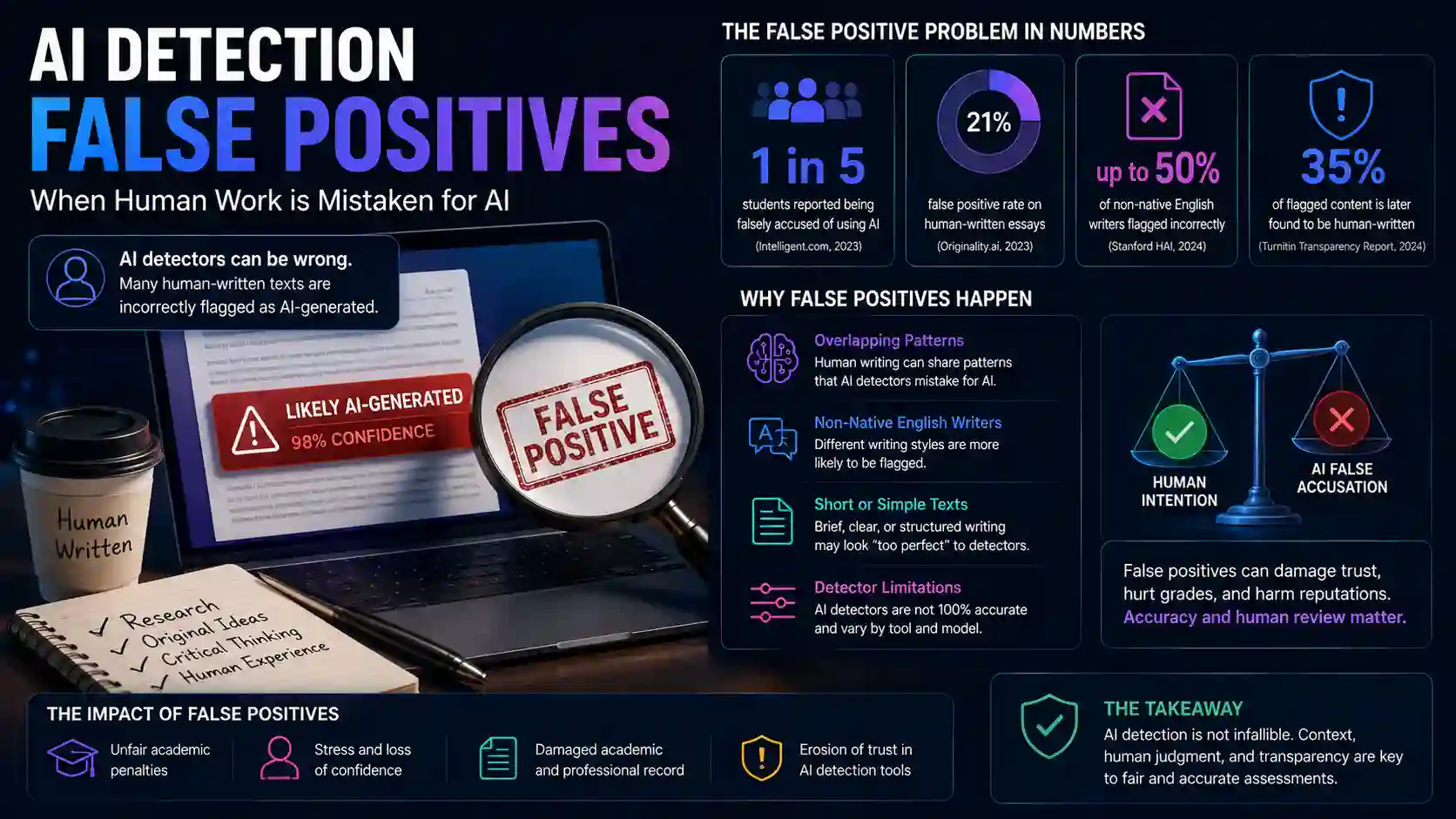
Every case in this tracker traces back to the same underlying technical weakness: AI detectors score text using signals like perplexity and burstiness, which measure how predictable word choice and sentence rhythm are. Formal, simple, or highly structured writing, common among non-native English speakers, students with certain disabilities, and even careful native speakers, can resemble the statistical signature of machine-generated text. Peer-reviewed research has repeatedly found detectors flag non-native English essays at dramatically higher rates than native English essays, and independent testing has found no widely used detector clears 80% accuracy under adversarial conditions.
What the courts are not deciding
No case tracked here has produced a binding ruling that AI detectors are inherently too unreliable to use at all. The Newby ruling turned on the university’s process, not a scientific finding about Turnitin’s accuracy. The Yang ruling upheld a decision that used a detector score as one input among several. Readers should be cautious of any summary that claims a court has categorically banned AI detection, which has not happened as of this update.
This is also why so many universities have quietly moved away from central detector-based enforcement even without being sued, a trend documented in our list of universities that have banned AI detectors and in the broader policy landscape covered in our 50-university AI detection policy study. Litigation risk is now a factor schools weigh alongside detector accuracy when deciding whether to keep a tool active.
If You’ve Been Accused: A Student and Parent Playbook
- Do not panic into silence. Ask, in writing, exactly what evidence supports the accusation, including the full detector report, not just a summary score.
- Preserve your process evidence immediately. Draft history, version timestamps, outlines, research notes, and browser or document activity logs are consistently the strongest evidence in every case in this tracker.
- Get independent detector results if relevant, but don’t rely on them alone. Courts have treated contrary detector scores as supporting evidence, not as automatic proof of innocence.
- Use the internal appeals process fully before considering litigation. Every tracked case went through a school hearing or appeal first; courts generally expect that process to be exhausted.
- Flag any disability or language-related context early and in writing if it’s relevant, since several successful defenses rested on evidence submitted well before the case reached court.
- Consult an education attorney before filing anything if the internal process fails. Litigation costs in this tracker ran from tens of thousands to well over a hundred thousand dollars, so understand the realistic cost and timeline first.
Risk Reduction Playbook for Schools and Faculty
Write More Naturally, Disclose Honestly, Reduce False-Flag Risk
Part of what’s fueling this litigation wave is that ordinary, careful human writing sometimes reads as “too clean” to a detector. If your syllabus allows AI-assisted editing, WriteHuman can help smooth an AI-assisted draft into natural, readable prose, provided you follow your institution’s disclosure rules. It is a writing-quality tool, not a way to evade a professor’s AI policy, and it will not protect you from a misconduct finding if the underlying use itself was prohibited.
Why This Litigation Wave Matters Beyond the Courtroom
These lawsuits are unfolding against a backdrop of rapidly rising AI use in academic work, detailed in our 2026 statistics on AI-generated research papers, and rising institutional spending on detection infrastructure, covered in our breakdown of how much universities spend on AI detection tools. There’s also an environmental dimension worth noting: the same generative AI systems producing the text these tools try to detect run on data centers with a real physical footprint, a topic we explore in AI data centers and the environment. Detection policy, institutional cost, and environmental impact are all downstream of the same underlying shift toward AI-saturated academic work.
Frequently Asked Questions
Has anyone actually won a lawsuit over a false AI detection accusation?
Yes. In Matter of Newby v. Adelphi University, a New York court found the university’s AI-plagiarism finding against the student was without valid basis and ordered the record expunged. It is the clearest reported student win to date, though it turned on the fairness of the university’s process rather than a general ruling against AI detectors.
Can a school punish a student based only on a Turnitin or GPTZero score?
No court has categorically banned that, but the reported rulings suggest real legal risk when a detector score is the only evidence and the student wasn’t given a fair chance to respond. Schools that corroborate a detector flag with independent evidence and document a fair hearing process have fared better in court so far.
Has a student ever lost one of these lawsuits?
Yes. Haishan Yang’s expulsion from the University of Minnesota was upheld on appeal, and a related federal due-process claim was dismissed, because courts found the university’s finding rested on more than a single detector score.
What legal claims are being used in these lawsuits?
Due process and breach-of-contract claims appear most consistently. Disability discrimination (ADA/Section 504) and national-origin discrimination (Title VI) claims appear when the plaintiff’s background matches known detector bias patterns. One case adds a defamation claim against a named faculty member, and one K-12 case adds a Title IX-style statistical disparity argument.
Are Turnitin or GPTZero being sued directly?
Not as of this update. Every confirmed lawsuit names the school, school district, or individual administrators and faculty as defendants. The detection vendor’s score is treated as disputed evidence within the case, not as the target of the suit.
How much does it cost to fight a false AI accusation in court?
Reported figures vary widely. The Newby family reportedly spent over $100,000 in legal fees for a single state-court proceeding. Haishan Yang’s combined damages claims across multiple filings exceed $1.3 million, reflecting years of litigation across state, federal, and appellate courts.
What should a student do immediately after being accused?
Request the full underlying report rather than accepting a summary score, preserve drafts and version history, use the school’s internal appeal process fully, and consult an education attorney before considering litigation. Every case in this tracker went through an internal disciplinary process before reaching court.
Research Sources and Further Reading
This tracker draws on court-filing summaries, law-firm client alerts, and news reporting on each case. Readers should verify current docket status directly through the relevant court before citing case details in a formal context.
View all sources used in this tracker
- Inside Higher Ed: Adelphi Student Wins AI Plagiarism Lawsuit
- CBS News New York: Adelphi Facing Lawsuit After AI-Assisted Plagiarism Accusation
- Rutgers Bloustein School: Samuel Quoted in AI Lawsuit Against Student
- Crowell & Moring: Ivy League Lawsuit Centers on Alleged Impermissible Use of AI
- GovTech: Yale Student Suing Over Accusation of Improper AI Use
- GovTech: Student Sues University of Michigan Over AI Misconduct Accusation
- Plagiarism Today: Student Sues University of Michigan Over AI Allegations
- MPR News: PhD Student Says University of Minnesota Expelled Him Over AI Allegation
- Minnesota Daily: PhD Student Sues UMN, Files Human Rights Complaint
- TechSpot: University of Minnesota Sued by Student Over AI Expulsion
- EdScoop: Expelled Student Sues U. Minnesota After Claims of AI Use
- Minnesota Lawyer: U of M AI Cheating Expulsion Upheld on Appeal
- Liebert Cassidy Whitmore: Federal Court Upholds University’s Disciplinary Process
- KARE 11: Student Expelled From University of Minnesota, Allegedly Using AI
- MinnPost: Schools Must Provide Clear, Consistent AI Guidelines
- GradPilot: AI Cheating Lawsuits Tracker
- Detection Drama: AI Detection Lawsuits Research Summary
- Diglot: AI Detection Lawsuits 2026 — What ESL Writers Need to Know
- The Unemployed Professors: A Student Just Won a Lawsuit Over a Turnitin False Positive
- Rumi Docs: The Landmark Lawsuit Against AI Detectors
- ToHuman: AI Detection False Positives — GPTZero & Turnitin Flag Humans
- Fastio: GPTZero Review 2026 — Accuracy, Pricing, and Verdict
- JoshWP: AI Detection Policies at 50 Leading U.S. Universities
- JoshWP: Universities That Banned AI Detectors
- JoshWP: How Much Universities Spend on AI Detection Tools
- JoshWP: AI-Generated Research Papers — 2026 Statistics
- JoshWP: AI Data Centers and the Environment